Xi-Trump Summit Day 1: Trade Progress, Taiwan Warning, and the Yuan Stablecoin Subtext
China's Xi Jinping declared trade talks were making progress as the first US-China presidential summit since 2017 opened in Beijing on May 14, while warning that mishandling Taiwan could push relations toward open conflict. Beneath the diplomatic choreography, currency markets are watching whether the summit accelerates conditions for a yuan-backed stablecoin that Circle CEO Jeremy Allaire predicts could emerge within three to five years.
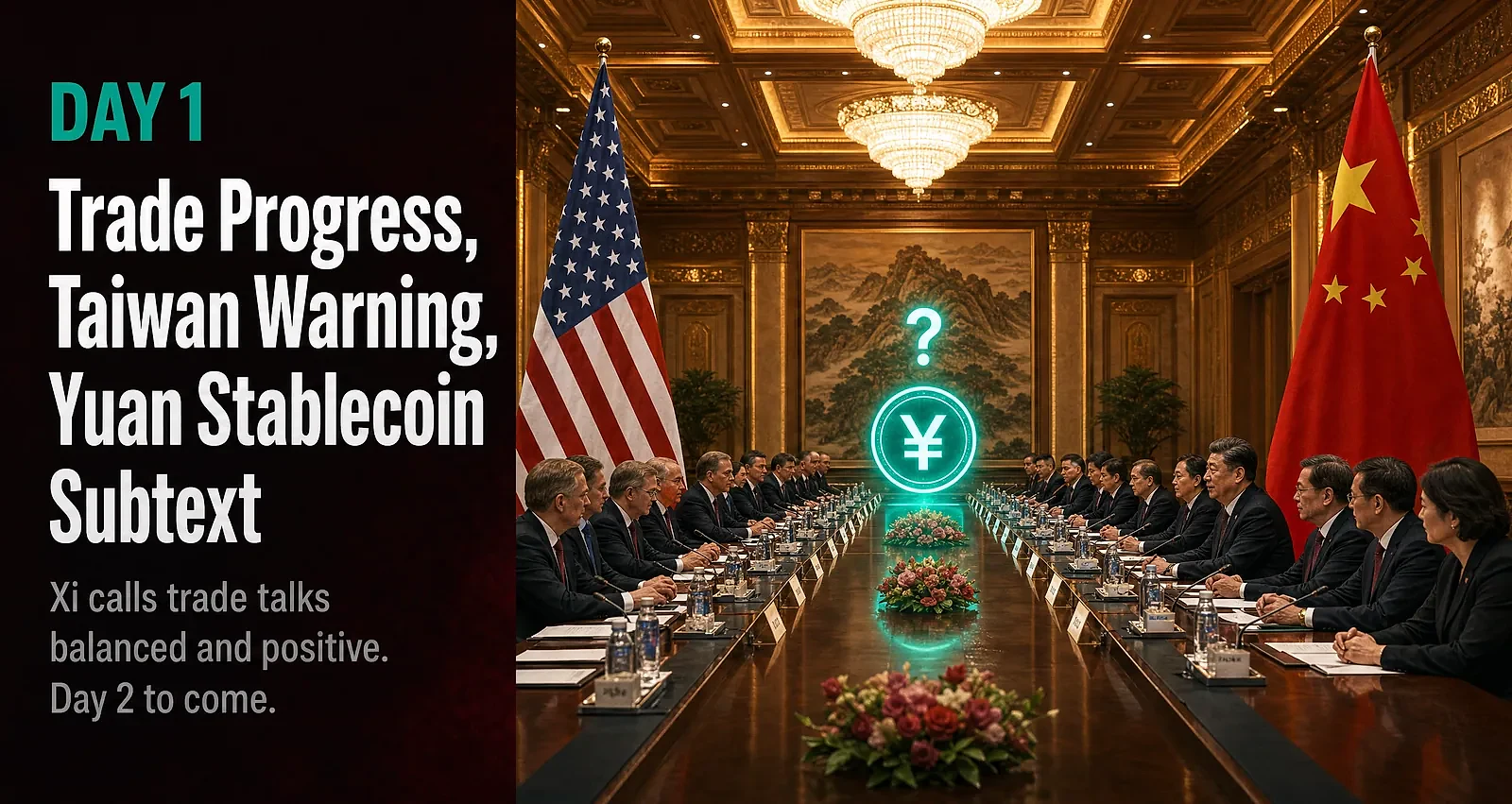
China's Xi Jinping opened a two-day summit with President Donald Trump at Beijing's Great Hall of the People on May 14, 2026, declaring that trade negotiations were yielding progress and that the two countries must handle their differences carefully to avoid conflict [1]. Trump, flanked by a delegation that included Elon Musk, Tim Cook, and senior executives from Citi, BlackRock, Blackstone, and Goldman Sachs, called the gathering potentially "the biggest summit ever" [4].
The Bilateral Opening
The ceremonial welcome, complete with a formal military guard of honor, set the stage for a meeting that carries unusual geopolitical weight. The summit was originally scheduled for March 2026 but was postponed by six weeks after US and Israeli strikes on Iran triggered a regional escalation that upended Trump's original diplomatic sequencing [3][4]. Trump had anticipated arriving in Beijing having compelled Tehran to stand down; instead, the Strait of Hormuz remains partially blockaded, exposing the limits of US coercive leverage and handing Xi a rare source of quiet advantage [4].
The CFR's pre-summit analysis noted that Xi was expected to project "calm confidence" with the goal of "managed equilibrium," while Washington's ambitions had narrowed from a grand bargain to a set of stabilizing deliverables on agriculture, aerospace, and investment [3]. The first day's optics conformed to that assessment.
"Balanced and Positive" Trade Track
The clearest concrete signal of Day 1 came from China's foreign ministry, whose readout stated that US-China economic and trade teams meeting in South Korea on May 13 had reached "overall balanced and positive outcomes" [1]. That language is calibrated: it confirms a working-level advance without committing either side to specific headline numbers ahead of Day 2.
The diplomatic runway stretches back to November 2025, when Trump and Xi agreed to a substantive trade framework in Seoul. Under that deal, China halted fentanyl precursor shipments, suspended expansive export controls on rare earths, and issued general licenses for gallium, germanium, antimony, and graphite exports benefiting US end-users. Beijing also committed to purchasing at least 25 million metric tons of US soybeans annually through 2028 and dropped retaliatory tariffs on US agricultural goods including chicken, wheat, corn, cotton, and pork [5]. Washington in turn reduced fentanyl-related tariff surcharges by 10 percentage points and maintained its suspension of heightened reciprocal tariffs through November 2026.
Item — November 2025 Status — May 2026 Summit Context
Rare earth export controls — Suspended; general licenses issued — Extension/permanence under discussion
Soybean purchases — 25 MMT/year committed through 2028 — Agricultural package likely extended
Fentanyl precursor halt — In effect — Compliance monitoring ongoing
Gallium / Germanium / Antimony / Graphite — General licenses issued — Monitoring; possible expansion
Retaliatory tariffs on US ag goods — Suspended — Subject to broader truce renewal
US reciprocal tariff suspension — In effect through Nov 2026 — Renewal timeline being negotiated
Workshop-level talks in recent months have sketched out a proposed Board of Trade and a parallel Board of Investment, bilateral institutional bodies that could be announced as headline deliverables if Day 2 produces the expected framework [3].
Taiwan Red Line
Xi's most pointed statement of the day was not about commerce. He told Trump that Taiwan was "the most important issue in US-China relations" and that if handled poorly, disagreements over the island could send bilateral relations "down a dangerous path" and produce "an extremely dangerous situation" [1]. The warning was notable for its directness at a summit explicitly framed around economic normalization.
Beijing is expected to press Washington for an explicit statement opposing Taiwan independence, restrictions on arms sales, and reduced US-Taiwan security cooperation, though no Day 1 commitments in either direction have been reported [3].
"Taiwan was the most important issue in US-China relations and if handled poorly could lead to conflict and an extremely dangerous situation."
- Xi Jinping, Great Hall of the People, May 14, 2026 [1]
Iran Ceasefire and Hormuz on the Agenda
The Iran file carries acute economic stakes for both sides. More than 30 percent of China's oil imports transit the Strait of Hormuz, and the partial naval blockade has contributed to elevated global energy prices since early 2026 [4]. Xi's leverage here is structural: China holds political ties with Tehran and is positioned as an intermediary capable of either facilitating or obstructing a ceasefire framework.
While Trump said on Tuesday that Iran was "very much under control," the summit agenda includes de-escalation pathways and a possible restart of ceasefire talks [2]. The CFR noted that no breakthrough on Iran was likely from the summit itself, but that both leaders proceeding with the meeting despite the unusual circumstances signals mutual interest in the optics of stability [3].
The Yuan Stablecoin Subtext
For foreign-exchange and digital-asset markets, the summit carries a longer-horizon implication that received little attention in diplomatic briefings: the trajectory of the Chinese yuan as a reserve and settlement currency, and whether Beijing's gradually shifting posture on digital finance could culminate in a yuan-backed stablecoin.
Circle co-founder and CEO Jeremy Allaire, speaking in Hong Kong on April 16, 2026, told Reuters there was "a tremendous opportunity for a yuan stablecoin" and predicted China could roll one out within three to five years [6][7]. Allaire framed the dynamic as a technological arms race: "If there's currency competition, you want your currency to have the best features possible. This is becoming a technological competition" [7].
"There is a tremendous opportunity for a yuan stablecoin. If there is currency competition, you want your currency to have the best features possible. This is becoming a technological competition."
- Jeremy Allaire, Circle CEO, Hong Kong, April 16, 2026 [7]
China's government has acknowledged exploring a yuan-backed stablecoin but has not committed publicly, maintaining its 2021 ban on cryptocurrency trading and mining [6]. Allaire identified the critical structural precondition: the yuan would need to be freely convertible, with Beijing relaxing government foreign-exchange controls, before a yuan stablecoin could function as globally usable digital currency [6].
Stablecoin — Issuer — Backing — Est. Market Share — Notes
USDT (Tether) — Tether Ltd — USD — ~70% — Dominant global settlement token
USDC — Circle — USD — ~28% — Regulated; institutional focus
Yuan stablecoin (proposed) — TBD — CNY — 0% (not launched) — Requires yuan convertibility
A Reuters report from August 2025 first surfaced that Chinese policymakers were considering a yuan-backed stablecoin specifically to boost global yuan adoption, framing it as a complement to the existing digital yuan (e-CNY) infrastructure [6]. The Xi-Trump summit, if it produces any movement on currency policy or financial openness, could advance or delay that timeline. USDC and USDT currently capture more than 98 percent of the stablecoin market and serve as de facto extensions of USD monetary dominance in digital settlement rails. A yuan stablecoin would represent the first major geopolitical alternative.
Allaire also noted that stablecoins are increasingly treated as financial infrastructure for cross-border settlements rather than speculative instruments, and that they can outperform central bank digital currencies as a vehicle for currency internationalization [6].
What Day 2 Could Confirm
Day 2 on May 15 is when the substantive deliverables, if any, are expected to be formalized. Markets and analysts will be watching for: formal announcement of the Board of Trade and Board of Investment mechanisms; any joint statement language on Taiwan; a ceasefire framework outline for Iran or a Hormuz de-escalation roadmap; an extension or renewal of the November 2025 trade truce beyond November 2026; and any language touching on currency policy, financial market access, or digital finance that could affect the yuan stablecoin timeline.
The first day confirmed that Xi has arrived with clear redlines and a stable domestic position, while Trump has arrived with reduced leverage but a cabinet-level business delegation signaling appetite for deal-making. Whether those asymmetric positions produce a durable framework or a set of optics-driven announcements will become clear by close of business on May 15.
References
[1] Arab News / Reuters, "China's Xi hails trade progress in Trump summit, sends Taiwan warning," May 14, 2026. https://www.arabnews.com/node/2643516/world
[2] Politico, "Trump has a weak hand to play in summit with Xi," May 13, 2026. https://www.politico.com/news/2026/05/13/trump-summit-xi-trade-hormuz-00915983
[3] Council on Foreign Relations, "At the Trump-Xi Summit, China Will Have the Upper Hand," May 10, 2026. https://www.cfr.org/articles/at-the-trump-xi-summit-china-will-have-the-upper-hand
[4] New York Times, "Distracted and Bogged Down, Trump and Xi Enter a Summit of Reduced Ambitions," May 12, 2026. https://www.nytimes.com/2026/05/12/us/politics/trump-xi-summit.html
[5] White House, "Fact Sheet: President Donald J. Trump Strikes Deal on Economic and Trade Relations with China," November 2025. https://www.whitehouse.gov/fact-sheets/2025/11/fact-sheet-president-donald-j-trump-strikes-deal-on-economic-and-trade-relations-with-china/
[6] Yahoo Finance / CryptoProwl, "China Expected To Launch Yuan Stablecoin Within Five Years," April 16, 2026. https://finance.yahoo.com/markets/crypto/articles/china-expected-launch-yuan-stablecoin-141300811.html
[7] Investing.com, "Circle CEO sees 'tremendous opportunity' for yuan-backed stablecoin," April 16, 2026. https://www.investing.com/news/stock-market-news/circle-ceo-sees-tremendous-opportunity-for-yuanbacked-stablecoin-4617097