Western Union StableCard Goes Live in 37 Markets on Solana with Rain and USDPT
Western Union and Rain launched StableCard, combining a USDPT wallet and Visa secured credit card across 37 markets. The product makes the remittance recipient, not just the sender, the focus of Western Union's Solana strategy.
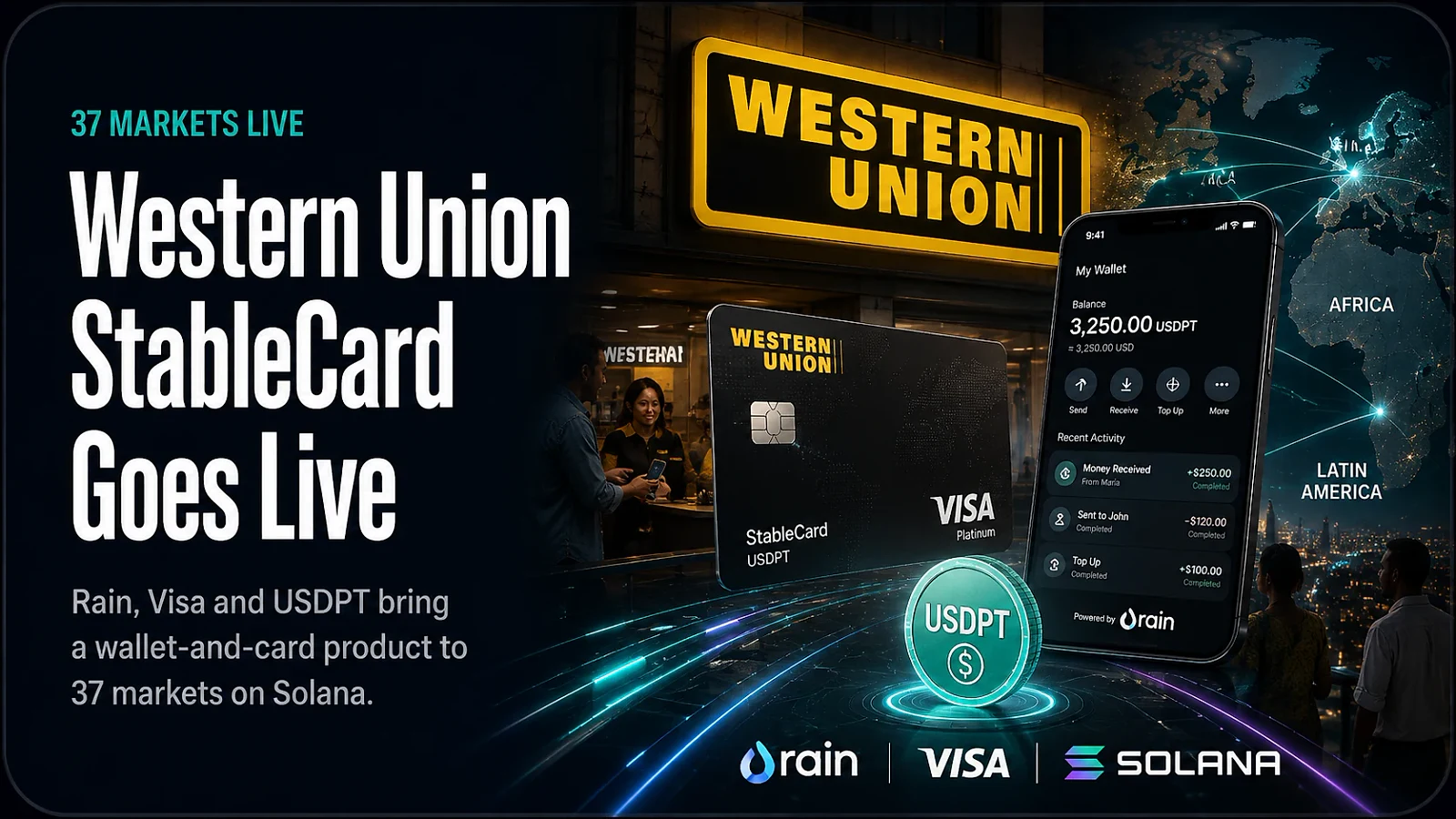
Western Union has launched StableCard with stablecoin payments platform Rain, taking USDPT from a remittance settlement asset to a consumer spending product across 37 markets. The August 4 release combines a digital wallet with a Visa secured credit card, allowing recipients to receive, hold, transfer and spend dollar value rather than immediately convert a transfer into local currency.[1]
For the 165-year-old remittance company, the shift is direct: a transfer can enter USDPT, travel on Solana, sit in a Rain-powered wallet and be spent through Visa. StableCard is available from the Apple App Store and Google Play, supports Apple Pay and Google Pay, and converts USDPT to local currency at checkout.[2]
The card is the missing consumer layer
USDPT launched May 4 for Western Union's digital-asset infrastructure, with Anchorage Digital Bank issuing the token on Solana and handling custody. StableCard makes that infrastructure consumer-facing: an eligible recipient can direct a transfer into the wallet, retain a dollar-denominated balance and spend through the card network.[1][2]
Rain supplies the application, embedded wallet, compliance infrastructure and card issuance. Its Visa and Mastercard principal memberships give Western Union an established card-program stack, while Visa offers access to 175 million merchant locations globally.[2][3]
"Stablecard represents the next step in making global financial services more accessible to our customers," said Devin McGranahan, Western Union's president and chief executive officer. "By combining the stability of a dollar-backed digital asset with the scale of Western Union's global network and Visa's acceptance footprint, we're giving consumers a new way to hold value, move money and spend confidently across borders."[1]
The distinction is material in remittance corridors. Receiving value is only the first half of a transfer. A recipient who receives local currency at once loses the option to retain dollar exposure, while a recipient who receives a stablecoin without a practical spending method still faces an off-ramp problem. StableCard attempts to address both choices in the same product: dollar balance first, local-currency conversion only at the moment of purchase.
Rollout is broad, but country detail remains limited
Western Union has disclosed the overall market count but not a public country-by-country list in its launch release. It says the initial markets include places where demand for stablecoins is visible and local currencies can be volatile; the company is targeting more than 60 markets by the end of 2026. Reporting on the launch also identifies Latin America and Asia as expansion regions for the second half.[1][3]
StableCard rollout and scale — Launch data
Initial supported markets — 37 markets on August 4, 2026
Public country list by region — Not disclosed in the launch announcement
Named expansion regions — Latin America and Asia in the second half of 2026
Target coverage by year-end — More than 60 markets
Visa acceptance footprint — 175 million merchant locations globally
USDPT supply at launch — 7.4 million tokens across 162 addresses
USDPT share of Solana stablecoins — 0.05% of a $15.8 billion total
The supply line is the most revealing number in the table. USDPT's 7.4 million tokens were only 0.05% of Solana's $15.8 billion stablecoin total on August 4. That is minute against Western Union's scale, but it does not undercut the launch thesis. It shows that USDPT supply has preceded broad consumer utility only modestly. The card can become the demand generator, with minting following real recipient balances and payment use rather than being created speculatively ahead of distribution.[2][3]
A vertically integrated answer to remittance competition
The architecture is more integrated than a conventional transfer payout. Western Union originates the customer relationship and the transfer; USDPT is its branded dollar asset; Anchorage Digital Bank is the issuer and custodian; Rain runs the wallet and card program; Visa delivers merchant acceptance. That structure gives Western Union more control over the path from fiat to digital dollars to point-of-sale spending than a remittance firm simply adding a third-party stablecoin option.[1][3]
Provider or model — What the recipient receives — Difference from StableCard
Western Union StableCard — USDPT wallet plus Visa secured credit card — Branded stablecoin and spend product in one flow across 37 markets
Wise — Cross-border fiat transfer and account-style balances — No USDPT card proposition is part of this launch
Nium — Payments infrastructure for businesses and platforms — Operates as infrastructure, rather than this consumer-branded dollar wallet and card
MoneyGram — Consumer remittance service — Its separately reported MGUSD work remains distinct from StableCard
The comparison clarifies why this is more than another stablecoin wallet. Tether and LemFi have demonstrated the appeal of stablecoin-linked remittance distribution, while Mastercard and Yellow Card have pushed access through EEMEA corridors. Western Union owns the customer brand and dollar asset, while Rain and Visa provide payment-network reach. Visa Direct's expansion to 195 countries also shows why card and payout networks are becoming the bridge from onchain value to commerce.[4][5]
Investors registered the strategic wager on launch day: Western Union shares rose 5.2% to $6.89. That does not prove adoption. Fee schedules, the country list and active-card figures will be more meaningful tests of whether diaspora customers want dollars they can spend immediately, rather than cash or a bank credit to convert.[5]
Supply follows utility
The critical watchpoint is not whether a 7.4 million-token stablecoin can immediately challenge USDT or USDC. It is whether the card converts Western Union's remittance distribution into recurring USDPT balances. If recipients repeatedly choose to retain and spend USDPT, the token's supply can grow as a consequence of utility. That supply-follows-utility pattern could gradually pressure incumbent stablecoins in remittance corridors where the integrated fiat-to-wallet-to-card route is easier than assembling several services.
Western Union is targeting more than 60 markets by year-end, so the next evidence will be operational: which countries open, how much of remittance volume redirects into wallets and whether card transactions become habitual. The company has now made its Solana rails visible to consumers. The question is whether remittance recipients will make them their daily spending rail.
References
[1] Western Union, "Western Union Launches Stablecard in Partnership with Rain," August 4, 2026. https://ir.westernunion.com/news/archived-press-releases/press-release-details/2026/Western-Union-Launches-Stablecard-in-Partnership-with-Rain/default.aspx
[2] Solana Compass, "Western Union and Rain Launch Stablecard on Solana in 37 Markets," August 5, 2026. https://solanacompass.com/news/western-union-and-rain-launch-stablecard-on-solana-in-37-markets
[3] Binance Square, "Western Union Launches Solana-Powered Stablecoin Card Across 37 Markets," August 4, 2026. https://www.binance.com/en/square/post/352226581552257
[4] Crypto Briefing, "Western Union Launches StableCard for Instant Remittance Spending Across 37 Markets," August 4, 2026. https://cryptobriefing.com/western-union-stablecard-remittance-stablecoin/
[5] Yahoo Finance, "Visa Puts Stablecoins at the Center of Cross-Border Payments," August 2026. https://finance.yahoo.com/markets/crypto/articles/visa-puts-stablecoins-cross-border-222304577.html