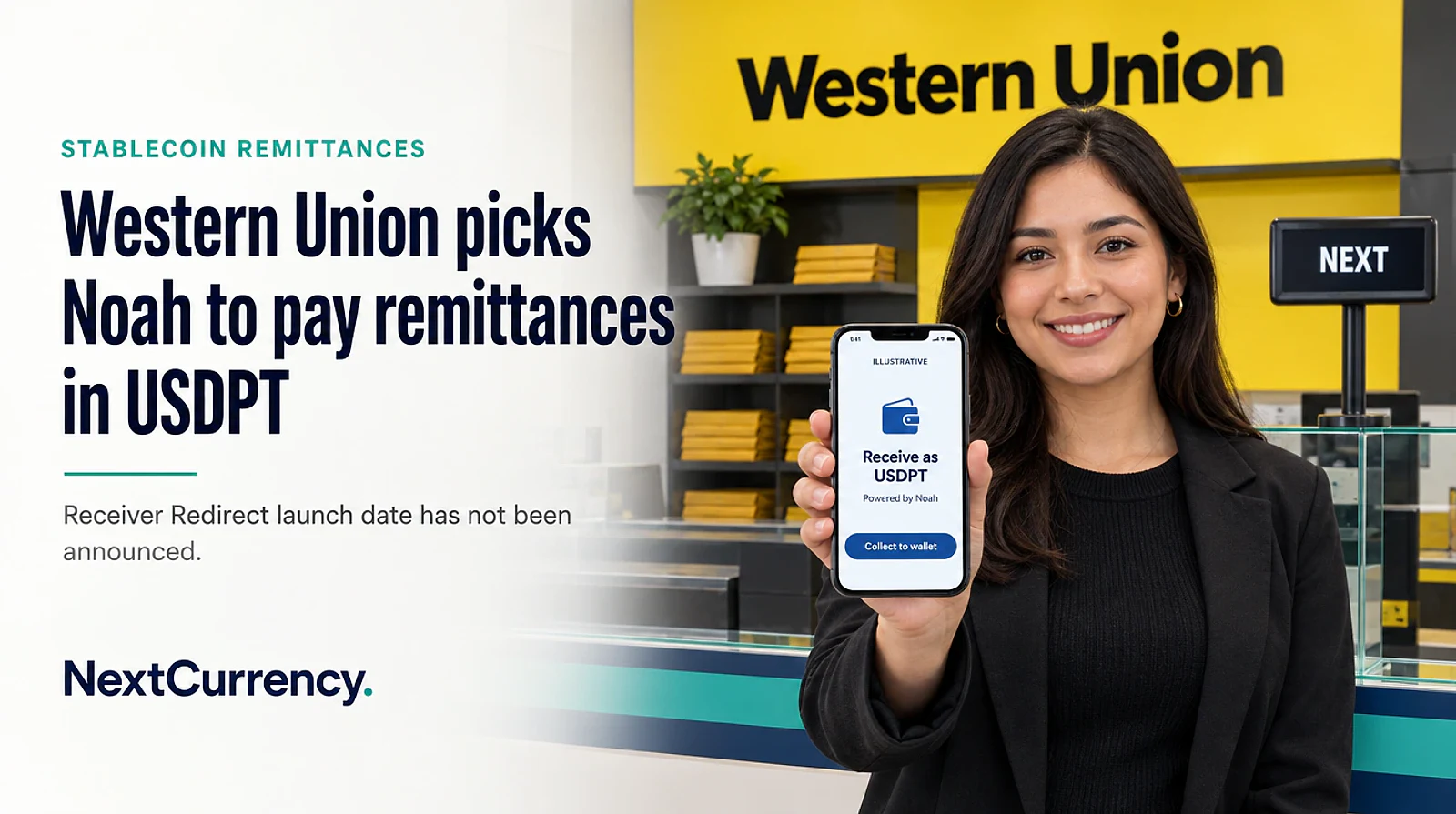
Western Union Picks Noah to Pay Out Remittances in Its USDPT Stablecoin
Noah will supply the treasury, licensing, pre-funding and conversion behind Western Union's Receiver Redirect service, which lets recipients collect a transfer as USDPT in a Western Union wallet. No launch date, fees or eligible markets have been announced.
By Daniel Osei, Journalist, Payments and Cards
Western Union has selected Noah, a stablecoin payments infrastructure provider, to power Receiver Redirect, a service that will let a remittance recipient collect money as USDPT, Western Union's US dollar stablecoin, rather than as cash or a bank deposit. Noah announced the agreement on 20 October 2026, and the release was distributed on GlobeNewswire on 21 October. It includes a quote from Western Union's global head of digital assets.
The service is announced, not live. Neither company gave a launch date, fees, transfer limits or a list of eligible sending and receiving countries.
How Receiver Redirect is meant to work
According to the release, a sender would use Western Union's network of more than 500,000 agent locations to send funds that arrive as USDPT. The recipient would collect the stablecoin into a Western Union wallet and could hold it indefinitely through Stablecard, the Western Union wallet and card product announced in August 2026.
USDPT is issued by Anchorage Digital Bank on Solana. Noah says it will provide "the treasury and licensing required to pre-fund, convert, and disperse USDPT to recipients," and will handle local regulatory compliance for transfers. The companies describe the service as covering stablecoin transfers in more than 60 currencies across more than 200 countries and territories. That is the stated design scope, not a confirmed list of markets at launch.
"This new capability is a global first, taking a Western Union money transfer and delivering it directly into the customers' stablecard wallet in USDPT stablecoin," said Malcolm Clarke, Western Union's global head of digital assets.
Why the payout leg matters
Stablecard already gives Western Union customers a place to hold dollar value in USDPT. Receiver Redirect would connect it to the core remittance business: an ordinary transfer, including one funded with cash at an agent, could end as a stablecoin balance instead of a local-currency payout.
That would change two things. First, the recipient could stay in dollars and choose when to convert, which is a large part of a stablecoin balance's appeal in high-inflation markets. Second, the final leg would run on a stablecoin wallet rather than a local bank or cash-pickup partner, although Noah would still have to pre-fund and convert on Western Union's behalf. Noah's role is the operational layer that makes that work: holding inventory, converting currencies and keeping each transfer within local rules.
What is not yet known
The release cites World Bank estimates of $905 billion a year in remittance flows and average fees of about 6% of the transfer value. These are market context, not service results. Noah says stablecoin transfers will cut delays "from days to hours" and reduce fees to "a fraction of the cost". That is a company claim; no pricing has been published. Customers will need to see conversion spreads, wallet fees and cash-out costs before they can compare the service with existing Western Union payouts.