Visa Launches Stablecoin Platform and Activates USDC Payouts Across 195 Countries
Visa launched its Stablecoin Platform with Open USD in beta, then activated USDC prefunding and payouts for eligible Visa Direct clients across more than 18 billion endpoints in 195 countries and territories.
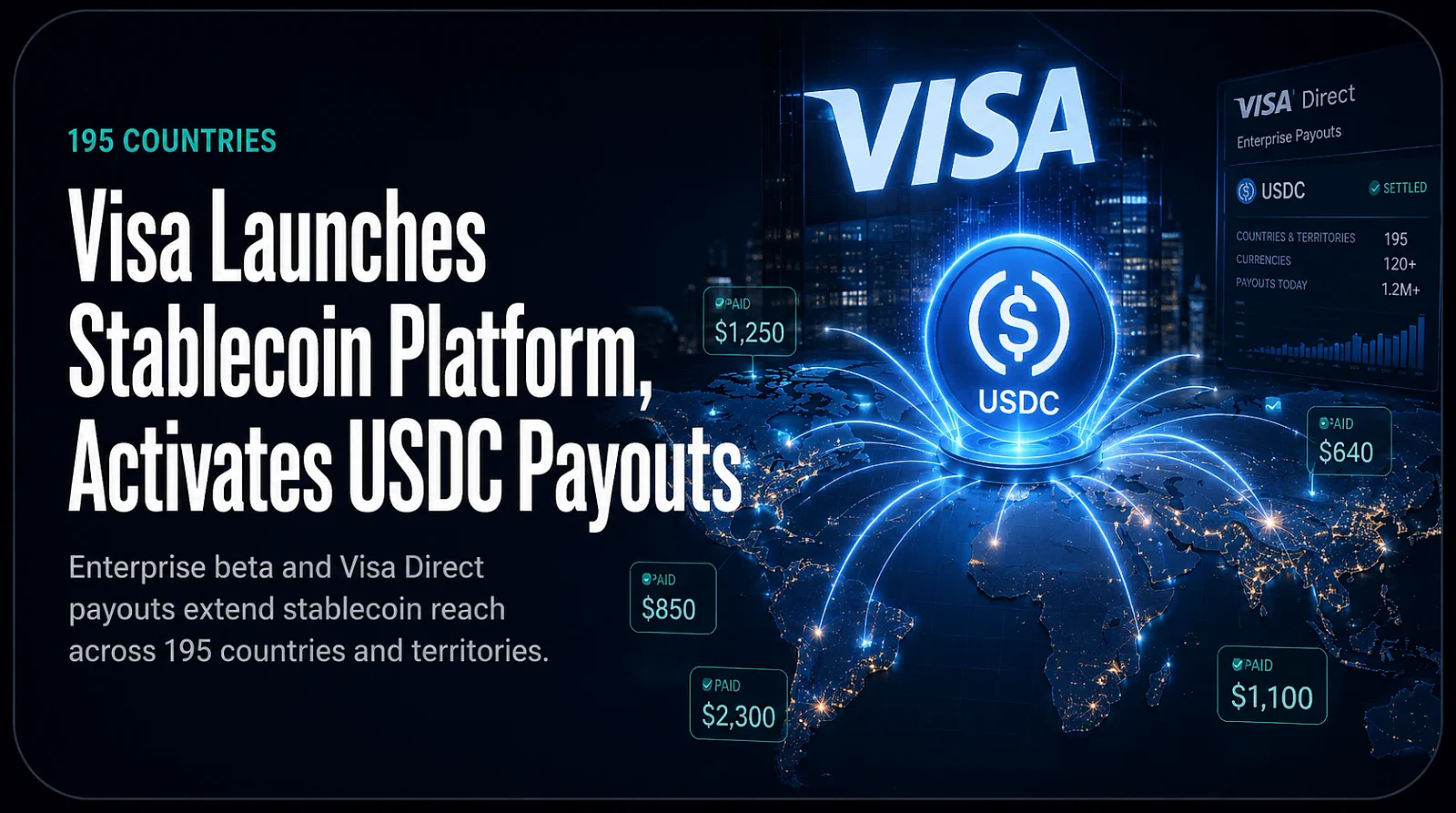
Visa has made two consequential stablecoin moves in less than three weeks, opening an enterprise platform for issuance and treasury operations on July 16 and activating USDC prefunding and payouts through Visa Direct on August 5. Together, the launches put the card network on both sides of institutional stablecoin money movement: the systems that create and manage tokens, and the payout rail that sends value to cards, accounts, and wallets around the world.[1][2]
The timing matters. Visa Direct's stablecoin capability is live for eligible clients across more than 18 billion endpoints in 195 countries and territories, according to Visa's partner zerohash. That turns a once-narrow settlement experiment into a production-oriented option for cross-border treasury funding and payouts, while the Visa Stablecoin Platform, or VSP, gives institutions a controlled place to bring those operations onchain.[1][2]
Two Moves in Three Weeks
The first announcement arrived July 16. Visa introduced VSP as a Visa-managed enterprise environment for financial institutions, fintechs, payment providers, and crypto-native companies. It began in beta with select clients, and Open USD, or OUSD, is its initial stablecoin. Visa says broader availability will be shaped by what it learns from the beta rather than by a published general-availability date.[1]
The second move, announced August 5 with zerohash, connects stablecoin prefunding and payouts to Visa Direct. Eligible clients can fund accounts and disburse payouts in stablecoins. USDC is the primary settlement asset in the live deployment, while zerohash provides the regulatory and technical layer across dozens of blockchains and stablecoins.[2][5]
The distinction between the products is important. VSP is an institutional operations layer, not Visa issuing a proprietary dollar token. Visa provides the environment, wallet tooling and integrations; Open Standard introduced Open USD. Visa Direct, by contrast, is the outbound money-movement route. A corporate treasury can use stablecoins to position funds, then make a payout through a network that already reaches cards, bank accounts and digital wallets.
Visa Stablecoin Platform: What It Does
VSP consolidates wallet infrastructure, blockchain connectivity, approval systems, custody processes and payment integrations. Clients can onboard to Visa's Wallet-as-a-Service stack or connect existing wallets, link bank accounts, and configure policies for movements. The platform supports minting, redemption, holding and transfers, beginning with Open USD.[1]
Visa also describes dual-control approvals, passkeys, allow lists and audit logs, operational controls intended to answer who may initiate and approve a transfer and where value can be sent.[1]
"Stablecoins are opening up a new layer of programmable money, but for most institutions the hard part isn't the concept, it's the operational reality," said Jack Forestell, Visa's chief product and strategy officer.[1]
"With the Visa Stablecoin Platform, we're giving our clients a single place to mint, move and manage stablecoin operations with the controls, security and network reach they already expect from Visa," Forestell said.[1]
The table below shows how VSP advances Visa's prior stablecoin work. It is an expansion of the stack, not a replacement for cards or settlement.
Visa stablecoin capability — Earlier Visa effort — VSP and Visa Direct expansion in 2026
Stablecoin-linked card spending — More than 130 programs in 50+ countries — Remains the consumer and business acceptance layer
Card-program volume — About $5.2 billion processed in 2025 — Earlier reporting put the 2026 stablecoin program at about $7 billion annualized
Stablecoin settlement — Select issuers could settle with Visa seven days a week in a pilot — VSP adds controlled mint, redeem, hold and transfer operations
Institutional wallet operations — Limited tokenized-asset platform sandbox — Wallet-as-a-Service, passkeys, allow lists, dual approvals and audit logging
Global money movement — Visa Direct network already reached cards and accounts — Stablecoin prefunding and payouts across 18B+ endpoints in 195 countries and territories
Visa's own March update provides the scale behind that starting point: stablecoin-linked cards processed approximately $5.2 billion in 2025, up 319% year over year, across more than 130 programs in over 50 countries. Visa characterized that amount as only 0.04% of its $14.2 trillion total global volume, a reminder that the infrastructure has material reach but remains early in Visa's overall payments business.[3]
Visa Direct + USDC Across 195 Countries
Visa Direct gives the story its operational consequence. The August 5 announcement is not a new consumer wallet or a limited demonstration of a transfer between two blockchain addresses. Eligible Visa Direct clients can pre-fund accounts and make payouts in stablecoins, using the existing global push-payments network as the distribution footprint.[2]
USDC is the primary settlement asset. That choice connects the new payout capability to one of the most widely used regulated dollar tokens, while the zerohash integration leaves room for a wider set of chains and stablecoins underneath the service. Visa Direct's 18 billion-plus endpoints encompass eligible cards, accounts and digital wallets, rather than 18 billion separate people, but the number conveys a distribution surface no standalone stablecoin issuer has built by itself.[2]
"Stablecoins are creating new opportunities to make money movement faster and more flexible, particularly for cross-border use cases," said Mark Nelsen, Visa's global head of product.[2]
"Working with zerohash helps us bring stablecoin capabilities to our clients at scale, in a way that's reliable and interoperable with the financial systems they already rely on today," Nelsen said.[2]
For a multinational, the relevant use case is not necessarily paying a merchant in a token. It is funding a payout corridor, managing liquidity between entities, or paying a contractor, supplier or customer through a familiar endpoint. Stablecoins can move value continuously; Visa Direct supplies the endpoint network, risk framework and integration route. By announced endpoint reach, this is the largest institutional cross-border USDC payout deployment yet described publicly.[2]
Open USD and the Consortium Question
Using Open USD as VSP's initial asset may look like an exclusive strategic choice, but Visa has publicly framed the product more broadly. The platform begins with OUSD and Visa is an Open Standard partner, yet VSP's stated purpose is to make stablecoin operations accessible through a common Visa environment. Bloomberg reported that the beta launch is intended to let financial firms issue, move, manage and transfer stablecoins across blockchain networks through one platform.[4]
That nuance is especially relevant because Visa has already participated in Circle's Arc ecosystem and was named in prior reporting about a possible Stripe, Visa, Mastercard and Coinbase stablecoin consortium. The latter remained reported, not confirmed, as of the August 5 announcement. It should not be treated as a launched product or evidence that a single consortium will determine Visa's stablecoin strategy.
Visa's position is better described as distribution neutrality with infrastructure depth. VSP begins with an Open Standard asset, Visa Direct uses USDC as its primary settlement asset, and Visa's earlier card and settlement programs have connected stablecoin balances to its acceptance network. That places the company near several institutional stablecoin alliances without requiring it to make its network dependent on one issuer.
The Merchant Rails Answer to Circle Arc
Circle Arc and related networks seek to improve how value moves across financial institutions and blockchains. Visa's response is not just to operate another chain-adjacent service. It is to bind onchain liquidity to the rails institutions already use for settlement, treasury controls, card acceptance and payouts.
The merchant side remains substantial. Visa says stablecoin-linked cards let consumers and corporates spend at the more than 175 million merchant locations that accept Visa globally. At checkout, the merchant experience is intended to look like a normal Visa transaction, with blockchain complexity handled behind the scenes.[3] That is why Visa's reported dominance in stablecoin card spending matters: the company is not starting from a theoretical future network. It already has programs, acceptance and settlement relationships to attach to the new infrastructure.
The combined architecture therefore separates functions cleanly. VSP manages the onchain operating layer. USDC can provide the funding asset for Visa Direct. Visa Direct handles global disbursement. Stablecoin-linked cards translate balances into merchant acceptance. Each component has different compliance and commercial owners, but the integration makes them more useful together.
What Comes Next
The immediate test is adoption by the select VSP beta clients and eligible Visa Direct customers. Visa has not disclosed VSP transaction volumes, named beta users or a general-availability date. Nor does the 18 billion endpoint figure mean every endpoint will receive every stablecoin payout on day one; client eligibility, local rules, onboarding and product configuration still matter.[1][2]
Those caveats do not weaken the shift. Visa has moved from stablecoin-funded cards and selected settlement pilots to a managed operating platform and a global payout path.
For NewCurrency readers, the signal is less about a contest between OUSD and USDC than about the commercial infrastructure around both. Visa is building the connective layer, where institutional stablecoin supply, compliance controls and endpoint distribution meet. The VSP beta and Visa Direct launch make that strategy tangible: stablecoins are being inserted into payment operations that already operate at global scale.
References
[1] Visa, "Visa Introduces Platform for Stablecoin Minting, Movement and Management," July 16, 2026. https://investor.visa.com/news/news-details/2026/Visa-Introduces-Platform-for-Stablecoin-Minting-Movement-and-Management/default.aspx
[2] zerohash, "zerohash Powers Stablecoin Payout and Prefunding Capabilities for Visa Direct," August 5, 2026. https://zerohash.com/press/zerohash-powers-stablecoin-payout-and-prefunding-capabilities-for-visa-direct
[3] Visa, "Stablecoin-linked cards and money movement," March 31, 2026. https://www.visa.com/en-us/thought-leadership/innovation/stablecoin-linked-cards-monetize-money-movement
[4] Bloomberg, "Visa Launches Stablecoin Platform to Expand Crypto Offerings," July 16, 2026. https://www.bloomberg.com/news/articles/2026-07-16/visa-is-expanding-its-crypto-push-with-new-stablecoin-platform
[5] Yahoo Finance, "Visa Puts Stablecoins Into Its Cross-Border Payout Rail Across 18 Billion Endpoints," August 5, 2026. https://finance.yahoo.com/markets/crypto/articles/visa-puts-stablecoins-cross-border-222304577.html