Visa Issues RFP for New Stablecoin Settlement Partner After Mastercard Buys BVNK
Visa is seeking a new stablecoin settlement and OTC partner after Mastercard's $1.8 billion BVNK acquisition. The RFP demands crypto-exchange licences in the US, Canada, UK and Singapore, multi-stablecoin swaps, and Open USD settlement support.
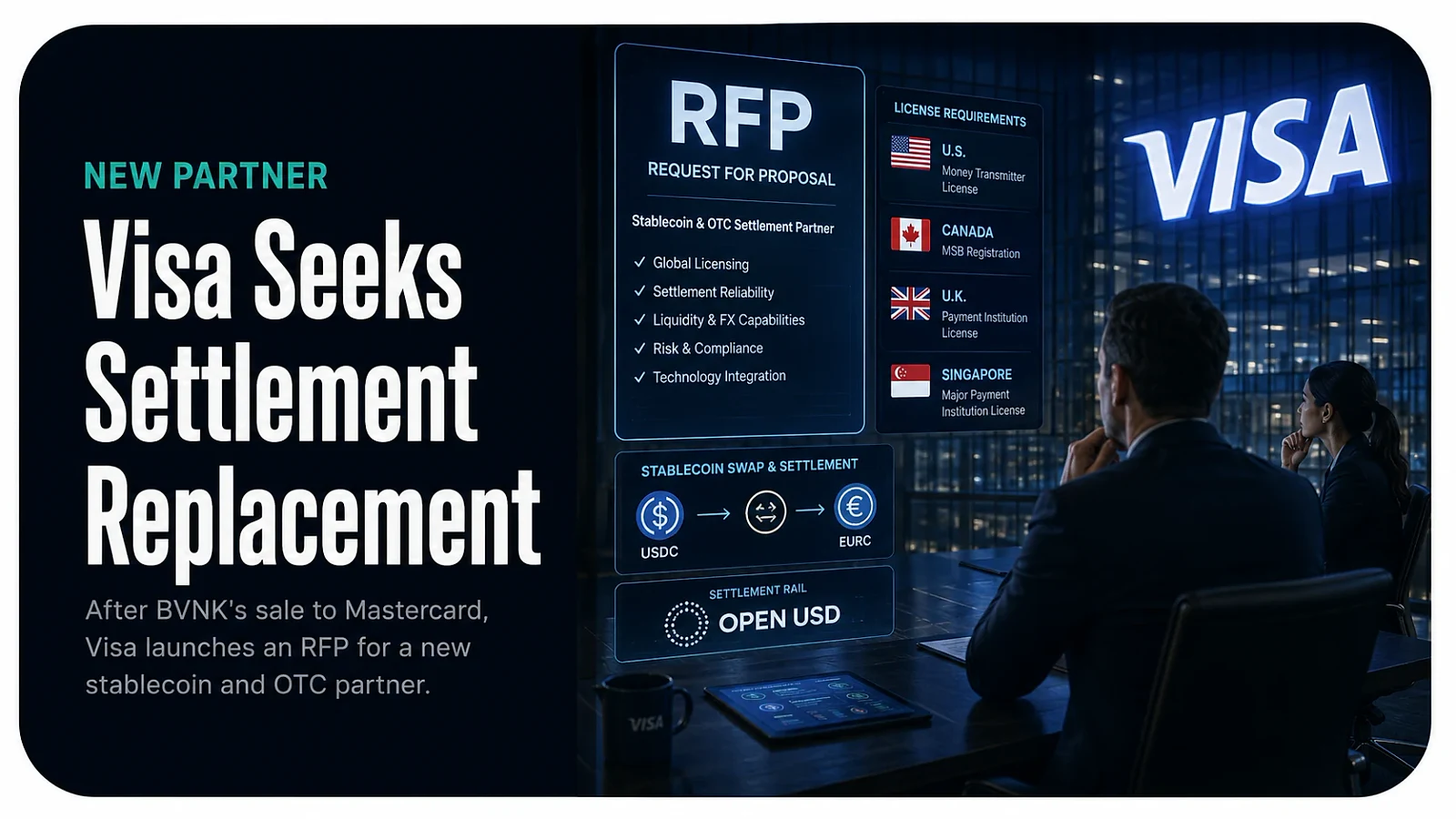
Visa has issued a request for proposal for a new stablecoin settlement and over-the-counter, or OTC, partner, after Mastercard acquired its former partner BVNK. CoinDesk, which reviewed the RFP documents, reported August 18 that the successful provider must combine multi-market crypto licensing with stablecoin swaps, OTC capability and settlement for Open USD, or OUSD.[1]
The search turns a corporate acquisition completed just 15 days earlier into an operational test for Visa's stablecoin strategy. Mastercard closed its acquisition of BVNK on August 3 in a transaction valued at up to $1.8 billion; Visa cannot sensibly leave a core settlement function with an infrastructure provider now owned by its closest card-network rival.[3]
A replacement search, not a signed partnership
Visa's existing settlement partner was BVNK. The RFP is therefore not evidence that Visa has picked a winner or that its current stablecoin services have stopped working. It is a rebid for a key part of the backend as ownership of the incumbent changed, and Visa declined to comment on the process.[1]
The documents set an unusually high qualification threshold. A potential partner must hold cryptocurrency-exchange licences in the United States, Canada, the United Kingdom and Singapore, while being able to swap and support a range of stablecoins. It must also provide settlement for Open USD, the consortium project involving Visa, Mastercard, Stripe and a wider group of institutions.[1][2]
“The need for a stablecoin partner licensed in all major markets has narrowed the scope of potential partners somewhat,” Visa said in RFP material reviewed by CoinDesk.[1]
That statement is the crucial constraint. Many firms can offer custody, wallet software, liquidity routing or card programmes. Far fewer can deliver regulated exchange and OTC functions in all four named markets. PYMNTS separately corroborated the reported search on August 18, according to follow-up coverage.[2]
Visa RFP requirement — Specific requirement — Why it narrows the field
Licensed markets — 4: US, Canada, UK and Singapore — A single operating model must satisfy four separate regulatory perimeters
Trading and liquidity — Stablecoin swaps and OTC support — Visa needs conversion and liquidity operations, not only wallet infrastructure
Asset coverage — A range of stablecoins — The provider cannot be built around one settlement token
Consortium settlement — Settle OUSD — The service must connect to Visa's Open Standard strategy as well as existing rails
OUSD is the strategic tell
The explicit OUSD requirement makes the RFP more than a procurement exercise. Visa already has a production-facing stablecoin deployment with Zero Hash, which on August 5 began powering stablecoin prefunding and payouts for eligible Visa Direct clients. Visa Direct reaches more than 18 billion endpoints across more than 195 countries and territories, and Zero Hash provides the regulatory and technical stack across dozens of blockchains and stablecoins.[4]
That deployment has been centered on USDC for the announced Visa Direct capability. Visa's July Stablecoin Platform uses OUSD as its initial supported token, alongside the Visa Direct deployment.[1] The RFP's OUSD clause points elsewhere: Visa wants its next settlement and OTC layer to be ready for the consortium stablecoin, rather than treating the replacement purely as a way to preserve USDC flows. Open USD is not a Visa-issued token. It is a shared project, and requiring support positions Visa to keep building its own platform and payout rails around a multi-party monetary standard.[1][2]
The contrast with Mastercard is now stark. Mastercard has internalized BVNK and its stablecoin infrastructure. Visa is rebuilding around an external provider while staying inside a consortium that includes Mastercard. Visa is also a founding validator for Circle's planned Arc network, showing that its approach is not to choose one token or one chain, but to retain options across settlement layers.[8] The RFP is the plumbing work necessary to keep that option set credible.
The small field around the RFP
No company has been named as a finalist. The comparison below is an illustrative market map, not a Visa shortlist. The decisive question for every candidate is whether it can meet the four-jurisdiction exchange-licensing test, a fact not established for any candidate below by the cited public materials.
Candidate — Public connection to Visa or payments — Relevant recent signal — Four-jurisdiction licence status in cited public materials
Rain — Visa issuer and Mastercard Principal Member — Raised $58 million in Series B financing; acquired Ansa on August 12.[6][7] — Not established
Zero Hash — Powers Visa Direct stablecoin prefunding and payouts — Supports Visa Direct's 18bn-plus endpoint reach in 195-plus countries and territories.[4] — Not established
Bridge — Stripe-owned stablecoin infrastructure provider — Luxembourg MiCA CASP authorisation plus EMI licence, with EU reach.[5] — Not established
Fireblocks and adjacent orchestrators — Potential technology layer alongside a regulated liquidity provider — Could assist with orchestration rather than supply the regulated exchange role — Not established; would need the required licensing structure
Rain is notable because its card-network position spans both Visa and Mastercard, while the Ansa acquisition adds stored-value and merchant-wallet capabilities to its payments stack.[6] Yet network membership and a strong funding record are not substitutes for the precise licences in Visa's request. The same distinction applies to Zero Hash: its live Visa Direct role gives it familiarity with Visa's operating model, but the RFP documents were reportedly written after that announcement and address markets where Zero Hash does not hold a licence.[1][4]
Bridge has a different attraction. Stripe's infrastructure subsidiary has secured a MiCA Crypto-Asset Service Provider authorisation and an Electronic Money Institution licence in Luxembourg, a useful European regulatory base but not proof of coverage in the four RFP jurisdictions.[5] Fireblocks and similar providers could be relevant as orchestration layers, but the language of the RFP puts exchange licences and OTC capability at the center, not merely the software layer.
Visa's next decision matters more than the announcement
For now, the confirmed news is the RFP. There is no published timetable, contract value, finalist list or selected provider. But Visa has shown what it values: regulated coverage, multi-stablecoin liquidity and an OUSD-ready settlement backend. Those requirements make the search smaller than a conventional vendor comparison and turn the winner into a strategic control point in Visa's stablecoin stack.[1]
The immediate consequence of Mastercard's BVNK deal is not that Visa has withdrawn from stablecoins. It is that Visa is publicly reorganizing the infrastructure underneath its push into them. A partner that satisfies all four licences and can settle OUSD would let Visa preserve independence from Mastercard-owned plumbing while advancing a consortium-led alternative.
References
[1] CoinDesk, "Visa looking for new stablecoin settlement partner after BVNK sale to Mastercard," August 18, 2026. https://www.coindesk.com/business/2026/08/18/visa-is-looking-for-a-new-stablecoin-settlement-partner-now-that-bvnk-is-owned-by-mastercard
[2] Yahoo Finance, "Visa's Search for a New Stablecoin Partner Reveals a Strategic Divide," August 18, 2026. https://finance.yahoo.com/markets/crypto/articles/visa-search-stablecoin-partner-reveals-220233895.html
[3] Mastercard, "Mastercard completes acquisition of BVNK to advance global stablecoin capabilities," August 3, 2026. https://www.mastercard.com/us/en/news-and-trends/press/2026/august/mastercard-completes-acquisition-of-bvnk-to-advance-global-stabl.html
[4] zerohash, "zerohash Powers Stablecoin Payout and Prefunding Capabilities for Visa Direct," August 5, 2026. https://zerohash.com/press/zerohash-powers-stablecoin-payout-and-prefunding-capabilities-for-visa-direct
[5] FinTech Futures, "Stripe's Bridge secures EU MiCA authorisation and e-money licence," July 6, 2026. https://www.fintechfutures.com/blockchain-crypto-digital-assets/stripe-bridge-eu-mica-authorisation-e-money-licence
[6] Rain, "Behind the buy: building Rain's stored value layer with Ansa," August 12, 2026. https://www.rain.xyz/resources/rain-acquires-ansa-for-stored-value-solution
[7] PR Newswire, "Rain Raises $58M Series B Led by Sapphire Ventures," August 28, 2025. https://www.prnewswire.com/news-releases/rain-raises-58m-series-b-led-by-sapphire-ventures-to-become-the-enterprise-stablecoin-platform-of-record-302540587.html
[8] Circle Internet Financial, "Circle Reports Second Quarter 2026 Results," August 5, 2026. https://www.circle.com/pressroom/circle-reports-second-quarter-2026-results