U.S. Bank Completes Live USBDC Cross-Border Pilot on Stellar
U.S. Bank used USBDC in a live North America–Europe payment on Stellar, testing minting, redemption, freeze and clawback controls.
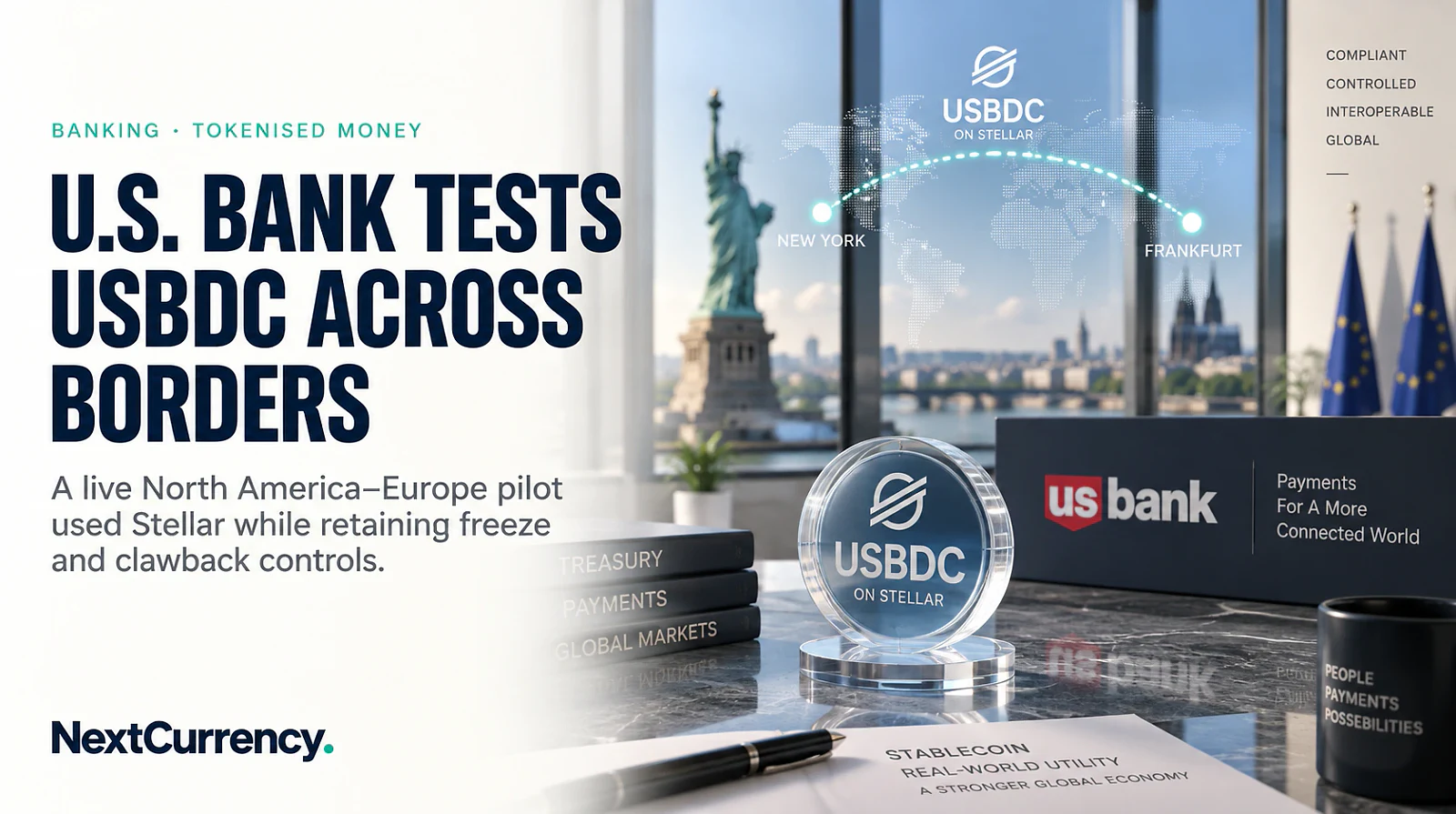
U.S. Bank has completed a live cross-border payment using USBDC, its proprietary U.S. dollar-backed stablecoin, between bank entities in North America and Europe on the public Stellar network.
The September 9 announcement is an important step beyond the bank's earlier development work, but its scope is narrower than the word “launch” might suggest. The verified event is a live pilot transaction between U.S. Bank entities. The bank has not announced general customer access to USBDC or a public distribution program. U.S. Bank.
The pilot kept conventional bank controls
U.S. Bank said the test covered the full lifecycle of the token, including minting, payment and redemption. It also tested freeze and clawback functions.
Those controls are central to the design rather than incidental additions. A regulated bank issuing digital money has legal, compliance and operational responsibilities that differ from those of an unmanaged bearer asset. The ability to restrict or reverse a token under defined circumstances can be necessary for sanctions controls, fraud response, operational errors and other bank obligations.
The pilot therefore demonstrates a model in which a public blockchain supplies the transaction infrastructure while the issuer retains authority over the money it creates.
Stellar separately described the transaction as real-money movement on its network, confirming the use of the public chain. The test does not mean that every Stellar address can mint, redeem or freely access the bank's token.
A public blockchain does not require a permissionless liability
The transaction weakens a common binary in digital-money debates. Banks do not have to choose between keeping all activity on private ledgers and issuing unrestricted tokens on a public chain.
USBDC shows a third model: a bank-controlled dollar liability can use public blockchain infrastructure while preserving issuer-level permissions. That makes the network layer and the legal nature of the money two separate design choices.
It also means USBDC should not automatically be treated as identical to USDC, USDT or a tokenised deposit. U.S. Bank has described USBDC as a proprietary dollar-backed stablecoin. The precise customer claim, redemption rights, eligible holders and reserve treatment will need to be assessed from product terms if the bank moves beyond internal testing.
Treasury use is the more immediate institutional case
U.S. Bank identified liquidity management, cross-border treasury and collateral mobility among possible future uses. Those are areas where a bank can gain value from programmable, around-the-clock movement without first building a mass-market retail token.
A corporate treasury product would still need more than fast blockchain finality. Customers would need clear funding and redemption windows, accounting treatment, permissioning, limits, transaction reporting and a defined relationship between the token and their existing bank accounts.
That operational layer will determine whether the pilot becomes a product rather than remaining a technology demonstration.
What happens next
The next evidence to watch is external distribution. A customer pilot, published issuer terms, supported wallet rules or a commercial treasury product would materially change the status of USBDC.
For now, the September 9 transaction establishes something more specific: a major U.S. bank has shown it can move its own controlled digital dollar across regions on a public blockchain while retaining the intervention tools expected of a bank issuer.