UK plans payments-innovation objective for Bank of England covering stablecoins and digital money
HM Treasury plans to make payment innovation a secondary statutory objective for the Bank of England while keeping financial stability as its primary responsibility.
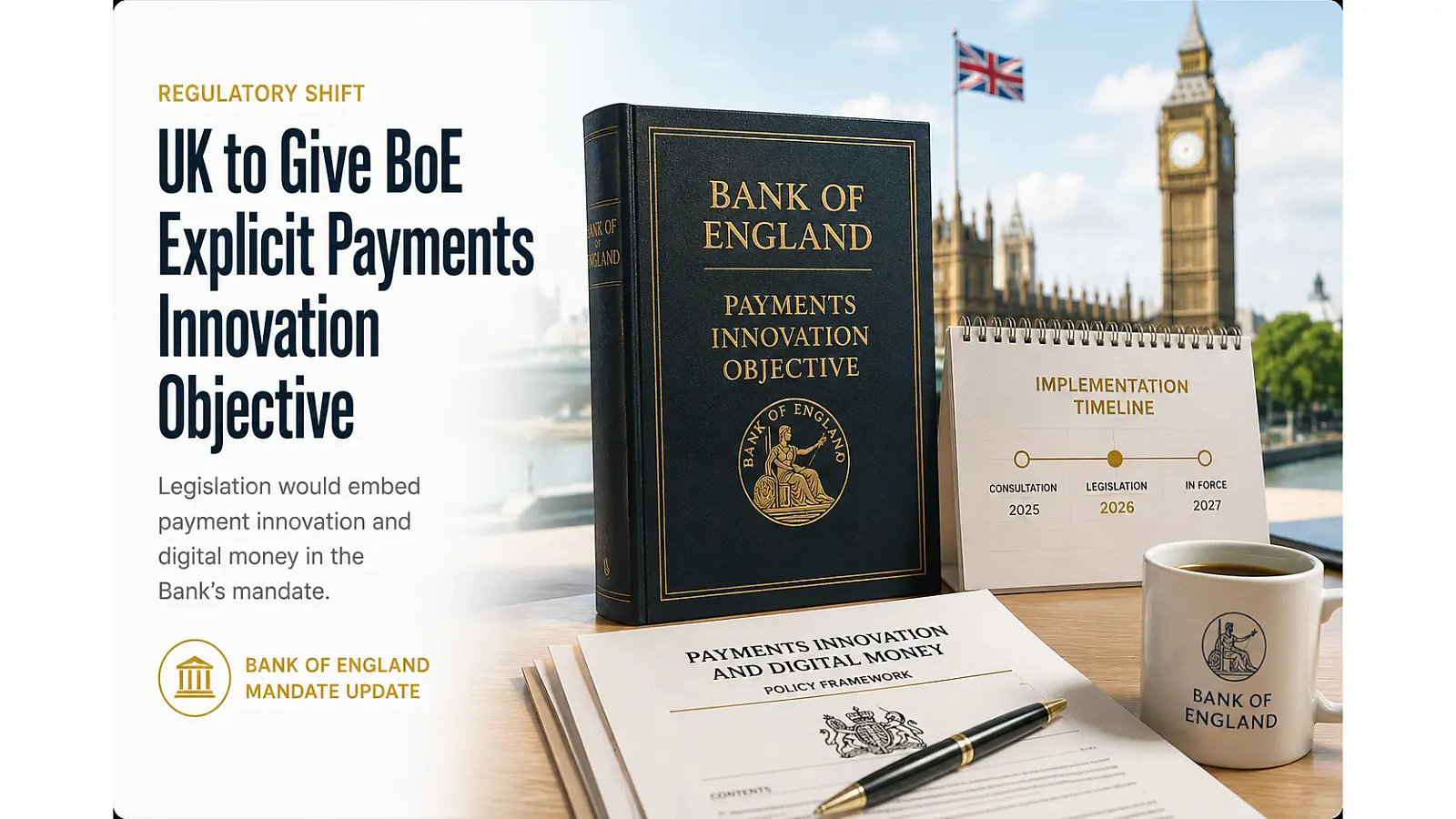
The UK government plans to give the Bank of England a new secondary objective to support innovation in systemic payment systems and emerging forms of digital money, including payment systems using stablecoins.
HM Treasury published the proposal on August 27. The change would place payments innovation alongside the Bank's existing financial-stability responsibilities, but explicitly subordinate it to the primary stability objective. The government expects to implement the change through amendments to the Financial Services and Markets Bill, which is due for further House of Lords consideration in September.
The proposal is therefore a legislative plan, not an enacted change to the Bank's mandate.
The change is about the regulator's objective, not a single stablecoin rule
The Bank of England already supervises systemic payment systems and has authority over systemic digital settlement assets. What changes under the government proposal is the statutory lens through which that supervision would be exercised.
HM Treasury says the Bank would be required to support innovation where consistent with financial stability and report annually to Parliament on how it is advancing the new objective. The framework would extend an approach already used for central counterparties and central securities depositories to systemic payment systems.
City Minister Lucy Rigby said tokenisation and distributed-ledger technology “have the potential to transform financial markets across the globe.” Bank of England Deputy Governor Sarah Breeden said the new objective would support innovation “without compromising on financial stability.”
The proposal lands as the UK builds its systemic stablecoin regime
The timing matters because the Bank is already finalising rules for sterling-denominated systemic stablecoins.
In June, the Bank published a policy statement and draft Code of Practice that increased the maximum share of systemic stablecoin backing assets permitted in interest-bearing short-term UK government debt from 60% to 70%. The remainder would be held in central-bank deposits under the proposed structure.
The Bank also replaced an earlier proposal for temporary user holding limits with a temporary £40 billion issuance guardrail for each systemic stablecoin. The guardrail is intended to address risks to bank deposit funding and credit provision while allowing households and businesses to use the tokens without individual holding caps.
The Bank and Financial Conduct Authority are working toward an end-to-end regime in which the FCA regulates issuance, custody and admission to trading for qualifying UK stablecoins, while systemic stablecoins recognised by HM Treasury would also come under Bank of England supervision.
Innovation becomes an explicit regulatory trade-off
The significance of the August proposal is institutional rather than promotional. Once enacted, the Bank would be formally instructed to consider payment innovation while carrying out its systemic-payment responsibilities.
That does not mean the Bank must approve a particular stablecoin, reduce reserve requirements or accept additional financial-stability risk. The Treasury notice specifically says the secondary objective would not require the Bank to support innovation where it would undermine stability.
But statutory objectives matter because they shape how regulators evaluate trade-offs. The Bank has described a future UK financial system as a multi-money environment in which commercial bank deposits, regulated stablecoins and central-bank money can interact. Giving payment innovation explicit status in the mandate could affect the pace and design of the infrastructure connecting those forms of money.
The next step is Parliament. Until the relevant amendment is passed, the Bank has not received the new objective. The correct market signal today is that the government wants innovation in digital money and systemic payments to become part of the Bank's formal regulatory responsibility, rather than an ancillary policy preference.
The UK's payments stack is changing at several levels
Policy layer — Current August 2026 position
Bank of England objective — Government proposes secondary payments-innovation objective
Systemic stablecoin reserves — Draft framework allows up to 70% in short-term UK government debt
Systemic stablecoin scale — Temporary £40B issuance guardrail per stablecoin
Implementation — Government plans amendments to the Financial Services and Markets Bill
Accountability — Bank would report annually to Parliament on the innovation objective
The combination matters because rule design and regulatory incentives are being changed in parallel. The June stablecoin framework deals with prudential mechanics: reserves, redemption resilience and potential effects on bank funding. The August proposal deals with the institutional objective that sits above future decisions.
For issuers and payment firms, that does not remove the need to meet prudential standards. It may, however, make questions of interoperability, market entry and infrastructure modernisation more explicit parts of the Bank's statutory balancing exercise. That is a more durable policy signal than a one-off sandbox or pilot because it would apply across future systemic-payment supervision once enacted.