TrueLayer and Papa Johns Run a UK AI-Agent Payment Over Pay by Bank Mandates
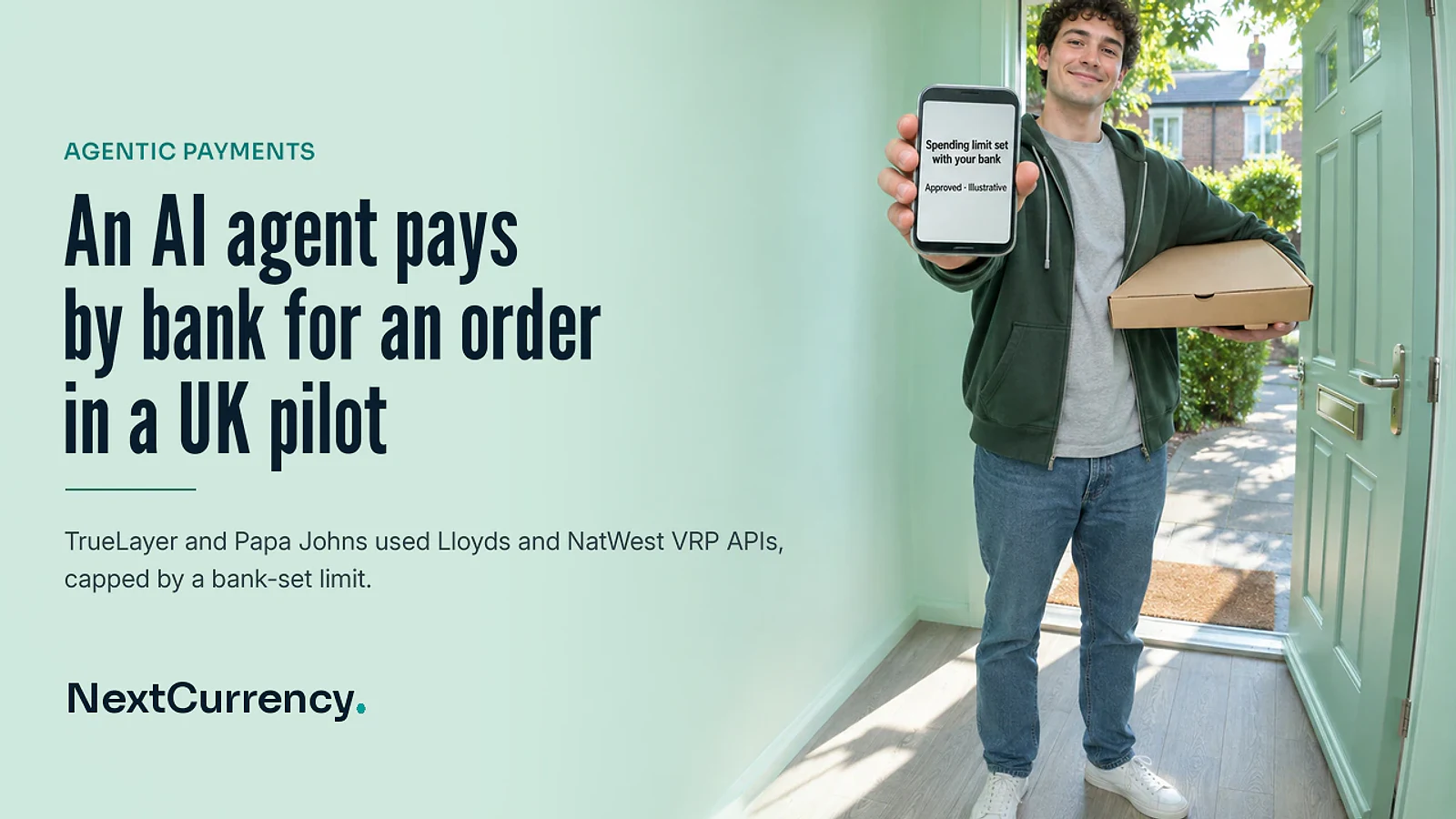
In a pilot run through the FCA's Supercharged Sandbox, a Papa Johns AI agent paid from a customer's linked bank account using Lloyds and NatWest variable recurring payment APIs, within a spending limit the customer set with the bank. TrueLayer presented the findings at the FCA's 26 November 2026 showcase.
By Daniel Osei, Journalist, Payments and Cards
TrueLayer and Papa Johns said on 27 November 2026 that they had completed what they call the UK's first agentic Pay by Bank payment: a Papa Johns AI agent took a customer's order and paid for it directly from the bank account the customer had linked to their Papa Johns account, rather than with a card.
The payment was part of a pilot run through the Financial Conduct Authority's Supercharged Sandbox, with UK retail banks including Lloyds and NatWest. TrueLayer says it was the first use of Lloyds' and NatWest's variable recurring payment (VRP) APIs for agentic payments, and that it shared its findings with the FCA and industry at the regulator's showcase on 26 November. It is a demonstration, not a commercial rollout: neither company gave a launch date, volumes or the number of customers involved.
How the mandate works
The model rests on an open banking mandate rather than stored card details. According to TrueLayer:
- The customer links a bank account once and sets a spending limit with their bank, per merchant or over specific time periods.
- Authorisation happens inside the customer's banking app, so no credentials or passwords are shared with the agent.
- The bank checks every payment against the customer's limits and declines anything above them; no AI agent can exceed the cap.
- The customer can cancel the mandate with the merchant or from the banking app at any time.
VRPs are the open banking instrument that lets a payer authorise a series of payments within agreed parameters, instead of approving each one. Applying them to agents means the control sits with the bank holding the account, not with the agent platform or the merchant.
Analysis: account-to-account rails pitch for agent checkout
Most agentic-commerce work so far has come from the card networks, which have been building tokenised agent credentials and readiness programmes for issuers and acquirers. TrueLayer's argument is that bank mandates suit agents better because the spending limit is enforced by the customer's bank and no card data reaches the agent. "Agents will choose the payment rail that is fastest, most secure and lowest cost, not the one people use out of habit," chief executive Francesco Simoneschi said.
The constraint is reach. The pilot used two banks' VRP APIs inside a regulatory sandbox, and an agent payment of this kind only works where the customer's bank exposes such an API for the purpose. The FCA framed the showcase as informing work on the conditions and standards needed to adopt the technology "fully and safely at scale", which is an acknowledgement that those conditions are not yet in place. TrueLayer's own figures, more than 30 million users across 22 countries and more than $150 billion in payments a year, are company claims.
What to watch
Whether Papa Johns moves the agent payment from pilot to its live ordering channels, which other UK banks expose VRP APIs for agent use, and what the FCA publishes from the Supercharged Sandbox showcase.
Sources
Explore NextCurrency
- Payments
- HSBC RedCoin Passes 100,000 Users About a Month After Launch
- Form3 to Let Clients Mint Stablecoins Through Its Payments API via Coinbase
- Mastercard Introduces Accept, Letting Debit Cardholders Take Payments in Their Banking App
- Alipay+ Connects Its 50-Plus Global Wallets to Brazil's Pix, a Week After Weixin Pay
- BANCOMAT and CBI Sign MoU for a Shared Italian Digital Euro Platform, With Nexi as Technology Partner
- BILL Agrees to $6.0 Billion Take-Private by TPG, With Corpay Taking About a Third and an Option to Buy the Rest in 2030