Thunes Connects 11,500 SWIFT Banks to 500 Million Stablecoin Wallets with Zero Additional Integration
Singapore-based Thunes has unveiled its Pay-to-Stablecoin-Wallets solution, enabling every institution on the SWIFT network to send real-time payouts in USDC and USDT to more than 500 million wallets across 140-plus countries through a single existing SWIFT message.
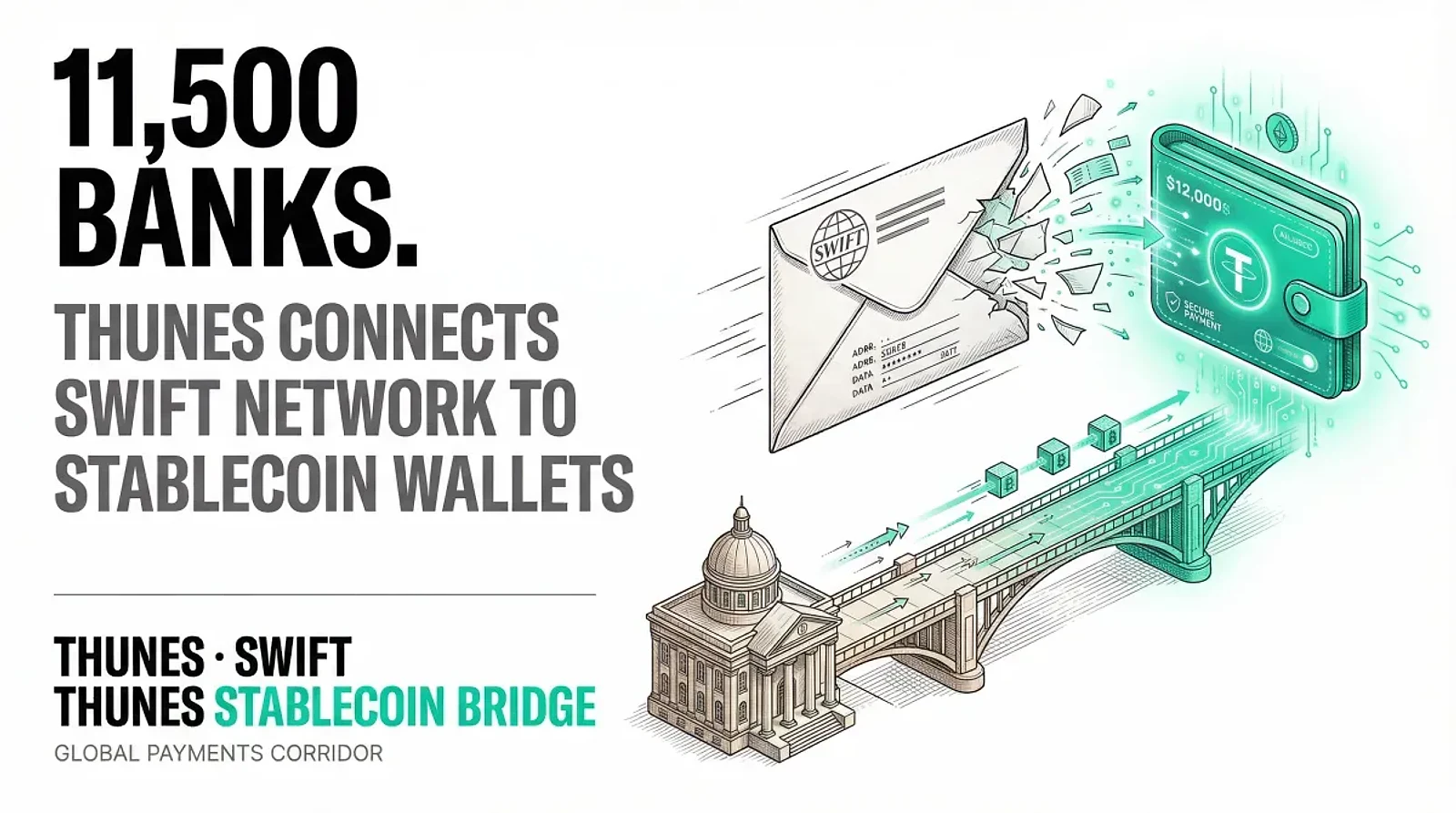
Thunes, the Singapore-headquartered cross-border payments infrastructure company, announced on March 17, 2026 the general availability of its Pay-to-Stablecoin-Wallets solution, a product that allows every one of the 11,500 financial institutions connected to the SWIFT network to route real-time payouts directly into stablecoin wallets without any new technical integration on the bank side. The solution, which went live in October 2025, reaches more than 500 million stablecoin wallets across 140-plus countries and supports both USDC and USDT, the two dominant dollar-pegged tokens by circulation [1].
How the Architecture Works
The core engineering insight behind Pay-to-Stablecoin-Wallets is that it asks nothing new of the sending bank. An institution dispatches a standard SWIFT message through its existing correspondent banking connection, exactly as it would for any conventional fiat transfer. Thunes intercepts that message at the network edge, converts the fiat value into the designated stablecoin using its proprietary SmartX Treasury System, and delivers the token amount to the recipient's wallet address in real time. The entire conversion and delivery sequence is invisible to the originating bank's operations or compliance teams [1].
The SmartX Treasury System manages the fiat-to-stablecoin liquidity pools that make instantaneous conversion possible without forcing the bank to hold or custody digital assets. Separately, Thunes' Fortress Compliance Platform applies end-to-end security, sanctions screening, and transaction traceability across every payout, ensuring the solution meets the regulatory and anti-money-laundering obligations that SWIFT member institutions are contractually bound to uphold [1].
"This is a defining moment for cross-border payments. By combining Swift's secure and resilient global banking infrastructure with Thunes' payout solutions, we're unlocking a new era of global money movement. Banks can now move value instantly across any rail, fiat or stablecoin, within a trusted, compliant network, using their existing Swift connection."
- Chloe Mayenobe, Deputy CEO at Thunes [1]
The Integration Barrier That Has Stalled Bank Adoption of Stablecoins
For the better part of a decade, stablecoin infrastructure has been inaccessible to mainstream banks not because of regulatory prohibition alone, but because of integration complexity. To participate directly in stablecoin settlement, a bank historically needed to build or license blockchain node infrastructure, establish digital asset custody arrangements, negotiate wallet API agreements with individual stablecoin issuers, and rearchitect compliance workflows to handle on-chain transaction monitoring. For most mid-tier and regional banks, that investment threshold was prohibitive relative to projected near-term transaction volumes.
Thunes' solution collapses that barrier entirely. Because the bank's technical interface remains a SWIFT message, the bank's core banking system, treasury desk, and compliance function require no modification. The complexity of bridging fiat rails to blockchain rails is absorbed entirely within Thunes' network layer. The result is that stablecoin payout capability becomes a day-one option for all 11,500 SWIFT members rather than a years-long infrastructure project [1].
Feature — Detail
SWIFT institutions reached — 11,500
Stablecoin wallets reachable — 500 million+
Countries covered — 140+
Stablecoins supported — USDC, USDT
Bank-side integration required — None
Settlement mechanism — Single SWIFT message
Operating hours — 24/7
Launched — October 2025
Extending a Three-Rail Strategy
Pay-to-Stablecoin-Wallets is the third product in Thunes' suite of SWIFT-connected payout rails, following Pay-to-Bank and Pay-to-Wallet solutions that the company had already rolled out to network members. The three solutions together give any SWIFT-connected originator the ability to deliver value to a bank account, a mobile money wallet, or a stablecoin wallet through identical origination mechanics. Thunes describes the combined offering as part of its Direct Global Network, a proprietary infrastructure that spans over 12 billion mobile wallets, stablecoin wallets, and bank accounts, plus access to 15 billion cards through more than 220 payment methods [1].
Members of the Direct Global Network include gig economy platforms such as Uber and Deliveroo, super-apps including WeChat, alongside money transfer operators, fintechs, payment service providers, and banks. The addition of stablecoin wallets as a payout rail extends the network's reach to a recipient segment that has grown rapidly in emerging markets, where USDT in particular has become a practical substitute for scarce hard-currency bank access.
"Through a single Swift message, any bank can now deliver instant payouts to all key destinations including wallets, banks and stablecoin wallets around the world, without complexity or integration barriers. It's interoperability at its best, connecting banks, wallets, and digital currencies through one simple connection."
- Elie Bertha, Chief Product Officer at Thunes [1]
Real-World Use Cases and the Currency Volatility Argument
Thunes has framed the commercial case for Pay-to-Stablecoin-Wallets around three high-frequency payment categories: salary payouts, family remittances, and business transfers. In each scenario, the stablecoin delivery format solves a persistent problem that conventional fiat transfers do not: the recipient in a high-inflation or currency-restricted market gains immediate access to dollar-denominated value without exposure to local exchange rate risk between payment dispatch and funds availability [1].
For an employer running international payroll to workers in currency-volatile markets, a USDT payout that arrives in seconds carries materially different economic value than a fiat wire that may take two to three business days to clear and settle in local currency at an unfavorable rate. For a migrant worker sending remittances home, the ability to deliver USDC directly to a family member's wallet bypasses correspondent banking chains that extract fees at each intermediate node.
Thunes' Chief Product Officer framed the launch explicitly as a response to accelerating stablecoin adoption rather than a bet on speculative demand: the solution is designed to match existing customer demand and solve real-world challenges faced by millions of individuals and businesses due to currency volatility and a growing need for faster payments and access to hard currencies [1].
Implications for the Fiat-to-Blockchain Bridge
The broader significance of the announcement extends beyond Thunes' own network. By routing stablecoin payouts through SWIFT rather than requiring banks to connect directly to blockchain infrastructure, Thunes has demonstrated an integration model that treats the blockchain leg of the transaction as a downstream delivery mechanism rather than a new asset class requiring new regulatory and operational frameworks at the bank level.
This architecture has a precedent in how early mobile money rails were adopted: banks did not build mobile money infrastructure themselves but rather connected to specialized operators who managed the last-mile distribution. Thunes is replicating that model for stablecoin delivery, positioning itself as the infrastructure layer between institutional finance and the digital asset ecosystem. If the pattern holds, the limiting factor on stablecoin adoption in institutional payment corridors shifts from bank-side readiness to recipient wallet penetration, an area where 500 million reachable wallets already represents substantial ground coverage [1].
Payment Type — Traditional SWIFT Transfer — Thunes Pay-to-Stablecoin
Settlement speed — 1-3 business days — Real-time, 24/7
Recipient requirement — Bank account — Stablecoin wallet
Currency exposure at receipt — Local fiat — USD-pegged stablecoin
Bank integration needed — Existing SWIFT — Existing SWIFT (unchanged)
Intermediary hops — Multiple correspondents — Single Thunes network hop
Operating hours — Business hours, weekdays — 24/7/365
Thunes is headquartered in Singapore and maintains offices in 14 locations globally. The company's Direct Global Network currently enables real-time payments in over 140 countries and more than 90 currencies [1].
References
[1] Thunes, via PR Newswire / Morningstar, March 17, 2026: https://www.morningstar.com/news/pr-newswire/20260317ln10756/thunes-brings-stablecoin-payouts-to-11500-banks-via-swift-connectivity