Three Stablecoin Chains Are Rewriting the Payments Playbook
Plasma, Tempo, and Codex each launched purpose-built payment blockchains within a twelve-month window, drawing hundreds of millions in institutional capital and collectively challenging the assumption that general-purpose networks are adequate rails for global dollar settlement.
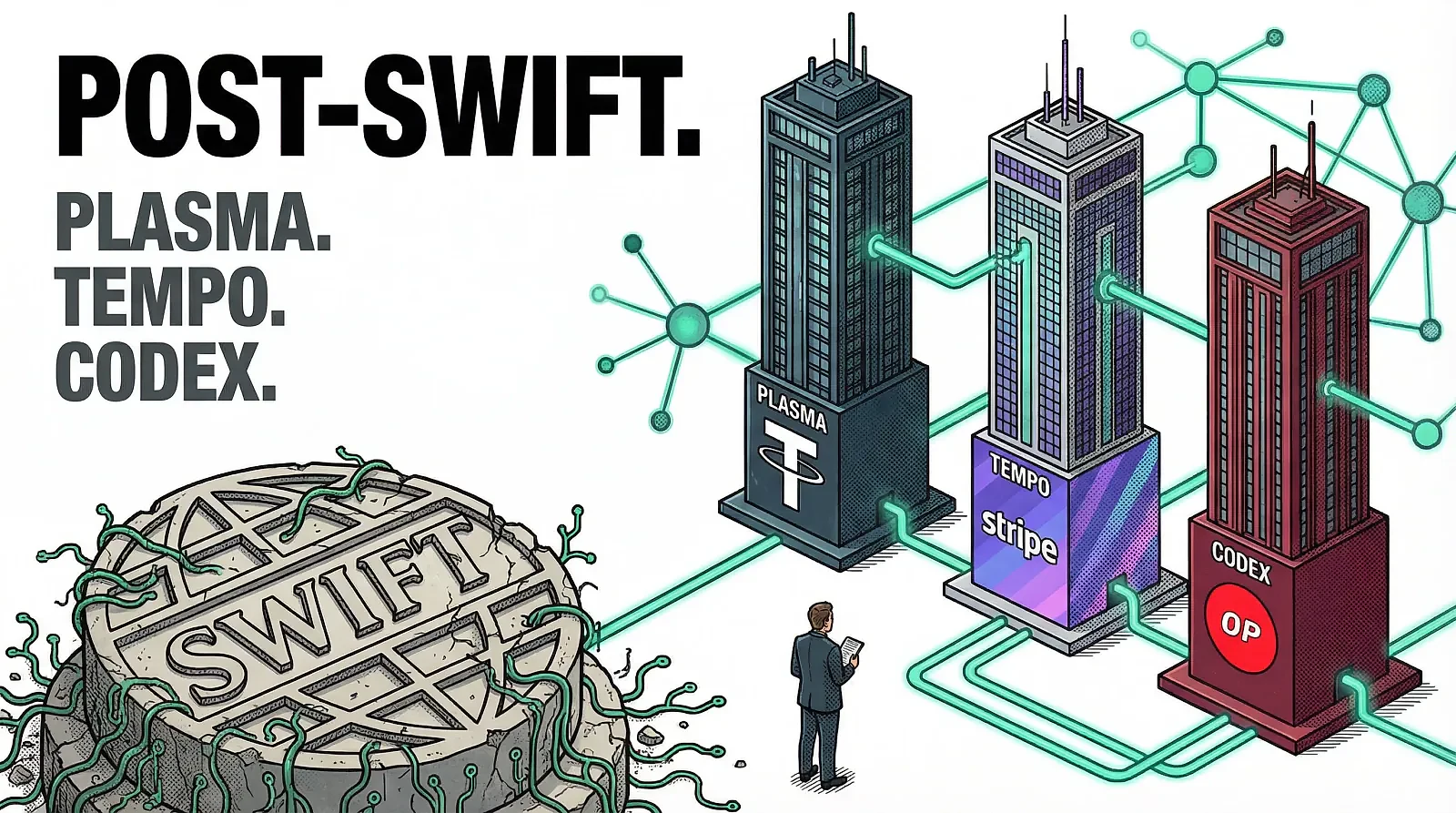
The stablecoin market crossed $230 billion in circulating supply without a single blockchain designed from inception to handle it. Plasma, Tempo, and Codex are three separate bets, from three distinct investor coalitions, that the absence of purpose-built payment infrastructure is the defining gap in financial technology today. Their near-simultaneous emergence is not coincidence; it is the market's response to a decade of watching stablecoin transactions compete for block space alongside NFT mints and leveraged trading on chains that were never engineered for payments.
The Structural Problem With General-Purpose Chains
The core critique shared by all three projects is identical even if their remedies differ: Ethereum, Solana, and comparable L1s are optimized for decentralization and programmability across an unlimited range of applications, which structurally conflicts with the requirements of high-frequency, low-margin payment flows. Fee volatility alone disqualifies general-purpose chains for many institutional use cases. When gas prices spike on Ethereum during periods of network congestion, a $12 wire-equivalent transaction can attract fees that erase its economic logic entirely. Solana offers lower fees but imposes a shared execution environment where payment throughput depends on whatever else the network is processing at a given moment.
Purpose-built stablecoin chains solve this by constraining the design space. When a chain has no decentralized exchange governance votes, no NFT auctions, and no lending protocol liquidation cascades competing for the same validator attention, fee predictability and settlement finality become engineering problems rather than auction-market outcomes. That constraint is a feature, not a limitation, and institutional capital is now pricing it accordingly.
Plasma: Tether's Own Rails
Plasma launched its mainnet beta on September 25, 2025, backed by Tether, Bitfinex, Peter Thiel, and Framework Ventures, having raised a combined $74 million at a $500 million valuation [1][2]. Its architectural bet is the most radical of the three: USDT is the native asset of the chain itself, meaning validators are compensated in USDT, gas fees are zero for standard transfers, and the chain's economic incentives align directly with stablecoin volume rather than with the price of a separate governance token.
The consumer-facing expression of this infrastructure is Plasma One, a neobank application launched alongside the mainnet that offers zero-fee USDT transfers, 10-plus percent yield on stablecoin balances, and a Visa-powered card accepted at merchants in 150 countries [3]. Within weeks of launch, 75,000 users had enrolled. The pre-launch deposit campaign attracted over $1 billion from more than 24,000 wallets, reflecting genuine demand for dollar-denominated savings products in emerging markets where local currency depreciation makes USDT a practical store of value [4].
The strategic logic is vertical integration at the infrastructure level. By controlling the chain, the token, and the neobank, Plasma closes the loop between settlement and distribution in a way no general-purpose L1 can replicate. The Tether relationship is not merely symbolic: Plasma inherits direct access to the largest stablecoin liquidity network in existence, a structural advantage with no obvious analogue for competing chains.
Tempo: Stripe's Institutional Play
Tempo represents a different thesis. Incubated jointly by Stripe and Paradigm and launched to mainnet in March 2026 after raising $500 million at a $5 billion valuation, Tempo is an EVM-compatible L1 engineered explicitly for enterprise payment workloads and AI agent commerce [5][6]. The chain deliberately issues no native gas token; fees are settled in any supported stablecoin, eliminating the balance-sheet volatility that makes crypto-native fee tokens unattractive to corporate treasury departments.
Tempo's signature feature is the Machine Payments Protocol (MPP), co-developed with Stripe and Visa and announced alongside the mainnet launch. MPP is an open agentic commerce standard that enables AI agents to autonomously initiate and complete payment sessions, with funds and instructions committed upfront and then executed across multiple transactions without further human authorization [5]. The protocol currently runs on Tempo but is designed to extend to other payment rails, including digital wallets and card networks. Over 100 services integrated with Tempo ahead of mainnet.
The chain's ISO 20022 compatibility is not a superficial feature. ISO 20022 is the structured data standard used by SWIFT, the Federal Reserve's FedNow, and virtually every major correspondent banking system. By mapping its transaction metadata fields directly to ISO 20022 schemas, Tempo enables smart contracts to interact with ERP systems and treasury platforms in ways that do not require custom middleware, closing the reconciliation gap that has historically made blockchain settlement invisible to corporate accounting workflows.
"We look at MPP as another way that you can have a very clear, defined protocol around how an agent communicates with merchants," said Cuy Sheffield, Visa's head of crypto, speaking to Fortune upon the mainnet launch [5].
Codex: The FX Settlement Layer
Codex is the oldest of the three, having launched its mainnet in Q1 2024 before the current wave of stablecoin enthusiasm reached its current intensity. Built on the OP Stack as an Ethereum L2, Codex raised $15.8 million in a seed round led by Dragonfly Capital, with participation from Coinbase Ventures, Circle Ventures, Cumberland Labs, and Wintermute Ventures [7][8]. The investor list reads as a who's-who of institutional stablecoin infrastructure, reflecting the network's primary focus: enterprise-to-enterprise cross-border settlement and stablecoin foreign exchange.
The product manifestation is Codex FX, a platform that provides instant quotes and atomic settlement across stablecoin-to-fiat, fiat-to-stablecoin, and stablecoin-to-stablecoin conversions, supporting USD, GBP, EUR, MXN, USDT, and USDC at launch [9]. The OP Stack architecture enables consistent gas fees, typically around $0.001 per transaction, unaffected by Ethereum mainnet congestion, while native USDC issuance through Circle's Cross-Chain Transfer Protocol v2 eliminates bridge risk from the settlement flow. Institutional custody platforms including Fireblocks and Dfns have integrated Codex, signaling readiness for regulated financial counterparties.
Comparison of Stablecoin-Native Chains
Chain — Backer — Mainnet — Architecture — Focus — Key Feature
Plasma — Tether, Peter Thiel, Bitfinex — Sept 2025 — L1 — Consumer neobank — USDT-native, zero gas
Tempo — Stripe, Paradigm — March 2026 — L1 (EVM, ISO 20022) — AI agent payments — MPP, sub-500ms finality
Codex — Dragonfly, Coinbase, Circle — Q1 2024 — L2 (OP Stack) — Stablecoin FX — Atomic cross-border settlement
Why Institutional Capital Is Betting on the Category
The combined funding across these three chains exceeds $600 million, drawn from investors whose prior exposure to payment infrastructure, stablecoin issuance, and enterprise software gives them credibility in estimating total addressable market. The shared thesis is not that stablecoins will displace fiat; it is that the settlement layer for digital dollars is a structurally distinct infrastructure problem from the general-purpose smart-contract platform problem, and that the winner of the former will not be the same entity as the winner of the latter.
The GENIUS Act of 2025, which established the first federal stablecoin regulatory framework in the United States, materially de-risked the category. Purpose-built stablecoin chains can engineer compliance features including user permissions, transaction metadata standards, and opt-in privacy directly into the protocol layer, rather than grafting them onto general-purpose infrastructure as an afterthought. That compliance architecture matters to the banks, payment processors, and multinational corporations that represent the institutional demand side of this market.
The differentiation between Plasma, Tempo, and Codex ultimately reflects three distinct points of leverage in the global payment stack: consumer distribution in emerging markets, enterprise and AI-agent commerce in developed markets, and institutional FX settlement across both. The premise that a single general-purpose blockchain can serve all three coherently is the assumption all three are quietly refuting.
References
[1] Plasma mainnet beta launch - https://finance.yahoo.com/news/plasma-launches-revolutionary-usdt-native-172446155.html [2] Plasma funding and Tether backing - https://ventureburn.com/xpl-jumps-58-as-plasma-mainnet-launches-with-tether/ [3] Plasma One neobank features - https://levex.com/en/blog/plasma-one-neobank-guide [4] Plasma pre-launch deposit campaign - https://blofin.com/en/academy/blofin-courses/plasma-overview-core-features-tokenomics-roadmap-explained [5] Tempo mainnet and MPP launch - https://fortune.com/2026/03/18/stripe-tempo-paradigm-mpp-ai-payments-protocol/ [6] Tempo payments infrastructure overview - https://www.paymentsjournal.com/stripe-launches-tempo-blockchain-to-power-ai-driven-payments/ [7] Codex seed round announcement - https://fortune.com/crypto/2025/04/04/codex-seed-round-dragonfly-coinbase-circle-15-8-million/ [8] Codex mainnet and architecture - https://www.gate.com/learn/articles/all-you-need-to-know-about-codex/8706 [9] Codex FX launch - https://www.linkedin.com/posts/stablecoin-news_updatecodex-has-officially-launched-activity-7440444364411031553-Qn84