The Yuan Stablecoin Is Not Coming: Beijing Bans Offshore CNH as Hong Kong Pivots to Gold and Bond Rails
Beijing's February ban on unapproved offshore yuan stablecoins has turned a long-running market forecast into a policy mismatch. Hong Kong's two licensed issuers are building HKD products while China expands gold, bond, liquidity and payment rails that retain official control over cross-border yuan use.
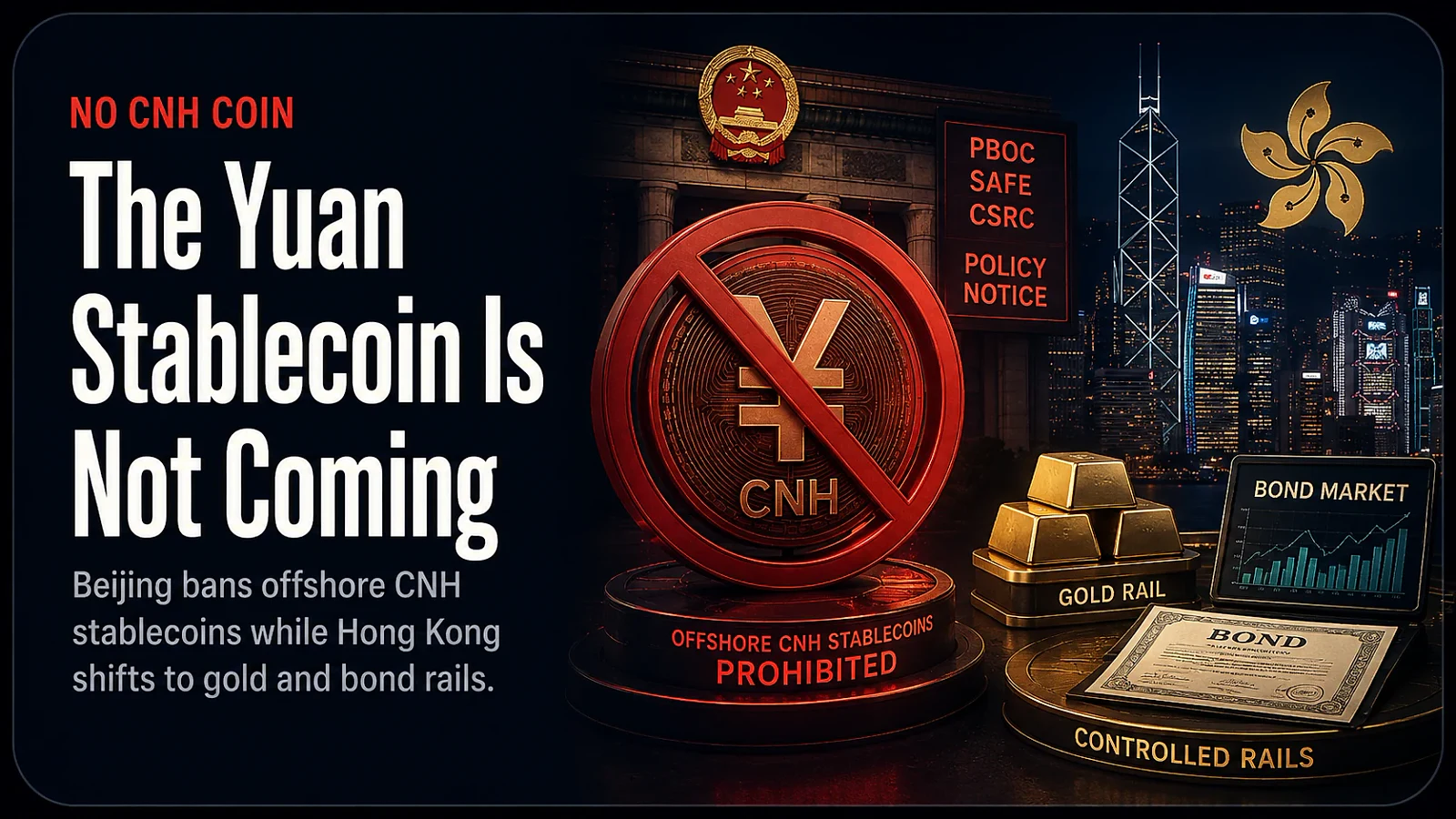
China has supplied its clearest answer yet: there will not be an open, private offshore yuan token. A Forbes analysis published August 9 put the conclusion plainly, but the operative event came earlier. In February, eight Chinese agencies led by the People's Bank of China barred unapproved offshore renminbi-linked stablecoins and extended approval requirements to offshore tokenization of Chinese assets. [1]
This is not a delay while Beijing studies the technology. It puts issuance behind explicit state permission while China builds other routes for offshore yuan liquidity and settlement. That is a choice of control over network effects.
The February notice closed the most obvious route
The February notice was a cross-border rule as much as a domestic crypto restriction. It prohibited the offshore issuance of yuan-linked stablecoins without approval and constrained token issuance abroad by Chinese entities. The agencies framed their concern around recurring speculation tied to virtual currencies and real-world-asset tokenization. [1]
“The yuan stablecoin is the most confidently predicted product in financial geopolitics, and the government that would have to permit it has spent twelve months killing it in writing.” [1]
A CNH token is different from an HKD token. A freely transferable yuan stablecoin could spread offshore liquidity across public networks and reduce cross-border friction outside Beijing's preferred perimeter. The February rule keeps permission, reserve, redemption and distribution inside the state system.
It also changes how to read Circle chief executive Jeremy Allaire's earlier three-to-five-year yuan-stablecoin forecast. Policy can change, but a market-driven CNH coin is no longer a credible base case when the rule bars that route. The more plausible outcome is supervised yuan infrastructure.
Hong Kong licensed two stablecoins, and neither is yuan
Hong Kong has not supplied a loophole. On April 10, the Hong Kong Monetary Authority, or HKMA, granted its first two stablecoin issuer licences to Anchorpoint Financial Limited and HSBC. The regulator said both licences took effect that day, while their business plans still required preparatory work before launch. [2]
Their initial denomination is the point. HSBC planned an HKD-denominated token, and Anchorpoint, the Standard Chartered, Animoca Brands and HKT venture, was likewise positioned around Hong Kong dollars. July reports pointed to proposed HKDAP distribution through OSL and HashKey, not a CNH coin.
That boundary had already been tested. After AnchorX promoted an offshore-yuan token, the HKMA publicly said no offshore-yuan stablecoin had been approved in Hong Kong and warned that claims of HKMA regulation were unlawful. The April licences did not reverse that message. [1]
Jurisdiction or market — Regulated issuer result — Currency result — Strategic signal
European Union under MiCA — 42 authorised electronic money token issuers after Bridge joined the register — Multiple fiat-referenced models can seek authorisation — A passportable regime is being populated
Hong Kong — 2 issuer licences, Anchorpoint and HSBC — HKD, not CNH — Curated local-currency issuance under HKMA supervision
Mainland China and offshore RMB policy — 0 approved yuan stablecoin issuers identified in the policy record — No private CNY or CNH coin without approval — Monetary sovereignty and capital control take priority
China is not indifferent to the dollar's digital reach. BIS Papers No. 170 says roughly 98% of stablecoin value is dollar-denominated and warns that digital dollarisation can create currency-substitution risks for emerging and developing economies. [5] Beijing is responding with supervised infrastructure, not a rival token built to travel on the same networks.
Gold, bonds and liquidity rather than a public CNH token
The July 7 package is the evidence: central gold clearing and settlement, revived US dollar gold futures with yuan futures under exploration, larger RMB funding capacity, and expanded Bond Connect access. Reuters reported that the Southbound Bond Connect quota would rise from RMB500 billion to RMB800 billion and the HKMA facility from RMB200 billion to RMB500 billion. [4]
The HKMA confirmed the RMB500 billion facility, effective July 10, alongside longer available tenors and additional Bond Connect, collateral and fixed-income measures. [3] These are balance-sheet and market-structure tools, not instruments designed to circulate as bearer-like public tokens.
Hong Kong and China rail — July 2026 measure — What it expands — Why it is not a yuan stablecoin
Gold settlement — Central clearing and settlement trial — Institutional metal custody and settlement — Settlement remains a regulated market function
Gold derivatives — USD gold futures revived; yuan futures explored — Hedging and price-discovery tools — Futures are contracts, not circulating payment tokens
HKMA RMB facility — RMB200bn to RMB500bn — Offshore bank funding and yuan liquidity — Access remains within an official facility
Southbound Bond Connect — RMB500bn to RMB800bn annual quota — Mainland investor access to Hong Kong bonds — Quotas and market rules govern capital movement
Panda bonds and CIPS — New yuan funding instruments and cross-border bank payment capacity — Issuance, settlement and correspondent-bank reach — Both work through identifiable institutional rails
The July sovereign panda-bond offering, targeting about $1 billion across three-year and five-year tranches, fits the same pattern. So does continuing growth in CIPS, China's cross-border interbank payment system. Both deepen RMB use through identifiable institutions and official rules, rather than a private CNH liability with global distribution.
A divergent regulatory contest
The United States is taking the opposite route. GENIUS and the companion CLARITY push aim to bring private issuance and trading into federal rules. Europe is filling a comparable MiCA rulebook, with Bridge taking the electronic-money-token issuer count to 42. The UK House of Lords has also pressed for an accountable stablecoin framework.
Those projects try to govern network effects. China's approach avoids creating the relevant network, then builds substitutes where it can control participants and capital pathways: gold settlement, panda bonds, Bond Connect, bilateral currency arrangements, CIPS and a small licensed HKD cohort.
The result is not an imminent digital yuan challenge to dollar stablecoins. It is a more conservative alternative financial stack. That may prove slower to achieve the liquidity and developer adoption of a globally distributed stablecoin, but it is aligned with Beijing's stated preference: yuan internationalisation without surrendering control over the rails.
References
[1] Forbes, “The Yuan Stablecoin Is Not Coming. Beijing Has Already Said So.,” August 9, 2026. https://www.forbes.com/sites/digital-assets/2026/08/09/the-yuan-stablecoin-is-not-coming-beijing-has-already-said-so/
[2] Hong Kong Monetary Authority, “Granting of stablecoin issuer licences,” April 10, 2026. https://www.hkma.gov.hk/eng/news-and-media/press-releases/2026/04/20260410-4/
[3] Hong Kong Monetary Authority, “New Measures to Support the Development of Hong Kong's Fixed Income and Currency Market,” July 7, 2026. https://www.hkma.gov.hk/eng/news-and-media/press-releases/2026/07/20260707-3/
[4] Reuters, “Beijing bolsters Hong Kong bond, gold trading in global yuan push,” July 7, 2026. https://www.reuters.com/world/asia-pacific/hong-kong-launches-gold-clearing-system-aims-be-regional-reserve-hub-2026-07-07/
[5] Bank for International Settlements, “The impact of stablecoins on the international monetary and financial system,” BIS Papers No. 170, May 5, 2026. https://www.bis.org/publ/bppdf/bispap170.htm