The Stablecoin Card Race: 17 Products, 5 Custody Models, and a Market Fracturing Along Infrastructure Lines
As of April 2026, at least 17 stablecoin-linked payment cards are live or in active launch across four major regions, with custody model now the primary competitive differentiator. KAST is shipping black metal Visa cards on Solana, Plasma One is deploying through Rain in Southeast Asia and the Middle East, MetaMask has moved self-custody to Mastercard via Linea L2, and Ether.fi Cash is settling on Scroll. The race is no longer about which card exists; it is about who controls the rails.
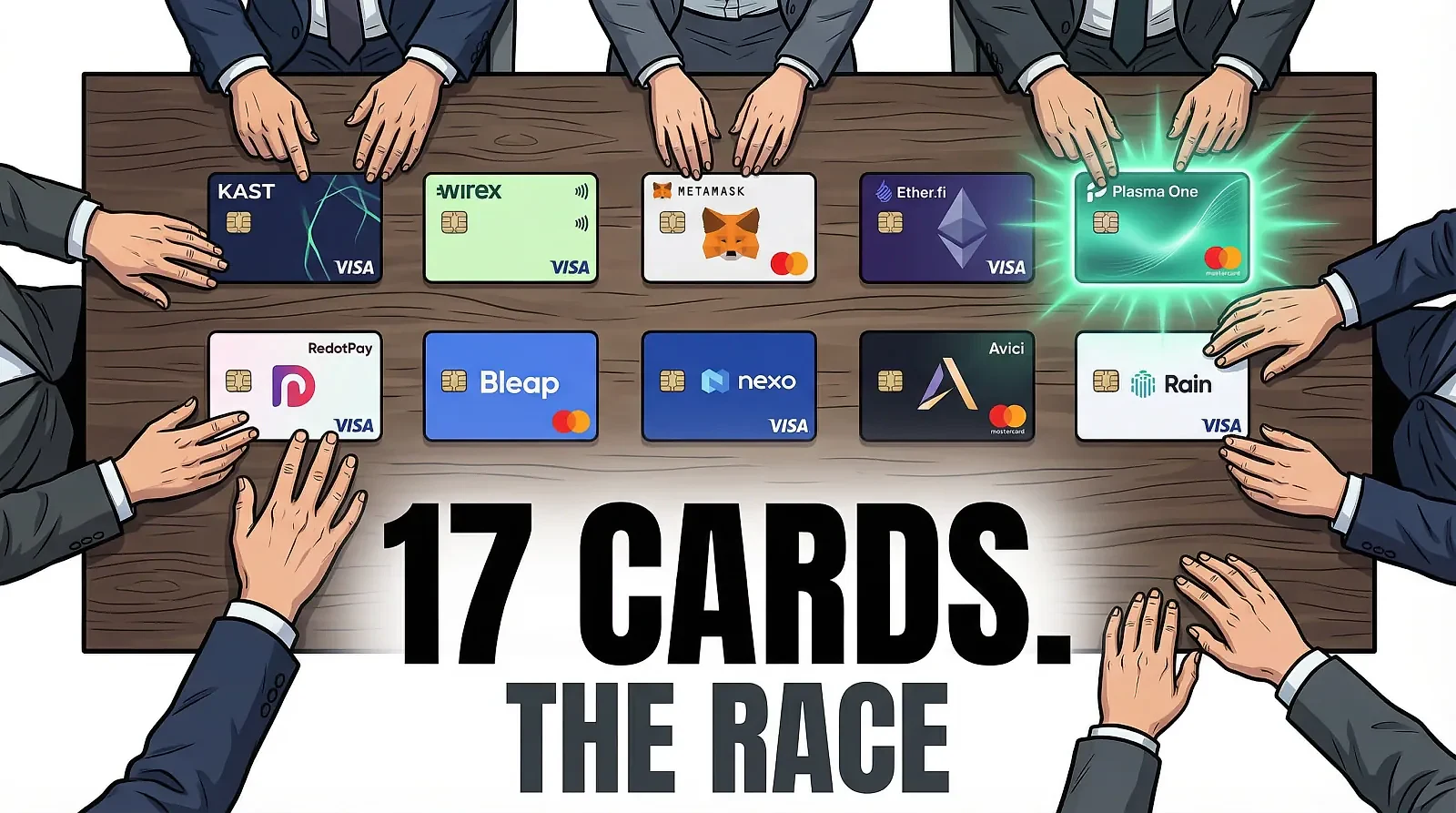
As of April 2026, the stablecoin payment card market has crossed a structural inflection point, with at least 17 products now live or in active rollout across Southeast Asia, the Middle East and North Africa, sub-Saharan Africa, and Europe, and with custody architecture having emerged as the decisive axis of competition. The proliferation is no longer speculative: issuers are shipping physical metal, onboarding millions of users, and embedding into payment networks that collectively settle trillions of dollars annually. [1][2]
Five Models, Not One
The central analytical mistake observers make when surveying this market is treating stablecoin cards as a homogeneous product class. They are not. The April 2026 landscape breaks cleanly into five distinct custody models, each carrying different counterparty risk profiles, regulatory obligations, and user experience trade-offs.
Custodial models, represented by KAST on Solana's Visa network and RedotPay on Visa, hold user stablecoins on-platform before converting at point of sale. RedotPay extended its Visa infrastructure during Q1 2026 to support direct QR payment networks across Southeast Asia, including Vietnam's VietQR system, putting USDC and USDT acceptance directly inside local merchant payment flows without requiring any additional hardware at point of sale. [2]
Non-custodial and self-custodial models represent the market's technical frontier. Ether.fi Cash, operating on the Scroll Layer 2 network, allows users to spend directly from a self-managed wallet position over Visa, eliminating the need to transfer funds to an exchange or custodian before spending. MetaMask, whose parent Consensys launched its Mastercard product via the Linea L2, pushes this further by supporting USDC, USDT, and WETH from a browser-extension or mobile wallet, with on-chain settlement on a network MetaMask controls. Bleap uses multi-party computation (MPC) key management on Mastercard to extend non-custodial principles to users who may not manage raw private keys, supporting USDC and EURC for European market positioning. [1][2]
The BaaS and infrastructure-layer model is perhaps the most strategically consequential. Rain, the card-issuing infrastructure provider, powers both Plasma One and an expanding roster of fintech and crypto products via its Visa BaaS stack. Plasma One, backed by Tether and Peter Thiel's Founders Fund, is currently shipping physical cards in Southeast Asia and the Middle East, denominating spending in USDT on the proprietary Plasma L1 chain. Rain's infrastructure role means that as more stablecoin neobanks reach product-market fit, they are increasingly likely to converge on a small number of underlying issuing partners rather than pursue independent bank sponsorship relationships. [1][2]
Wirex occupies a structurally distinct position as both a custodial card product and a BaaS provider in its own right, having signed an agreement to power Utorg's card program serving approximately 2 million users. Wirex supports over 200 cryptocurrency and fiat pairings across Visa and Mastercard, making it the broadest-coverage product in the current landscape. [1][2]
Finally, credit-line backed cards, led by Nexo on Mastercard, allow users to spend against collateralized crypto holdings rather than liquidating them, offering dual debit and credit functionality. This model is particularly relevant for users with significant long-term stablecoin or crypto positions who prefer not to trigger taxable events on every transaction. [1]
The April 2026 Competitive Map
Card — Network — Custody Model — Key Stablecoins
KAST — Visa — Custodial (Solana) — USDC, USDT
Wirex — Visa/Mastercard — Custodial + BaaS — 200+ crypto/fiat
Ether.fi Cash — Visa — Non-custodial (Scroll L2) — USDC, ETH
MetaMask — Mastercard — Self-custodial (Linea L2) — USDC, USDT, WETH
Rain — Visa — BaaS/infra layer — USDC, USDT
RedotPay — Visa — Custodial — USDC, USDT
Bleap — Mastercard — Non-custodial (MPC) — USDC, EURC
Plasma One — Visa (via Rain) — Non-custodial — USDT (Plasma chain)
Avici — Visa — Self-custodial (Solana) — USDC
Nexo — Mastercard — Custodial (credit line) — Multi
Regional Fault Lines
The geographic distribution of launches is not random. Southeast Asia and MENA share a structural profile that makes them primary targets: large unbanked or underbanked populations, high existing stablecoin trading volumes, significant remittance flows, and, in MENA's case, regulatory environments actively cultivating digital asset licensing. Plasma One's physical card rollout targeting both regions simultaneously reflects a deliberate calculation about where stablecoin-native consumers already exist. RedotPay's QR expansion into Vietnam taps a market where mobile payment infrastructure is mature but dollar-denominated spending alternatives are scarce. [1][2]
Europe presents a different dynamic. Bleap's support for EURC, Circle's euro-pegged stablecoin, signals a bet that the MiCA regulatory framework active since late 2024 will accelerate euro-denominated stablecoin adoption in ways that dollar-only products cannot capture. MetaMask's Mastercard product is also available across European jurisdictions, with Linea's EVM compatibility reducing integration overhead for existing DeFi users who already hold USDC or USDT in wallet form. [1][2]
Africa is the next declared frontier. Wirex has publicly positioned sub-Saharan Africa as a core expansion market, where dollarization pressure and remittance costs create acute demand for USDC-based spending capability outside the traditional banking infrastructure. [1]
The Infrastructure Bottleneck
Beneath the brand-level competition, a consolidation dynamic is forming at the infrastructure layer. Card issuing in regulated markets requires bank sponsorship, BIN sponsorship, network licensing with Visa or Mastercard, and in most jurisdictions an e-money or payments institution license. These requirements create a natural chokepoint. Rain has already positioned itself as the issuing infrastructure of choice for multiple stablecoin card programs, a position with strong network effects: each new program adds data, compliance precedent, and negotiating leverage with card networks.
"Rain's model is less about being a consumer brand and more about being the AWS of stablecoin card issuance," one infrastructure analyst noted in Q1 2026, describing the dynamic as analogous to early cloud computing where brand competition obscured a deeper platform consolidation underneath. [1]
KAST's decision to ship a black metal physical card in April 2026 represents a different strategy: premiumization as a retention mechanism in a market where the underlying stablecoin product is increasingly commoditized. When USDC spending on Visa is available from a dozen providers, the card material, the cashback structure, and the brand become the actual differentiators at the consumer layer. [1]
Where the Market Is Heading
The stablecoin card market in April 2026 is best understood as a layered competitive structure rather than a winner-take-all race. At the infrastructure layer, one or two BaaS providers are likely to consolidate the issuing stack across a large share of branded products. At the custody layer, self-custodial and non-custodial models will continue gaining share as L2 settlement costs fall and user experience improves. At the consumer layer, geographic and demographic segmentation will define winners: MENA and SEA for volume, Europe for regulatory compliance, and Africa for long-term growth.
The question is not whether stablecoins will become a major consumer payment instrument. The product evidence as of April 2026 makes that trajectory clear. The open question is which custody model, which infrastructure layer, and which regional regulatory framework will define the dominant design before the market reaches its next consolidation phase. [1][2]
References
[1] NCN Editorial compilation, April 2026 stablecoin card market digest [2] Brand announcements: KAST, Wirex, Plasma, RedotPay, Nexo, Ether.fi, MetaMask, Bleap, Rain (April 2026)