The Agentic Finance Week: Coinbase, Robinhood, and Alipay Ship AI Wallets in 48 Hours
In 48 hours across May 26 and 27, 2026, three of the world's most important financial platforms shipped production-grade agentic payment products, marking the moment AI-agent commerce moved from research demo to live consumer infrastructure.
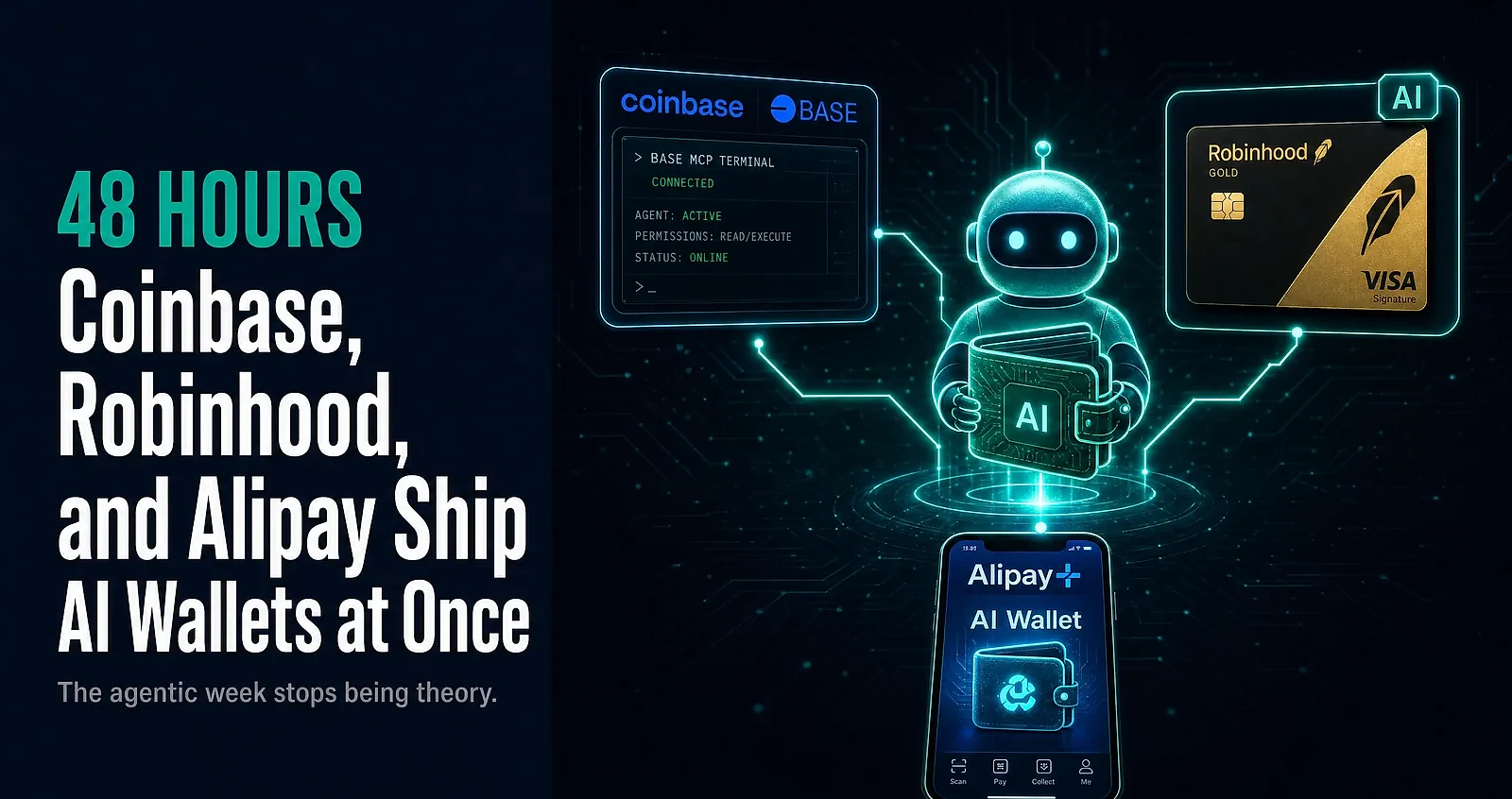
On the morning of May 26, 2026, Alipay unveiled an AI Wallet and Token Pay platform at its AI Payment Ecosystem Conference in China. Less than 24 hours later, Coinbase published its Base MCP server, enabling AI agents to execute DeFi transactions directly through conversational interfaces. On that same day, Robinhood announced two agentic products: a beta trading account controllable by third-party AI agents, and a virtual credit card designed for autonomous purchases. Three companies, three geographies, three completely different technical stacks, and one shared conviction: the time for AI agents to hold and spend money at scale has arrived.
The 48-Hour Convergence
The clustering was not coordinated. Each team had been building toward agentic finance for months, and the releases landed within a single news cycle by coincidence of roadmap timelines. What makes the window notable is precisely that independence. When three major financial platforms, operating under different regulatory regimes, serving different customer bases, and building on incompatible technical architectures, converge on the same product category in 48 hours, it signals a market inflection rather than a trend.
The broader context reinforces that reading. Circle launched its Agent Stack on May 11, 2026, giving developers a composable layer for USDC-denominated agent payments [1]. Stripe unveiled its Model Context Protocol integration at Stripe Sessions 2026, enabling merchants to accept AI-agent-initiated payments through its existing rails [2]. RedotPay and Tempo both shipped MCP-compatible payment products in the same B27 reporting cycle. AWS AgentCore added native x402 support, signaling that hyperscalers are treating the payment protocol as infrastructure rather than experiment [2]. The late-May 48-hour window is the capstone of that sequence, not an isolated event.
Coinbase Base MCP and the x402 Bet
Base MCP is a Model Context Protocol server that connects a user's Base Account on Coinbase's Ethereum layer-2 network to any MCP-compatible AI client, including Claude, ChatGPT, Codex, and Cursor [3]. The architecture is deliberately non-custodial: the MCP server never holds or accesses private keys, and every proposed transaction opens a separate review window in the Base app where the user can inspect expected asset changes before approving or rejecting [3].
At launch, Base MCP ships with skill plugins for Uniswap (token swaps), Morpho and Moonwell (lending markets), Avantis (on-chain perpetuals), Aerodrome, Bankr, and Virtuals [3]. A user can type "swap 100 USDC for ETH on Uniswap" into a Claude session and receive a transaction proposal that resolves inside the Base app on confirmation. Developers can build additional plugins that return unsigned transaction details to Base MCP, keeping final sign-off permanently with the user.
Authentication runs on OAuth 2.1, the same protocol underpinning most modern web login systems [4]. Payments between agent transactions use the x402 protocol, a standard Coinbase originally released in May 2025 and later developed in collaboration with Cloudflare [4]. Under x402, AI assistants pay for API calls and data services using USDC on Base, with transaction costs that can fall below a single cent. Fortune characterized the Base MCP launch as "Coinbase's push to promote x402 adoption," situating it within a broader effort by Coinbase and Stripe to redefine the technical substrate of online commerce [1].
"Unlike siloed agentic wallets that only live in a terminal, your Base Account travels with you, trades, history, and portfolio sync whether you're in-agent or in the Base App." - Coinbase
Lincoln Murr, Head of AI Product at Coinbase, described MCPs as a "nice wrapper" atop APIs that allow a wide variety of data requests without requiring rigid coding constraints, making them the connective tissue between conversational AI and on-chain execution [1]. Agent-based transactions currently total approximately $73 million over the past year according to a Keyrock report, a figure that underscores both the early stage of the market and the distance to the $14.5 trillion Visa processes annually [1].
Robinhood Agentic Trading and the AI Credit Card
Robinhood's May 27 announcement packaged two distinct products under the agentic banner. The first, Robinhood Agentic Trading, is a beta program that allows customers to create a dedicated brokerage account and connect it to a third-party AI agent via Robinhood's proprietary MCP servers [5]. Supported AI clients at launch include ChatGPT, Claude, OpenClaw, and Cursor. The agent can analyze portfolio concentration risk, assess sector exposure, review analyst notes, and execute trades, but only from funds held in that isolated dedicated account [5].
Equities are the only supported asset class at launch. Robinhood has committed to adding options, crypto, futures, event contracts, and prediction markets in subsequent releases, without specifying a timeline for digital assets [5]. Every trade triggers a real-time push notification to the user, and a one-tap kill switch disconnects the agent instantly [5]. Robinhood is explicit that customers bear ultimate accountability for agent actions, noting that AI agents "may make mistakes, misinterpret commands, act on incomplete or outdated data, and exhibit unpredictable behavior" [6].
"Our mission has always been to democratize finance for all, and now, that mission extends to AI agents." - Vlad Tenev, Robinhood CEO [5]
The second product, the Robinhood Agentic Credit Card, is a virtual card number distinct from the primary Gold Card, linked to an AI agent and governed by a user-defined monthly spending cap [7]. Users can require manual approval for every transaction or set an approval threshold so that purchases below a set amount clear automatically. The virtual card earns 3% cash back on all AI-agent-initiated purchases, the same rate as the standard Robinhood Gold Card [7]. It can be deleted at any time. The similar feature for the Platinum Card, a $695-per-year invite-only product launched in March 2026, will follow when the product reaches general availability [7].
Alipay AI Wallet, Token Pay, and the 100M User Base
Alipay's announcement came first chronologically, on May 26 at the company's Alipay AI Payment Ecosystem Conference, and it arrived with the most mature user-base statistics of the three launches. The company's existing AI Pay product had already surpassed 100 million users in February 2026 and recorded 300 million completed transactions before the new products went live [8].
The AI Wallet is a consumer-facing interface embedded inside the standard Alipay app. It lets users monitor agent-initiated tasks before payment, intervene during execution, and review spending logs afterward, a three-stage authorization model that matches the conservative posture of the other two platforms [8]. The Token Pay product targets AI model companies directly, providing infrastructure for subscription billing, token top-ups, and high-frequency microtransactions. MiniMax and Stepfun, two of China's prominent generative AI developers, are live on Token Pay at launch [8].
Ant Group's full-stack AI payment solution claims compatibility with 95% of OpenClaw-type AI agents and integrates with a range of AI systems: Alibaba's Qwen, smart glasses from Rokid, retail mini-programs used by brands including Luckin Coffee, and smart cockpit systems for in-car AI [9]. AI development platforms Coze and Qoder are also listed as integration partners [9]. Alipay and its partners simultaneously launched what they describe as China's first Agentic Commerce Trust Protocol, intended to establish a common standards layer governing interactions between AI systems and commercial platforms [9].
Ant Group CEO Cyril Han framed the initiative in terms of infrastructure continuity rather than speculative novelty:
"While the essence of commerce remains unchanged in the age of AI, the emergence of AI agents is reshaping everything. Drawing on 22 years of technological expertise and commercial know-how, Alipay is building a new generation of AI payment services to accelerate the growth of the agentic commerce ecosystem." - Cyril Han, CEO, Ant Group [9]
Three Stacks, One Idea
The technical architectures could hardly be more different, which makes the convergence all the more meaningful.
Dimension — Coinbase Base MCP — Robinhood Agentic — Alipay AI Wallet + Token Pay
Settlement layer — Non-custodial, on-chain (Base L2) — Custodial brokerage account — Closed-loop Alipay rails
Payment standard — x402 + USDC on Base — Fiat (USD) — Alipay proprietary + Token Pay
AI clients supported — Claude, ChatGPT, Codex, Cursor — Claude, ChatGPT, OpenClaw, Cursor — Qwen, Coze, Rokid, Qoder, OpenClaw-type
Asset classes at launch — Crypto (swap, lend, perps) — Equities (stocks) — Consumer payments + AI subscriptions
User authorization model — Per-txn sign-off in Base app — Push notification + kill switch — Pre/during/post authorization in Alipay app
Key safety feature — MCP server holds no private keys — Isolated dedicated account — Agentic Commerce Trust Protocol
Existing base — 73M in agent txns (Keyrock) — 70M+ Robinhood users — 100M AI Pay users, 300M txns
Geography — US / Global (crypto) — US — China / Global (via Alipay)
All three share the same foundational architecture: the AI agent proposes, the user approves, and the financial institution or protocol executes. None of the three systems give an agent unconditional spending authority. The variance is in where the assets sit, what they can buy, and who the regulatory counterparty is.
The Settlement Asset Question
The three launches also crystallize the open question in agentic commerce: which settlement asset wins? Coinbase is betting on USDC on Base, a dollar-denominated stablecoin on a public blockchain, with x402 as the inter-agent payment protocol. Every sub-cent transaction is composable, programmable, and auditable on-chain. Robinhood routes everything through fiat USD held in custodial brokerage accounts, offering zero crypto exposure but maximum regulatory clarity for its US retail user base. Alipay operates inside a closed-loop yuan-denominated network at a scale neither American company has yet achieved, with Token Pay adding a B2B layer for AI model subscriptions that has no direct counterpart in the Coinbase or Robinhood offerings.
The 2025 to 2026 arc suggests all three models will coexist for some time. Circle's Agent Stack and Stripe's MCP integration sit closer to Coinbase's stablecoin-native approach, while traditional banks and brokerages will likely follow Robinhood's fiat-custodial template. The Chinese market, with Alipay's 1.3 billion-user super-app as its center of gravity, will develop largely on its own trajectory, shaped by Ant Group's infrastructure and domestic regulatory frameworks.
AI Agent Payment Ecosystem: Key Partners by Platform
Platform — AI Agent Integrations — DeFi or Finance Protocols — B2B or Developer Partners
Coinbase Base MCP — Claude, ChatGPT, Codex, Cursor — Uniswap, Morpho, Moonwell, Avantis, Aerodrome — Bankr, Virtuals, Cloudflare (x402)
Robinhood Agentic — Claude, ChatGPT, OpenClaw, Cursor — N/A (equities only at launch) — Robinhood Gold Card, Platinum Card
Alipay AI Wallet — Qwen, Coze, Qoder, Rokid, OpenClaw-type — N/A (closed-loop fiat) — MiniMax, Stepfun, Luckin Coffee
Circle Agent Stack — Universal (USDC rails) — USDC on Base, Ethereum, Solana — Multiple DeFi protocols
Stripe MPP — Claude, GPT-4o, others — N/A (fiat card rails) — Shopify, enterprise merchants
What Production-Grade Agent Commerce Looks Like Now
The 48-hour convergence answers a question that dominated fintech commentary throughout early 2026: when does agentic finance become real? The answer, it turns out, is when three independent platforms, under distinct incentives, ship user-facing products in the same news cycle.
Production-grade does not mean frictionless. Every platform reviewed here layers in explicit human approval at the transaction level. Robinhood isolates agent funds in a separate account. Coinbase confirms that nothing happens on-chain without user sign-off. Alipay wraps the AI Wallet in a three-stage authorization flow. The safety architecture is conservative by design, because the user trust required for autonomous financial agents does not yet exist at scale, and each platform is trying to build that trust incrementally.
What the week confirmed is that the infrastructure is no longer experimental. The agent-to-payment pipeline now runs across a non-custodial crypto protocol, a major US retail brokerage, and the world's largest super-app payments network. The settlement assets differ. The geographies differ. The regulatory environments differ. The underlying product, however, is the same: a defined financial identity for an AI agent, with human-set policy governing every dollar it touches.
The $73 million in total agent-based transactions recorded over the past year [1] will look small in retrospect. The infrastructure to move that figure by orders of magnitude is now in place.
References
[1] Fortune, "Coinbase pushes further into AI payments with new MCP for Base network," May 26, 2026. https://fortune.com/2026/05/26/coinbase-pushes-further-into-ai-payments-with-new-mcp-for-base-network/
[2] The Paypers, "Coinbase launches Base MCP tool for AI-driven crypto transactions," May 27, 2026. https://thepaypers.com/crypto-web3-and-cbdc/news/coinbase-launches-base-mcp-tool-for-ai-driven-crypto-transactions
[3] crypto.news, "Coinbase's Base gives AI agents new crypto wallet powers," May 27, 2026. https://crypto.news/coinbases-base-gives-ai-agents-new-crypto-wallet-powers/
[4] CryptoBriefing, "Base MCP skill enables AI agents to manage wallets and tokens on-chain," May 27, 2026. https://cryptobriefing.com/base-mcp-ai-agents-wallets-tokens/
[5] CryptoBriefing, "Robinhood enables AI chatbots for share trading, with crypto next in line," May 27, 2026. https://cryptobriefing.com/robinhood-ai-chatbots-share-trading/
[6] Investopedia, "AI Is Reaching Deeper Into Your Pockets: Robinhood Now Lets Your Agents Trade Stocks," May 27, 2026. https://www.investopedia.com/the-future-of-finance-looks-agentic-what-robinhood-s-latest-offerings-enable-ai-to-do-11984907
[7] The Next Web, "Robinhood lets AI agents trade stocks and use credit cards," May 27, 2026. https://thenextweb.com/news/robinhood-is-letting-ai-agents-trade-stocks-and-spend-money-on-your-credit-card
[8] TechNode, "Alipay launches AI payment solution, AI wallet, Token Pay services as AI commerce expands," May 26, 2026. https://technode.global/2026/05/26/alipay-launches-ai-payment-solution-ai-wallet-token-pay-services-as-ai-commerce-expands/
[9] CFOTech Asia, "Alipay launches AI Wallet and Token Pay for agentic commerce," May 27, 2026. https://cfotech.asia/story/alipay-launches-ai-wallet-token-pay-for-agentic-commerce