Tether Seeks $15-20B at $500B Valuation as KPMG Audit and 116-Tonne Gold Position Signal Empire Ambitions
Tether is in advanced talks to raise $15-20 billion at a reported $500 billion valuation, with a 14-day investor deadline expiring in mid-April 2026, as the company simultaneously discloses it holds 116 tonnes of physical gold and brings a Big Four auditor to verify its $185 billion reserve base.
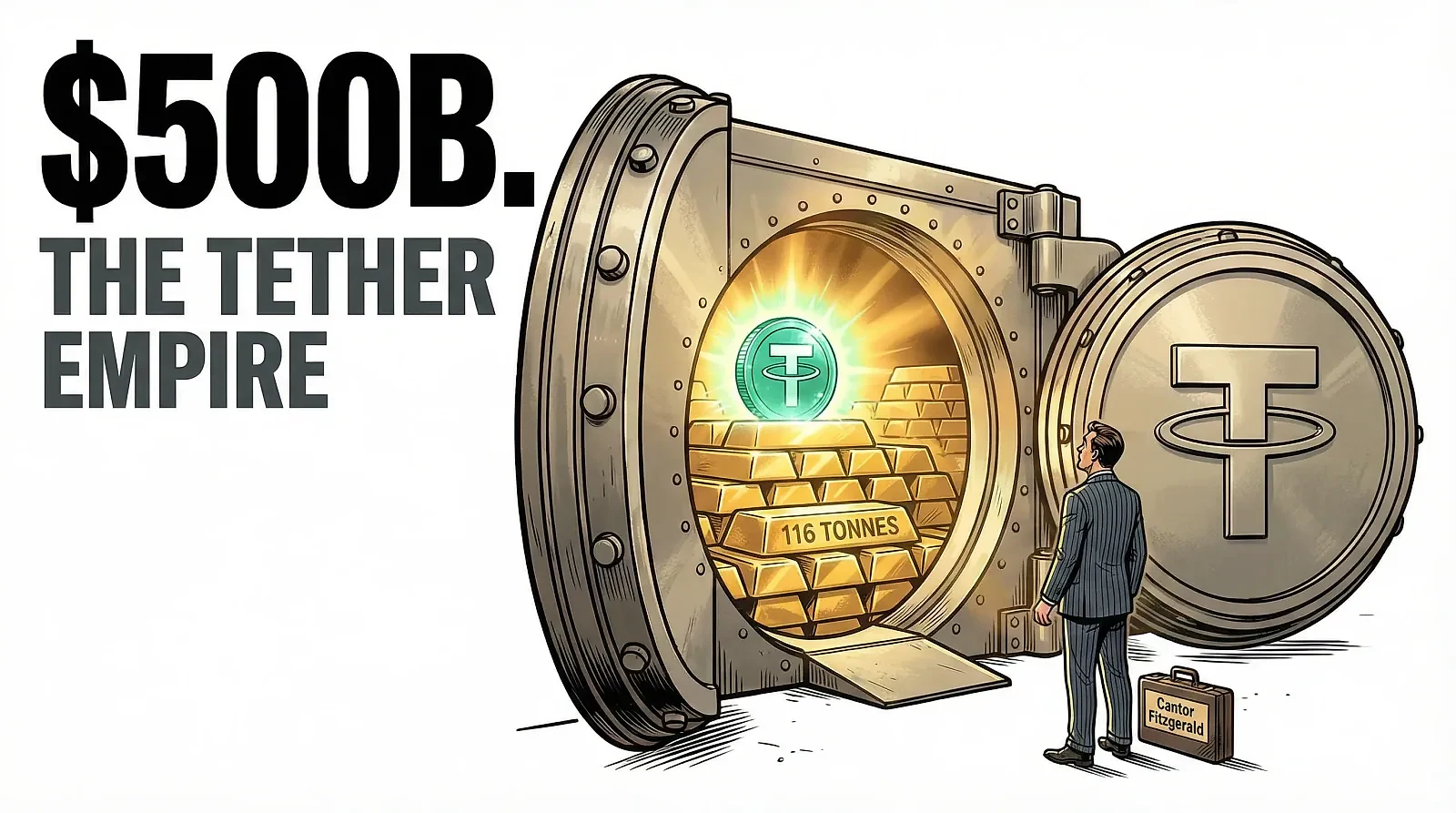
Tether, the issuer of the world's largest stablecoin USDT, is conducting a fundraising round targeting $15 to $20 billion at a reported $500 billion valuation, advised by Cantor Fitzgerald, with a 14-day investor deadline that opened in early April 2026 and closes in mid-April. The company has simultaneously revealed a 116-tonne physical gold position and commissioned a KPMG audit of its $185 billion in reserves, laying the groundwork for what executives describe as a diversified financial infrastructure group spanning artificial intelligence, energy, media, and commodity trading.[1]
Fundraising Round: Scale and Strategy
The fundraising mandate, managed by Cantor Fitzgerald, positions Tether among the most ambitiously valued private companies in the financial technology sector. The $500 billion headline figure reflects not just USDT's dominant stablecoin position but the cumulative valuation of several parallel businesses the company has built since its founding. Proceeds from the raise are earmarked across four growth verticals: QVAC, Tether's artificial intelligence division; an energy business; a media portfolio; and a commodity trading operation.[1]
The 14-day window imposed on prospective investors is unusual for a raise of this magnitude and signals confidence from Tether's leadership that demand will absorb the offering without extended roadshow activity. Cantor Fitzgerald's involvement carries particular weight given the firm's existing relationship with Tether through US Treasury holdings that underpin a portion of the reserve base.[1]
Gold: The World's Largest Non-Sovereign Holder
A Jefferies research note published ahead of mid-April details that Tether holds 116 tonnes of physical gold, a position that places the company ahead of all private institutions and behind only national central banks in outright bullion ownership. The accumulation has been aggressive: Tether's purchases in the most recent quarter equalled approximately 12% of total global central bank gold buying for the same period, and the company is reportedly on track to acquire another 100 tonnes through the remainder of 2026.[1]
The gold strategy serves dual purposes. It provides reserve diversification for the XAUT tokenized gold product, which listed on BNB Chain in March 2026 after gold surged 64% in 2025, its largest annual gain in four decades.[2] It also positions Tether as a commodity-backed institution at a time when sovereign reserve managers globally are accelerating allocations away from fiat instruments.
KPMG Audit: Big Four Scrutiny Arrives
In March 2026, Tether confirmed it had engaged a Big Four accounting firm to conduct what would be the most rigorous independent review of its reserves in the company's history.[3] The firm was subsequently identified as KPMG, tasked with auditing $185 billion in assets. The announcement follows years of pressure from regulators and institutional investors who questioned whether Tether's quarterly attestations provided sufficient transparency.
"Tether's mission has always been to build trust through action, not promises. Trust is built when institutions are willing to open themselves fully to scrutiny."
- Paolo Ardoino, CEO, Tether
Tether's CFO Simon McWilliams noted that the Big Four firm was selected through a competitive process and that the organization was already operating at audit-grade standards before the engagement began.[3] The audit's scope covers USDT's $184-185 billion reserve base, which includes US Treasuries, repo agreements, and the expanding gold position.
USDT Market Cap: On Course to Surpass Bitcoin and Ethereum
Bloomberg Intelligence analyst Mike McGlone has issued one of the more striking macro calls on the stablecoin sector, arguing that USDT's trajectory places it in direct competition with the two largest digital assets by market capitalization.
"USDT is on a path to surpass both Bitcoin and Ethereum," McGlone wrote, citing what he termed a stability premium that becomes increasingly attractive to institutional allocators during periods of elevated macro uncertainty.
At a $184 billion market cap with 570 million users and a 56.7% share of the global stablecoin market, USDT's scale is already comparable to mid-tier sovereign debt markets. The January 2026 launch of USAT, a US-regulated stablecoin issued through Anchorage Digital Bank, adds a compliant domestic variant that addresses the primary concern of US institutional adopters who could not hold a Cayman-structured instrument.[1]
tether.wallet and QVAC: Direct-to-Consumer and AI Pivots
April 14, 2026 also marked the launch of tether.wallet, Tether's first direct consumer product: a self-custodial digital wallet designed to bring USDT and related products into the hands of the estimated billions of users the company describes as underserved by traditional financial infrastructure.[2] The wallet represents a strategic shift from Tether's historical role as a wholesale infrastructure provider toward retail distribution.
Five days earlier, on April 9, Tether's QVAC division released the QVAC SDK, an open-source cross-platform toolkit designed as a universal AI building block capable of running, training, and evolving machine intelligence across any device without cloud dependency.[2] The anti-cloud positioning differentiates QVAC from major AI infrastructure providers and aligns with Tether's consistent preference for decentralized, sovereign-grade technology stacks.
Tether's Expanding Empire: April 2026 Snapshot
Division — Status — Scale
USDT Stablecoin — Live — $184B market cap, 570M users, 56.7% market share
USAT (US-regulated) — Live (Jan 2026) — Via Anchorage Digital Bank
tether.wallet — Live (Apr 14, 2026) — First direct consumer product
Physical Gold (XAUT) — Active — 116 tonnes, largest non-central-bank holder
KPMG Audit — Underway — $185B reserves
QVAC (AI) — SDK launched Apr 9, 2026 — Local AI, open-source, anti-cloud
Hadron (Tokenization) — Live — RWA platform, integrated with Plasma
Funding Round — In progress — $15-20B at $500B reported valuation
Context: From Stablecoin to Financial Conglomerate
The convergence of these disclosures in a single week reflects a deliberate communications strategy ahead of the fundraising close. Investors evaluating a $500 billion valuation are being presented simultaneously with a KPMG imprimatur, a gold stockpile that rivals sovereign treasuries, a new consumer product with immediate distribution to 570 million existing users, and an AI toolkit with open-source credibility. Each element addresses a different category of institutional concern: audit quality, reserve asset diversification, revenue diversification, and technology optionality.
The 14-day fundraising window, the simultaneous wallet and QVAC SDK launches on April 14, and the Jefferies gold disclosure all point to a coordinated inflection moment for a company that began as a narrow dollar-pegging mechanism and has since expanded into one of the most structurally complex entities in the digital asset sector.[1][2][3]
References
[1] WEEX (April 14, 2026): https://www.weex.com/news/detail/tether-ceo-hints-at-a-major-announcement-650275 [2] Tether Official News (April 2026): https://tether.io/news/ [3] Fortune (March 24, 2026): https://fortune.com/2026/03/24/tether-announces-it-has-brought-on-a-big-four-firm/