Tether Q2 2026: $1.5B Profit but Reserve Buffer Halves to $4.11B on Gold and Bitcoin Losses
Tether's BDO-prepared Q2 attestation reported $1.5 billion in net operating profit and a fully backed USDT reserve base, but its excess-reserve buffer fell from $8.23 billion to $4.11 billion as gold and bitcoin prices moved lower. The contrast puts renewed focus on the asset mix behind the world's largest stablecoin.
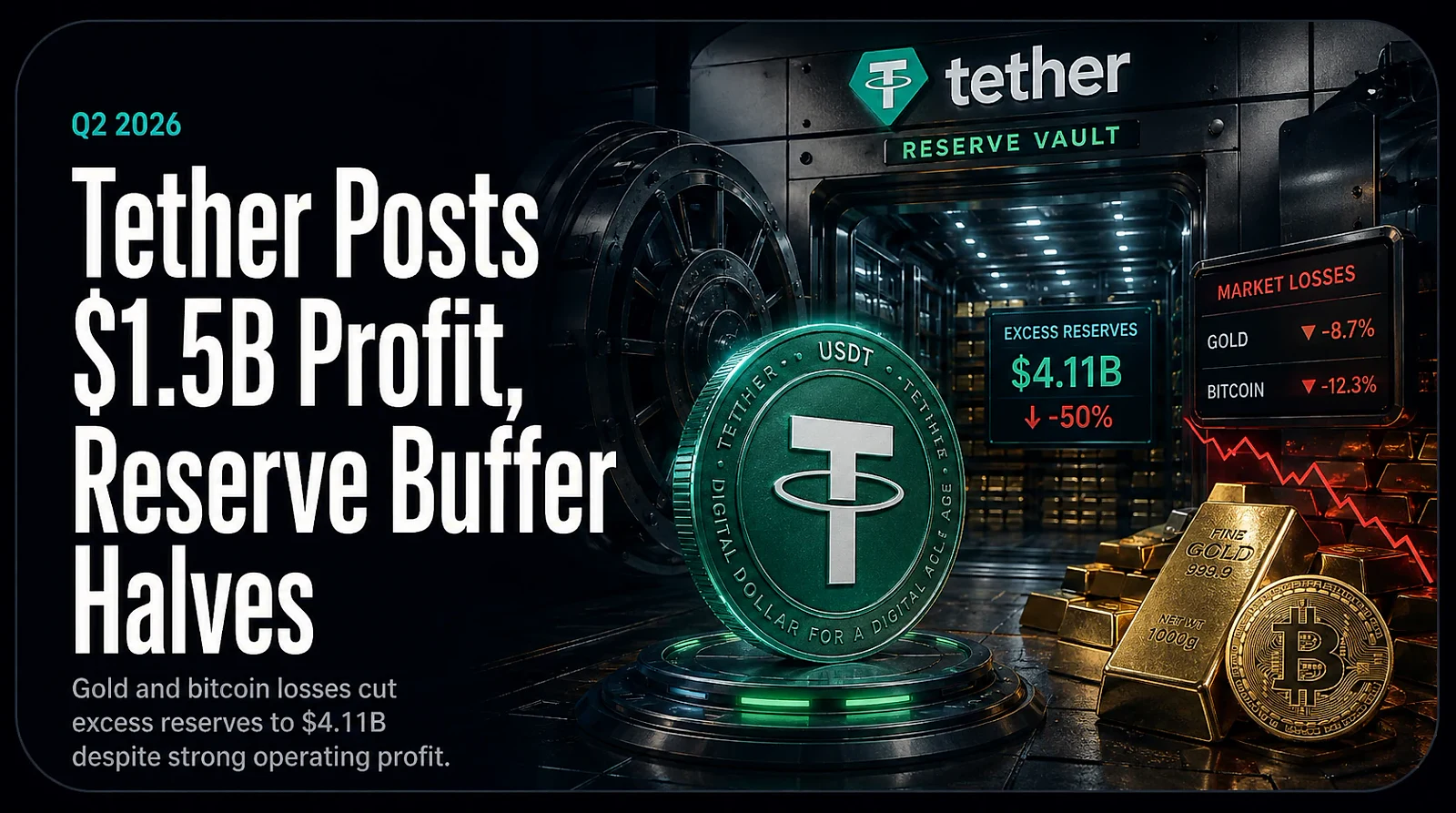
Tether reported $1.5 billion in net operating profit for the second quarter of 2026, but the BDO-prepared attestation released July 31 carried a more consequential balance-sheet signal: its excess reserve buffer fell to $4.11 billion, down from $8.23 billion at the end of March. The issuer said USDT remained fully backed, with $187.75 billion of assets against $183.64 billion of liabilities as of June 30, yet the speed of the cushion's decline shows the cost of holding assets that move with gold and bitcoin markets.[1][2]
USDT issuance was roughly flat over the quarter at about $184.6 billion, after a $446 million increase, and Tether retained more than 60% of the stablecoin market. The operational franchise still produced substantial income from its Treasury and repurchase-agreement portfolio. The question raised by the attestation is not whether USDT was backed on the reporting date, it was, but how much market volatility its surplus capital can absorb before that margin becomes uncomfortably narrow.[1][2]
A Profitable Quarter With a Smaller Shock Absorber
Excess reserves are the assets that remain after an issuer covers all reported liabilities, including tokens in circulation. They are a balance-sheet cushion, not the core one-for-one reserve claim. Tether reported an exact $4,109,529,196 excess of assets over liabilities on June 30. That still represents a positive surplus, so the report does not show a solvency gap or a failure to meet token liabilities.[1]
The comparison with March is nevertheless striking. The cushion contracted by $4.12 billion, almost exactly half, even while the company generated $1.5 billion in operating profit. Operating profit describes the yield generated by the reserve business, principally Treasuries and repo. It does not erase fair-value declines in investments held alongside those income-producing assets. In a stablecoin model, that distinction matters because redemptions are a liquidity promise while the corporate buffer is the first layer that absorbs market losses.[1][2]
“Q2 demonstrated the strength of Tether’s reserve strategy under real market pressure. The assets that back some of Tether’s reserves were tested directly during the quarter. Through all of the volatility, USD₮ remained fully backed with our reserves still exceeding liabilities by $4.11 billion.”
Paolo Ardoino, CEO of Tether[1]
Gold and Bitcoin Made the Difference
Tether added assets during the quarter, including 14 metric tons of physical gold and roughly 1,796 bitcoin. The additions raised its gold holdings to about 146.2 metric tons and bitcoin holdings to 98,933 BTC. But both positions were marked at lower prices at quarter-end. CoinDesk reported that the value of the gold position fell to $18.84 billion from $19.84 billion as gold dropped about 15%, while the reported bitcoin position fell to $5.80 billion from $6.62 billion as the valuation price declined to roughly $58,600 from $68,200.[2]
Reserve and USDT metric — Q1 2026 — Q2 2026 — Quarter-on-quarter change
Excess reserve buffer — $8.23B — $4.11B — -$4.12B, about -50%
Gold holdings — 132.2 tonnes — 146.2 tonnes — +14.0 tonnes
Reported gold value — $19.84B — $18.84B — -$1.00B
Bitcoin holdings — 97,137 BTC — 98,933 BTC — +1,796 BTC
Reported bitcoin value — $6.62B — $5.80B — -$0.82B
USDT issued — About $184.15B — About $184.60B — +$0.446B
The larger unit holdings but lower dollar values show why supply growth is not the main story. Tether also reduced secured-lending exposure by $2.38 billion, or 15%, but the reported buffer still narrowed as non-Treasury positions repriced. The Treasury and repo book delivered the quarter's operating profit, while the non-core allocation made the cushion more sensitive to market prices.[1][2]
Fully Backed Is Not the Same as Unexposed
The reported asset-liability figures are important. Total assets of $187.75 billion exceeded total liabilities of $183.64 billion, including $183.62 billion related to digital tokens. Tether retained a surplus above its reported obligations, and its release said the reserves were centered on short-duration, high-quality liquid assets. On those disclosed figures, there is no evidence in the Q2 attestation of undercollateralization.[1]
Still, the margin is now much thinner than in Q1. At $4.11 billion, the buffer equaled about 2.2% of reported liabilities, versus about 4.5% three months earlier. A holder's claim can remain fully reserved while the issuer's capacity to withstand another move in non-core assets decreases. That makes the size, valuation treatment, liquidity and disclosure of such positions central governance questions.
The Reserve-Design Divide
The contrast with Circle makes the policy choice clearer. Circle says USDC is backed 100% by highly liquid cash and cash-equivalent assets held separately from operating funds. Its disclosed framework centers on the BlackRock-managed Circle Reserve Fund, a registered government money market fund that can hold cash, short-dated US Treasuries and overnight Treasury repo, with the remainder held as cash at major banks. Circle also says it provides weekly reserve disclosures and monthly third-party assurance.[3]
This is not a claim that Tether is insolvent. It shows two designs: a cash, Treasury and government-money-market-fund model seeks to minimize valuation volatility, while Tether's more diversified structure can generate income but leaves the surplus more exposed to price moves outside Treasuries.
That is why the Q2 report belongs in the broader governance debate rather than a simple profit story. BIS Paper No. 170 warns that widespread stablecoin use can have major international monetary and financial effects, particularly in emerging and developing economies, and says outcomes will depend partly on regulatory responses.[4] In the United States, the CLARITY Act remains a market-structure proposal in Congress, with stablecoins excluded from its definition of digital commodities, underscoring that reserve design and issuer oversight remain a distinct policy question.[5]
USDT's disclosed reserves were above liabilities at quarter-end, the operating business remained highly profitable and market share held. But the buffer's halving gives users, counterparties and policymakers a number to watch next quarter: how the issuer's margin behaves when non-Treasury assets move against it.[1][2]
References
[1] Tether, "Tether Posts Strong Q2 Performance, Generates $1.5B Net Operating Profit, Maintains $4.11B Reserve Buffer, and Expands Gold Holdings to More Than 146 Tons," July 31, 2026. https://tether.io/news/tether-posts-strong-q2-performance-generates-1-5b-net-operating-profit-maintains-4-11b-reserve-buffer-and-expands-gold-holdings-to-more-than-146-tons/
[2] CoinDesk, "Tether clears $1.5 billion in profit as its safety cushion shrinks by half," July 31, 2026. https://www.coindesk.com/business/2026/07/31/tether-posts-usd1-5-billion-operating-profit-in-q2-as-reserve-buffer-falls-by-half
[3] Circle, "Transparency & stability," accessed August 11, 2026. https://www.circle.com/transparency
[4] Bank for International Settlements, "The impact of stablecoins on the international monetary and financial system, BIS Papers No 170," May 5, 2026. https://www.bis.org/publ/bppdf/bispap170.htm
[5] U.S. Congress, "H.R. 3633, Digital Asset Market Clarity Act of 2025," accessed August 11, 2026. https://www.congress.gov/bill/119th-congress/house-bill/3633/text