Tether Launches QVAC SDK to Run AI Locally on Any Device Without Cloud Dependency
Tether's QVAC team released an open-source SDK on April 9, 2026, enabling developers to build and deploy AI applications across iOS, Android, Windows, macOS, and Linux using a single codebase, with no reliance on centralized cloud infrastructure.
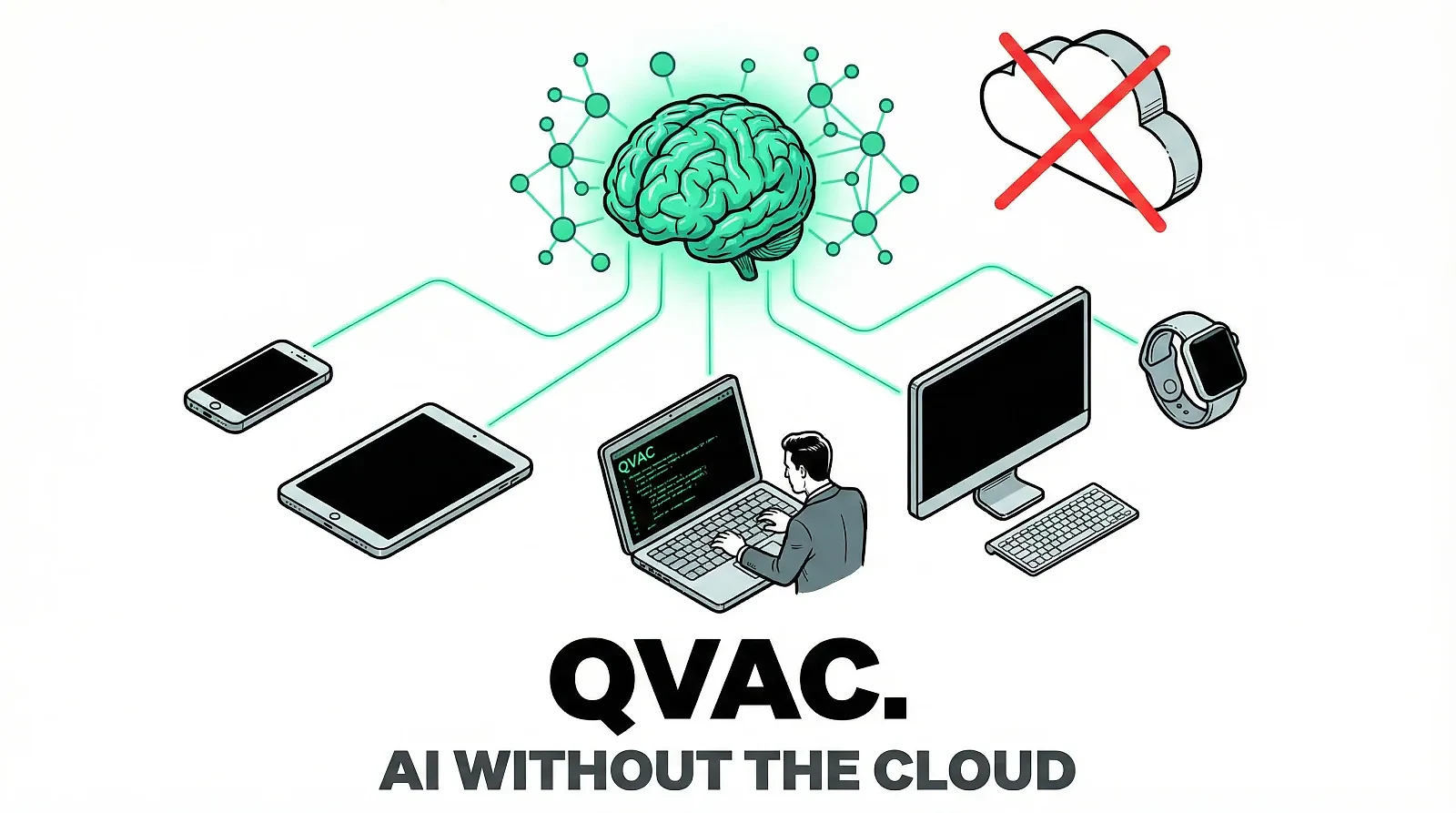
On April 9, 2026, Tether unveiled the QVAC SDK, a fully open-source cross-platform software development kit designed to run artificial intelligence directly on consumer hardware, from smartphones to industrial servers, without routing data through remote cloud services. The release marks the first public developer entry point into QVAC, Tether's local-first, peer-to-peer AI ecosystem, and positions the stablecoin issuer as a direct challenger to cloud-dependent AI platforms.
A Single Codebase Across Every Major Platform
The central engineering claim behind QVAC SDK is platform universality. Applications built with the toolkit run unchanged across iOS, Android, Windows, macOS, and Linux, using a unified JavaScript and TypeScript interface that abstracts away the complexity of platform-specific runtimes. Tether says developers write against one consistent API surface and ship to every environment without conditional branches or rewrites. Support for Swift, Kotlin, and Python SDKs is already on the roadmap.
At the inference layer sits QVAC Fabric, a fork of the open-source llama.cpp engine that Tether has extended to cover a broader set of modalities. Fabric handles text generation, embeddings, and multimodal workloads. The SDK bundles additional specialized engines alongside it: whisper.cpp and Parakeet cover speech-to-text, while Bergamot provides on-device neural machine translation. All engines are exposed through the same API, so developers can combine or swap capabilities without rewriting application logic [1].
The full capability set the SDK ships with today includes text completion, embeddings, vision, optical character recognition, text-to-speech, speech-to-text, translation, and retrieval-augmented generation. Every capability is implemented as a plugin, meaning developers can introduce new engines or model families without waiting for official SDK updates [2].
QVAC Fabric: Capabilities at Launch
Feature — Detail
Platform Support — iOS, Android, Windows, macOS, Linux
AI Engine — QVAC Fabric (llama.cpp fork)
Speech Engines — whisper.cpp, Parakeet
Translation Engine — Bergamot (NMT)
Capabilities — Text generation, speech, translation, image recognition, OCR, RAG
Distribution — P2P via Holepunch stack
Cloud Required — No
License — Open-source
Roadmap — Federated training, robotics, brain-computer interfaces
Peer-to-Peer Distribution and Delegated Inference
Beyond local execution, the SDK integrates peer-to-peer functionality through the Holepunch protocol stack, eliminating dependence on centralized model distribution servers. One device can act as an inference provider while another connects as a thin client in a fully peer-to-peer configuration, a pattern Tether calls delegated inference. This capability was first demonstrated in QVAC Workbench, launched in October 2025, and is now baked directly into the SDK.
Tether has already demonstrated the commercial potential of this architecture. At the Plan B conference in El Salvador, the team integrated WDK crypto payments into a coffee demo, combining local AI, peer-to-peer infrastructure, and digital payments in a single consumer experience. Near-term roadmap items include peer-to-peer swarms for decentralized training and fine-tuning, with longer-horizon targets covering robotics and brain-computer interfaces [1][2].
"The world is approaching a moment where billions of humans share the planet with billions of autonomous machines and trillions of AI agents. The current model, routing every decision through a centralized server, won't scale to meet that reality. The laws of physics alone make centralized AI a dead end: speed-of-light latency, single points of failure, and concentration of control are features of a system designed for a smaller world. QVAC is built for the world that's coming." - Paolo Ardoino, CEO of Tether [2]
Validated Before Launch
Tether did not ship QVAC SDK without prior stress testing. Several months before the April announcement, the team ran a fully remote 48-hour hackathon with approximately 40 participants. The results went beyond proof-of-concept: teams shipped projects including AI-assisted vision tools for visually impaired users and natural-language home automation systems capable of controlling entire physical environments. The hackathon gave Tether early signal that developers were ready to build serious applications on the stack, not just experiment with its philosophy [1].
The research program running in parallel has also yielded concrete outputs. Tether released QVAC Genesis II, a large synthetic educational dataset, in late 2025, and shipped BitNet support for QVAC Fabric, a quantization technique that improves inference efficiency on consumer-grade hardware. Both moves reflect the company's stated dual objective: improve the developer experience while simultaneously advancing what is technically possible at the edge of the network [3].
Part of Tether's Broader Diversification
The QVAC SDK launch fits a deliberate pattern of expansion beyond stablecoin issuance. Tether has signaled plans to raise between $15 billion and $20 billion to fund positions across AI, energy, media, and commodities. The company was separately reported to be in discussions to lead a 1 billion euro funding round in Neura Robotics, a deal that would tie directly into QVAC's robotics roadmap [3].
QVAC Health, a separate product in the ecosystem, demonstrates what local AI looks like in a privacy-sensitive consumer context. The application processes personal health records and wearable data entirely on-device, connecting to fitness trackers over Bluetooth Low Energy so that sensitive medical information never transits a cloud server before becoming useful to the user.
Tether frames the SDK not as another AI framework entering a crowded market but as infrastructure for a different model of ownership. The company draws an explicit parallel to Bitcoin's contribution to financial self-custody, arguing that QVAC does for intelligence what Bitcoin did for money: makes it possible to hold it yourself, without asking anyone's permission. The official blog post by Marco Chiappetta, published on launch day, puts it plainly: not rented intelligence, but owned intelligence [1].
Developers can access the SDK and documentation at qvac.tether.io.
References
[1] QVAC Official Blog - "The Future of AI Is Local": https://qvac.tether.io/blog/the-future-of-ai-is-local/ [2] Tether.io Press Release - QVAC SDK Launch: https://tether.io/news/tether-launches-qvac-sdk/ [3] Crypto Briefing - "Tether launches QVAC SDK for local AI across phones and desktops": https://cryptobriefing.com/tether-qvac-sdk-local-ai/