Tether Backs LemFi to Push USDT Into 30-Country Remittance Corridors
Tether has made a strategic investment in LemFi, the diaspora-focused remittance platform serving 1 million users across 30 countries, to replace SWIFT settlement with near-instant USDT transfers across Africa and Asia corridors.
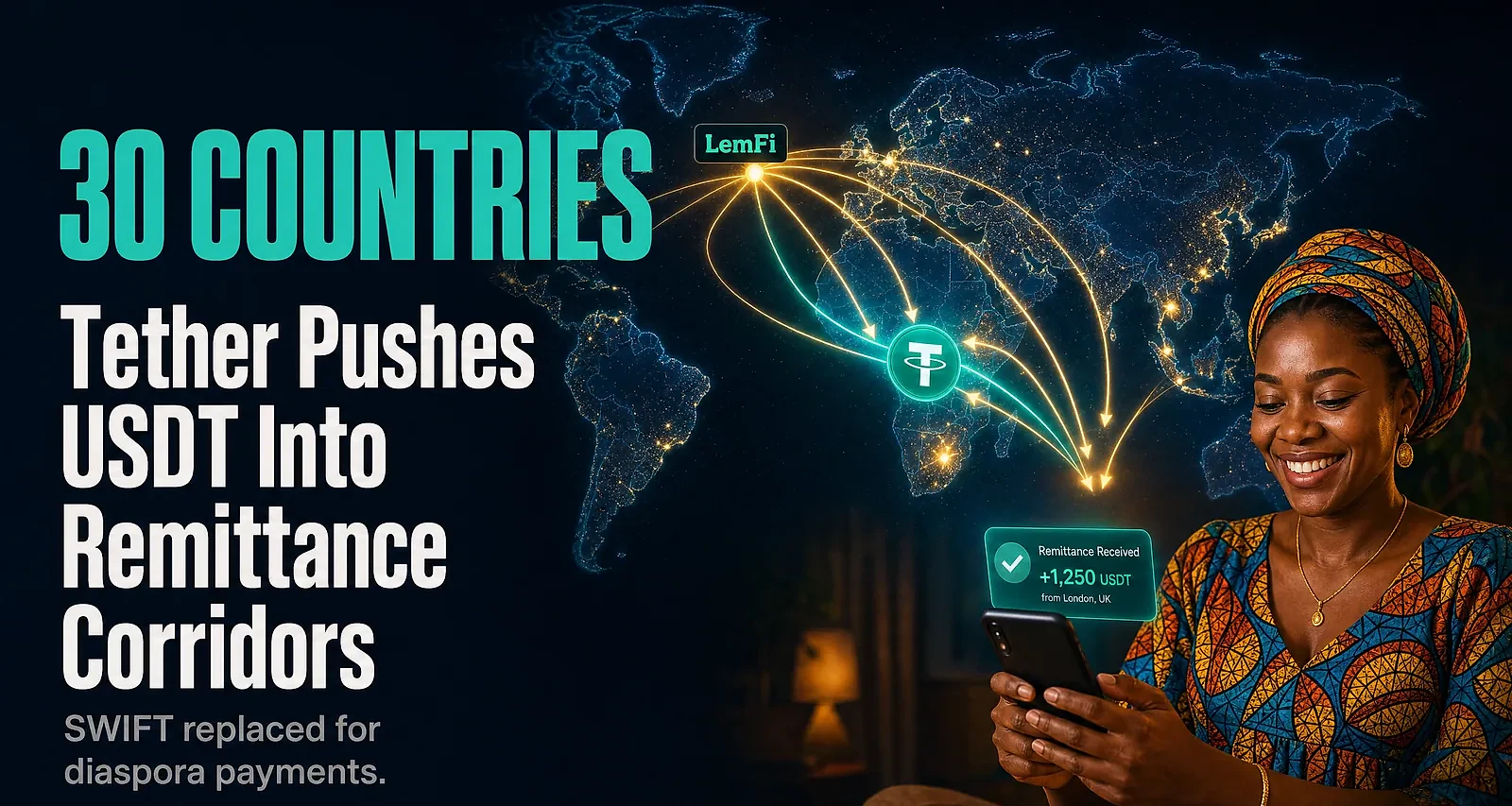
Tether, the issuer of the world's largest stablecoin by market capitalization, announced on May 18, 2026 that it has made a strategic investment in LemFi (Lemonade Finance), a cross-border remittance platform serving diaspora communities across 30 countries, with plans to embed USDT directly into LemFi's settlement infrastructure and displace traditional SWIFT-based transfer rails.[1]
USDT as the New Settlement Layer
The mechanics of the deal center on replacing multi-day correspondent banking chains with near-instant stablecoin settlement. LemFi's primary corridors run from the UK, US, Canada, and Europe to recipient communities in Africa and Asia, precisely the routes where SWIFT's latency and layered fees impose the highest cost burden on migrant workers. Under the new arrangement, USDT will serve as the underlying settlement asset across those corridors, with integration progressively extending to the full breadth of LemFi's product suite.[1][2]
Conventional wire transfers through correspondent banking networks typically settle in two to five business days and carry fees that absorb a meaningful share of each remittance. The World Bank estimates the global average cost of sending $200 stood at 6.4 percent in 2023, a figure that runs materially higher on certain Africa-bound corridors.[3] Stablecoin settlement, by contrast, can clear in seconds at a fraction of that cost, and the Tether-LemFi partnership is structured to pass those savings directly to end users.
"Our investment in LemFi reflects our shared vision on how money moves across borders, prioritizing speed, cost, and transparency. By supporting LemFi's growth and innovation roadmap, we are helping bring the benefits of a stable digital asset to more people who rely on remittances in their daily lives." - Paolo Ardoino, CEO, Tether[1]
LemFi's Scale and Funding History
Founded in 2020 by CEO and co-founder Ridwan Olalere, LemFi has grown from a Nigeria-focused money transfer app into a multi-corridor platform with over 1 million customers and more than $1 billion in monthly transaction volume.[4] The company has raised a total of $85 million across funding rounds, including a $33 million Series A led by Left Lane Capital in 2023. Highland Europe joined as an investor in October 2024. The Tether investment is undisclosed in size but is described as strategic, carrying board-level alignment on product direction.[2][4]
Olalere built LemFi on the conviction that remittance corridors in Africa and Asia share a common set of structural problems: compliance friction, slow settlement, and high correspondent banking fees. "The challenges Africans face in terms of sending money and compliance issues are strikingly similar to those faced by people from other emerging markets," he told TechCrunch in 2024. The Tether partnership is a direct extension of that thesis, substituting a blockchain settlement layer for legacy correspondent networks across all of LemFi's active markets.
Metric — Detail
Countries served — 30
Registered users — 1 million+
Monthly transaction volume — $1 billion+
Total funding raised — $85 million
Series A (2023) — $33 million, led by Left Lane Capital
Highland Europe investment — October 2024
Settlement layer post-integration — USDT (Tether)
SWIFT average settlement time — 2-5 business days
USDT settlement time — Near-instant
Tether's Expanding Payments Strategy
The LemFi investment is the latest move in a deliberate effort by Tether to position USDT as infrastructure rather than simply a trading asset. Paolo Ardoino has described the company's broader ambition as bridging traditional finance and digital assets in markets where banking access is constrained. LemFi fits that mandate precisely: the platform operates at the intersection of regulated money transfer services and underbanked populations across Sub-Saharan Africa and South and Southeast Asia.[1][2]
The competitive landscape Tether is entering through LemFi is crowded and well-capitalized. Wise completed its Nasdaq listing and built its business on transparent, low-fee cross-border transfers serving many of the same diaspora corridors. Western Union and MoneyGram retain massive agent networks across Africa and Asia, though both have faced structural margin pressure as digital alternatives gained share. Airwallex and Stripe have each moved to embed stablecoin settlement into business payment flows: Stripe announced stablecoin payouts across 160 countries in 2025, while Yellow Card partnered with Mastercard to extend stablecoin access across Europe, the Middle East, and Africa.[2]
What distinguishes Tether's approach is that it is not building a consumer-facing remittance product. Instead, it is acquiring equity stakes in regulated platforms that already have the compliance infrastructure, customer relationships, and regulatory licenses required to operate in these markets. LemFi brings all three, along with a customer base that depends on remittances as a primary household income source.
Settlement Method — Typical Speed — Estimated Cost (per $200 sent) — Infrastructure
SWIFT correspondent banking — 2-5 business days — 6-10% — Bank network
Wise (OFX model) — 1-2 business days — 0.5-1.5% — Local account network
Western Union / MoneyGram — Minutes to 1 day — 4-7% — Agent network + bank rails
USDT via LemFi (post-integration) — Near-instant — Sub-1% (target) — Tether blockchain settlement
Regulatory Context and the GENIUS Act
The announcement coincides with an active legislative moment for stablecoins in the United States. The GENIUS Act, which would establish a federal licensing framework for stablecoin issuers, has advanced through committee debate in 2026. A clearer regulatory perimeter for dollar-pegged stablecoins in the US would materially reduce compliance uncertainty for platforms like LemFi operating across multiple jurisdictions and using USDT as a core settlement asset. Tether's investment signals confidence that regulatory clarity is approaching, and that USDT's role in cross-border payments infrastructure is durable rather than transitional.[2]
Meta's integration of USDC for creator payouts and Stripe's stablecoin payout infrastructure each demonstrated that dollar-denominated digital assets can be embedded into consumer-facing financial products at scale. The LemFi partnership extends that pattern into one of the highest-need use cases globally: the roughly $700 billion in annual remittance flows that connect migrant workers with families in emerging markets.
LemFi CEO Ridwan Olalere framed the investment as both a commercial milestone and a confirmation of strategic direction. "We have always believed that the financial system should work equally well for everyone, regardless of where they live or where they are sending money," Olalere said in the announcement. "Integrating USDT into our infrastructure brings us closer to that reality, enabling faster, cheaper, and more reliable financial services for the millions of people who depend on us every day."[1]
For Tether, backing LemFi is a concrete step toward making USDT the default settlement layer for diaspora payments, one corridor at a time.
References
[1] FinTech Global, "Tether backs LemFi to boost stablecoin remittances," May 19, 2026. https://fintech.global/2026/05/19/tether-backs-lemfi-to-boost-stablecoin-remittances/
[2] Bitcoin.com News, "Tether Backs LemFi in Strategic Investment to Supercharge Migrant Remittances," May 19, 2026. https://news.bitcoin.com/tether-backs-lemfi-in-strategic-investment-to-supercharge-migrant-remittances/
[3] AMBCrypto, "Tether pushes USDT deeper into cross-border payments with LemFi investment," May 18, 2026. https://ambcrypto.com/tether-pushes-usdt-deeper-into-cross-border-payments-with-lemfi-investment/
[4] Highland Europe, "Ridwan Olalere - LemFi," March 2025. https://www.highlandeurope.com/stories/ridwan-olalere/