Tether and Georgia Launch GEL₮, the First Sovereign-Endorsed Lari Stablecoin
Tether and the Government of Georgia announced GEL₮ on May 25, 2026, a Georgian Lari-pegged stablecoin backed by the Prime Minister and overseen by the National Bank of Georgia, marking the first time a sovereign government has formally co-issued a national currency token on private stablecoin rails.
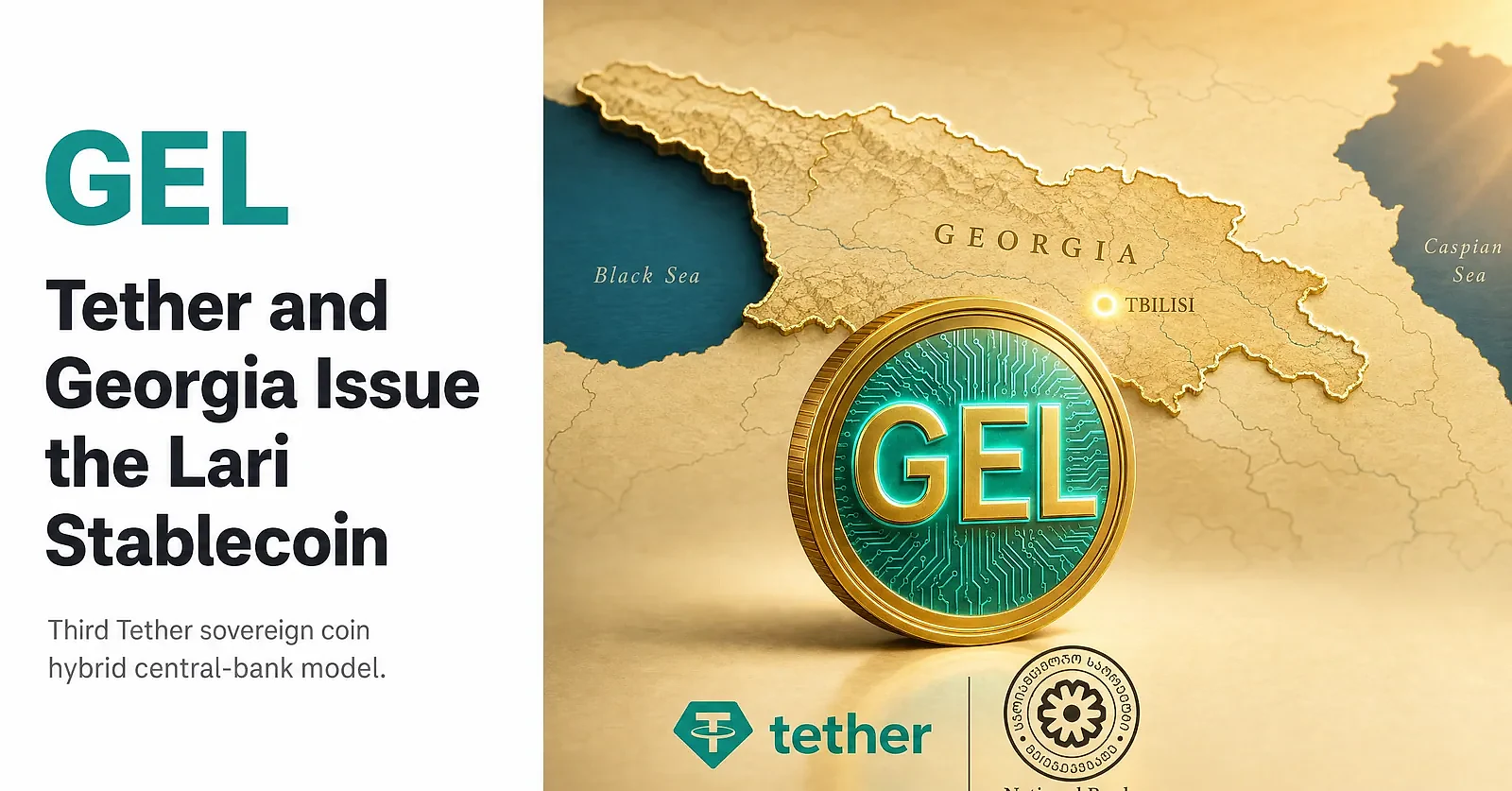
Tether and the Government of Georgia announced on May 25, 2026 the creation of GEL₮ (pronounced "gelt," also Yiddish for money), a stablecoin pegged one-to-one to the Georgian Lari and positioned as the official digital representation of the national currency. The announcement, backed at the highest levels of Georgia's government and central bank, introduces a hybrid public-private issuance model that differs structurally from both conventional private stablecoins and traditional central bank digital currencies.[1][2]
A Sovereign Endorsement Unlike Any Other
Three senior Georgian officials attached their names to the initiative: Prime Minister Irakli Kobakhidze, National Bank of Georgia President Natia Turnava, and Member of Parliament Vakhtang Turnava. All three framed GEL₮ as part of a deliberate effort to modernize Georgia's financial infrastructure and establish the country as the premier digital economy hub of the South Caucasus region.[2] Under the arrangement, Tether acts as the technical issuer and operational backbone while the National Bank of Georgia provides regulatory oversight, a separation that deliberately stops short of full central bank issuance.[3]
Tether chief executive Paolo Ardoino framed the partnership in terms of systemic change rather than niche experimentation.
"Stablecoins are no longer a niche financial instrument," Ardoino said, pointing to the company's USDT token, which is approaching $190 billion in market capitalisation, as evidence that stablecoins now function as mainstream monetary infrastructure.[2]
Tether's own press release described GEL₮ as "one of the first joint efforts to place a national currency directly onto digital asset rails under a purpose-built stablecoin regulatory framework," and added that "the launch comes as governments and central banks globally begin confronting a structural shift in how money moves."[4]
Infrastructure Already in Place
GEL₮ will launch on the same blockchain networks that currently carry USDT, giving it immediate access to the wallets, exchanges, payment processors, and remittance corridors that Tether's infrastructure already supports globally. Tether reports that its stablecoin infrastructure touches more than 400 million wallets worldwide, with dense adoption concentrated in emerging markets neighboring Georgia.[5] A retail user in Tbilisi who already holds USDT for cross-border transfers will be able to swap into GEL₮ inside the same wallet or remittance application from day one, requiring no new integration on the user's part.[5]
The reserve mechanics mirror USDT's structure: when a new GEL₮ is minted, matching Lari-denominated reserves are added; when a holder redeems, the token is burned and the underlying Lari is released. Tether attributed the viability of the structure in part to stablecoin regulations that the National Bank of Georgia established earlier in 2026, which barred stablecoin initial offerings outside the central bank's framework and required registered virtual asset service providers to meet consumer protection and risk management standards aligned with international norms.[3]
Tether's Sovereign Stablecoin Lineup
GEL₮ represents Tether's third government-partnered stablecoin product, joining USDT and MXNT, the Mexican Peso token Tether introduced for Latin American markets. MXNT has under $20 million in circulation compared to USDT's roughly $189 billion, illustrating the commercial gulf that remains between the flagship dollar token and local-currency experiments. Tether is also in the process of winding down a token pegged to the offshore Chinese yuan, citing insufficient demand.[1] The table below compares the three products across key dimensions:
Token — Peg Currency — Market Cap (May 2026) — Issuance Model — Sovereign Backing
USDT — US Dollar — ~$189 billion — Tether (private) — None
MXNT — Mexican Peso — <$20 million — Tether (private) — None
GEL₮ — Georgian Lari — Not yet launched — Tether + National Bank of Georgia — Prime Minister, Central Bank President
The contrast between MXNT's limited traction and GEL₮'s high-level sovereign backing is precisely what makes GEL₮ structurally distinct. Whereas MXNT is a private commercial product targeting peso-denominated commerce, GEL₮ carries formal government co-issuer status, a framework that analysts at CryptoSlate described as placing Georgia at risk of becoming "a regional test case for how smaller national currencies plug into crypto payment systems without surrendering the rails layer to dollar tokens."[3]
Strategic Logic: Frontier Markets and Local Rails
The Georgia deal reveals a deliberate strategic template for Tether: identify frontier markets where USD adoption is already high, where the central government is receptive to crypto-native infrastructure, and where regulatory frameworks are progressing faster than in larger economies, then offer a local-currency stablecoin running on USDT-compatible rails. Georgia qualifies on all three counts. The country ranks among the world's top nations for cryptocurrency mining activity, maintains one of the more permissive regulatory environments in the region, and has a population of 3.7 million whose cross-border commerce is constrained by the Lari's limited international circulation.[1]
For a small, open economy with limited reserve currency status, exporting fiat value into stablecoin form represents one of the few available mechanisms to increase international circulation without altering domestic monetary policy.[5] Georgia gets instant distribution through Tether's global network; Tether gets a sovereign co-issuer credential that distinguishes GEL₮ from any commercially issued local-currency token.
The model sits in direct competition with two alternative approaches to the same problem. First, Circle's USDC-first strategy prioritizes dollar-denominated stablecoins with bank partnerships and GENIUS Act compliance, leaving local-currency infrastructure largely to governments or niche players. Second, national CBDC programs, such as those under active development across the South Caucasus and Eastern Europe, require central banks to build and operate the full technical stack in-house, a process that has taken years in countries far larger than Georgia. GEL₮ offers a faster path at the cost of dependence on a private issuer's infrastructure, custody decisions, freeze powers, and chain selection.[3]
The comparison with Brazil's central bank, which has maintained a cautious stance toward private stablecoin issuance, and with Russia's recent crypto cross-border payment legislation underscores a broader divergence in sovereign approaches to digital money. Georgia is betting that first-mover advantage in the Tether ecosystem is worth the dependency risk.
Outlook and Unresolved Questions
No public timeline for the launch of GEL₮ has been announced. Tether stated that further information on the framework, launch timeline, and implementation details will be released at a later date.[1] Key structural questions remain open: which specific blockchain networks will carry GEL₮ at launch, where the Lari-denominated reserves will be custodied, who can initiate redemptions, and how far the National Bank of Georgia's real-time oversight will extend into Tether's issuance operations.
Tether's own Phemex-sourced product analysis noted that observers will watch the secondary-market price against the official Lari rate in the first ninety days after launch as the primary test of peg credibility.[5] If GEL₮ demonstrates sustained peg stability and measurable adoption in cross-border commerce, Tether has indicated that two or three additional emerging-market governments could announce similar partnerships before the end of 2027.[5]
References
[1] Reuters, "Tether and Georgia government to launch official stablecoin of Georgia," May 25, 2026. https://www.reuters.com/technology/tether-georgia-government-launch-official-stablecoin-georgia-2026-05-25/
[2] Blockhead, "Georgia, Tether to Launch Georgian Lari Stablecoin GEL₮," May 26, 2026. https://www.blockhead.co/2026/05/26/georgia-tether-to-launch-georgian-lari-stablecoin-gelt/
[3] CryptoSlate, "Tether's Georgia stablecoin plan moves early on national payment rails," May 25, 2026. https://cryptoslate.com/tether-georgia-stablecoin-plan/
[4] Central Banking, "National Bank of Georgia to launch stablecoin with Tether," May 26, 2026. https://www.centralbanking.com/fintech/7975977/national-bank-of-georgia-to-launch-stablecoin-with-tether
[5] Phemex Academy, "What Is GELT? Tether's Georgian Lari Stablecoin Explained," May 27, 2026. https://phemex.com/academy/what-is-gelt-tether-georgian-lari-stablecoin