Tempo Adds $7.5B Morpho DeFi Lending, Becoming a Full Financial Stack
Tempo, the Stripe and Paradigm-backed stablecoin payments blockchain, activated Morpho's $7.5 billion lending marketplace on May 18, allowing enterprises to lend, borrow, and earn yield on idle stablecoin balances directly on-chain, transforming the network from a pure payments rail into a complete institutional financial stack.
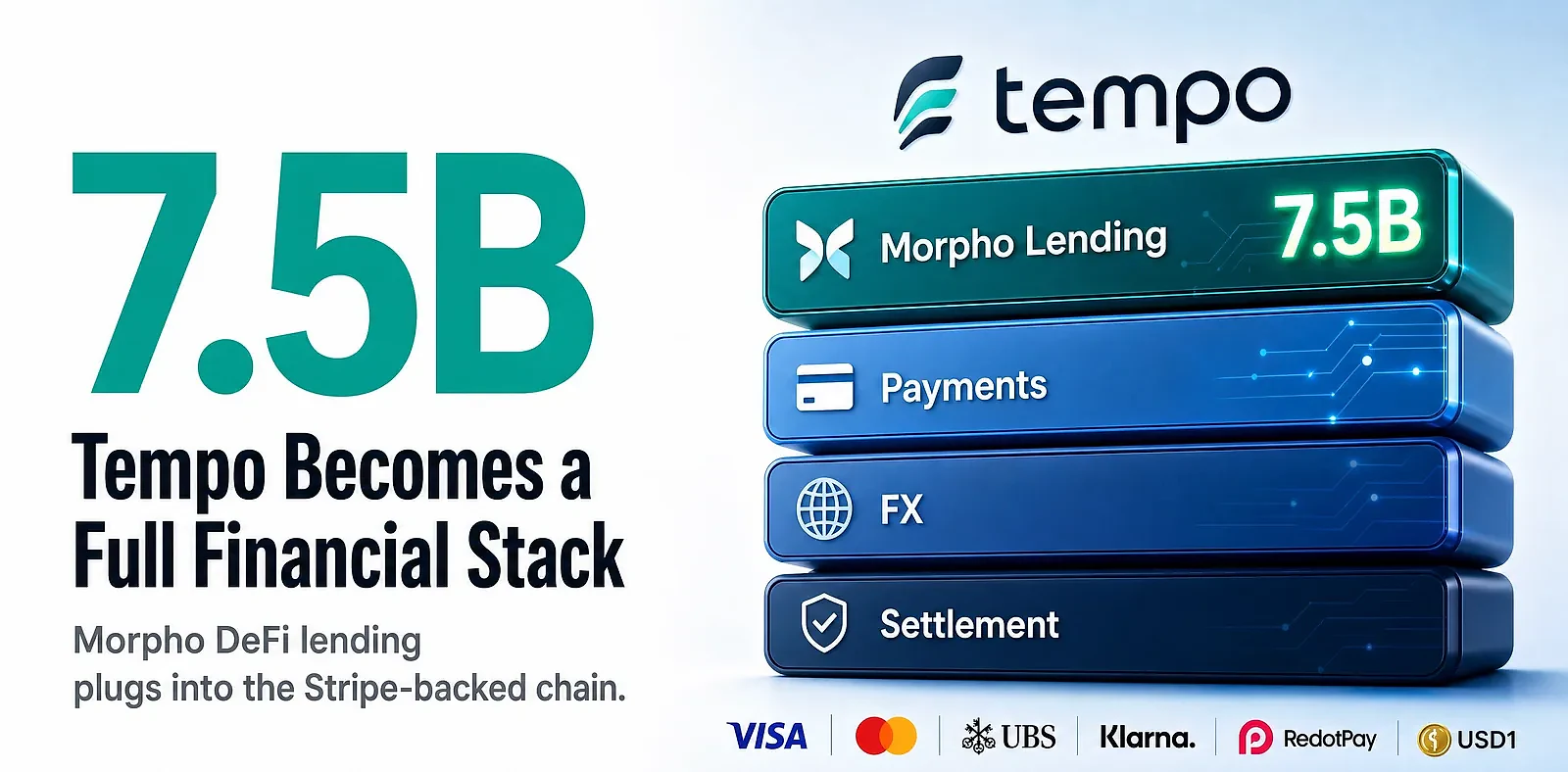
Tempo, the stablecoin payments blockchain incubated by Stripe and Paradigm at a roughly $5 billion valuation, went live with Morpho's $7.5 billion decentralized lending marketplace on May 18, 2026, marking the single most consequential expansion of the chain since its mainnet debut in March [1][2]. The integration gives fintechs and enterprises building on Tempo the ability to lend, borrow, and earn yield on idle stablecoin balances without routing funds to an external protocol or chain.
From Settlement Rail to Financial Stack
Tempo launched earlier this year as a payments-first layer-1 blockchain, offering stablecoin transfers, foreign exchange, and settlement services to institutional clients. Its design partners include Visa, Mastercard, UBS, Shopify, and Klarna, names that reflect the chain's positioning as infrastructure for regulated, enterprise-grade finance rather than retail crypto speculation [2][3]. Tenants already operating on the network include USD1, the Trump-affiliated dollar stablecoin; RedotPay, which uses Tempo's Machine Payments Protocol for agentic AI transactions; and KlarnaUSD, the Klarna stablecoin that was announced for Tempo mainnet deployment earlier in 2026 [3][4].
The gap in that product set was obvious: companies parking stablecoin balances on Tempo had no native mechanism to put those balances to work between payment cycles. Idle funds were, by definition, unproductive. The Morpho integration closes that gap by routing dormant balances into curated lending markets that settle entirely within the Tempo ecosystem.
Morpho's Modular Architecture
Morpho operates a modular lending system in which independent risk curators configure asset parameters, loan-to-value ratios, and liquidation thresholds for individual pools, rather than relying on a single monolithic governance structure to manage all markets centrally. Two specialized risk firms, Gauntlet and Sentora, have launched curated lending markets on the Tempo instance, setting the initial risk rules for the stablecoin and collateral pairs supported at launch [1][2]. Oracle infrastructure is provided by RedStone, which supplies real-time price feeds for stablecoins, bitcoin-backed assets, and tokenized real-world assets traded on the chain.
A Morpho Improvement Proposal (MIP 130), passed by the Morpho DAO ahead of the May 18 launch, authorized $172,000 in MORPHO token incentives to seed early liquidity and borrower activity on the Tempo instance [5]. The incentives are distributed under Morpho's Optimistic Rewards Framework and are initially focused on growing supply in key stablecoin pools, with particular emphasis on pathUSD, the Bridge-issued stablecoin that also serves as Tempo's native gas token.
"We're seeing growing demand from enterprises looking to integrate DeFi capabilities into their payments products and create more value for their users," said Eric Kang, head of go-to-market at Tempo [1].
Integration Specification
Component — Detail
Go-live date — May 18, 2026
Morpho total value locked — $7.5 billion
Risk curators — Gauntlet, Sentora
Oracle provider — RedStone
Assets supported — Stablecoins, BTC-backed assets, tokenized RWAs
MORPHO governance incentives — $172,000 (MIP 130)
Native gas token in focus — pathUSD (Bridge-issued)
Incentive distribution model — Optimistic Rewards Framework
Tempo's Expanding Product Stack
The Morpho activation is the most visible signal yet that Tempo is evolving beyond a single-function payments network. The chain now covers five distinct financial primitives under one roof: stablecoin payments and transfers, on-chain foreign exchange and settlement, agentic machine payments via the Machine Payments Protocol, DeFi lending and borrowing through Morpho, and on-chain yield generation for idle balances. The table below maps that stack against the institutions and protocols powering each layer.
Layer — Function — Key Partners or Tenants
Payments and transfers — Stablecoin movement, cross-border settlement — Visa, Mastercard, Klarna, Shopify
Foreign exchange — On-chain FX conversion — UBS, institutional design partners
Agentic machine payments — AI-to-AI transaction infrastructure — RedotPay, Machine Payments Protocol (Stripe)
Stablecoin issuance — Native and third-party stablecoins — KlarnaUSD, USD1, pathUSD
DeFi lending and yield — Borrow, lend, earn on idle balances — Morpho, Gauntlet, Sentora, RedStone
Institutional Momentum Behind Morpho
Morpho's arrival on Tempo is part of a broader push by the lending protocol into regulated financial infrastructure. Apollo Global Management announced in February that it would acquire up to 90 million MORPHO tokens over four years, representing approximately 9% of the total token supply, reflecting the asset manager's conviction in on-chain credit markets [1]. Morpho currently powers bitcoin-backed loans at Coinbase, lending products at Societe Generale Forge, Gemini, and Crypto.com, and serves as yield infrastructure for a growing list of fintech-facing deployments. The Tempo integration follows a similar deal with Stable, a stablecoin-focused chain that plugged Morpho into its Stable Pay application in October 2025.
For Morpho's co-founder and CEO Paul Frambot, the pattern is deliberate. Speaking at an industry event in 2025, Frambot described Morpho's architecture as a universal lending network designed for large-scale enterprise integration, arguing that the shift from DeFi-native retail usage toward institutional distribution would drive the protocol's next phase of volume growth [2].
What the Integration Means for Stripe's On-Chain Strategy
Tempo raised $500 million in its 2025 funding round at the $5 billion valuation, a figure that reflects Stripe's ambitions for the chain as more than a blockchain side project [2][3]. By adding Morpho, Tempo gives enterprise clients a reason to keep stablecoin balances on-chain rather than sweep them back to traditional bank accounts at the end of each business day. That retention is strategically important: the longer balances stay on Tempo, the more data, fee revenue, and network effects accrue to the chain's ecosystem.
The combination of payments infrastructure backed by Visa and Mastercard, agentic AI transactions built on Stripe's open-source protocol, tokenized RWA exposure via RedStone oracles, and now DeFi lending through Morpho positions Tempo as a credible institutional DeFi layer for fintech companies that want on-chain financial services without the complexity of managing multiple protocol integrations across competing networks.
References
[1] Peace Longe, "Tempo taps Morpho for $7.5B DeFi lending push," Crypto News, May 19, 2026. https://crypto.news/tempo-taps-morpho-for-7-5b-defi-lending-push/
[2] CryptoRank, "Tempo Expands Beyond Payments, Adds DeFi Lending via Morpho," May 18, 2026. https://cryptorank.io/news/feed/4544b-tempo-morpho-defi-lending-integration
[3] CryptoNews, "Stripe-linked Tempo brings Morpho lending markets to its payments chain," May 18, 2026. https://cryptonews.net/news/defi/32880975/
[4] Finovate, "Klarna Debuts KlarnaUSD Stablecoin," November 25, 2025. https://finovate.com/klarna-debuts-klarnausd-stablecoin/
[5] Morpho Governance Forum, "MIP 130 - MORPHO Incentives on Tempo," April 14, 2026. https://forum.morpho.org/t/mip-130-morpho-incentives-on-tempo/2233