Syria processes first international Mastercard payment in more than 15 years
QNB Syria completed an international Mastercard point-of-sale transaction after technical reconnection to the global network, moving Syria's card re-entry from planning to live payment execution.
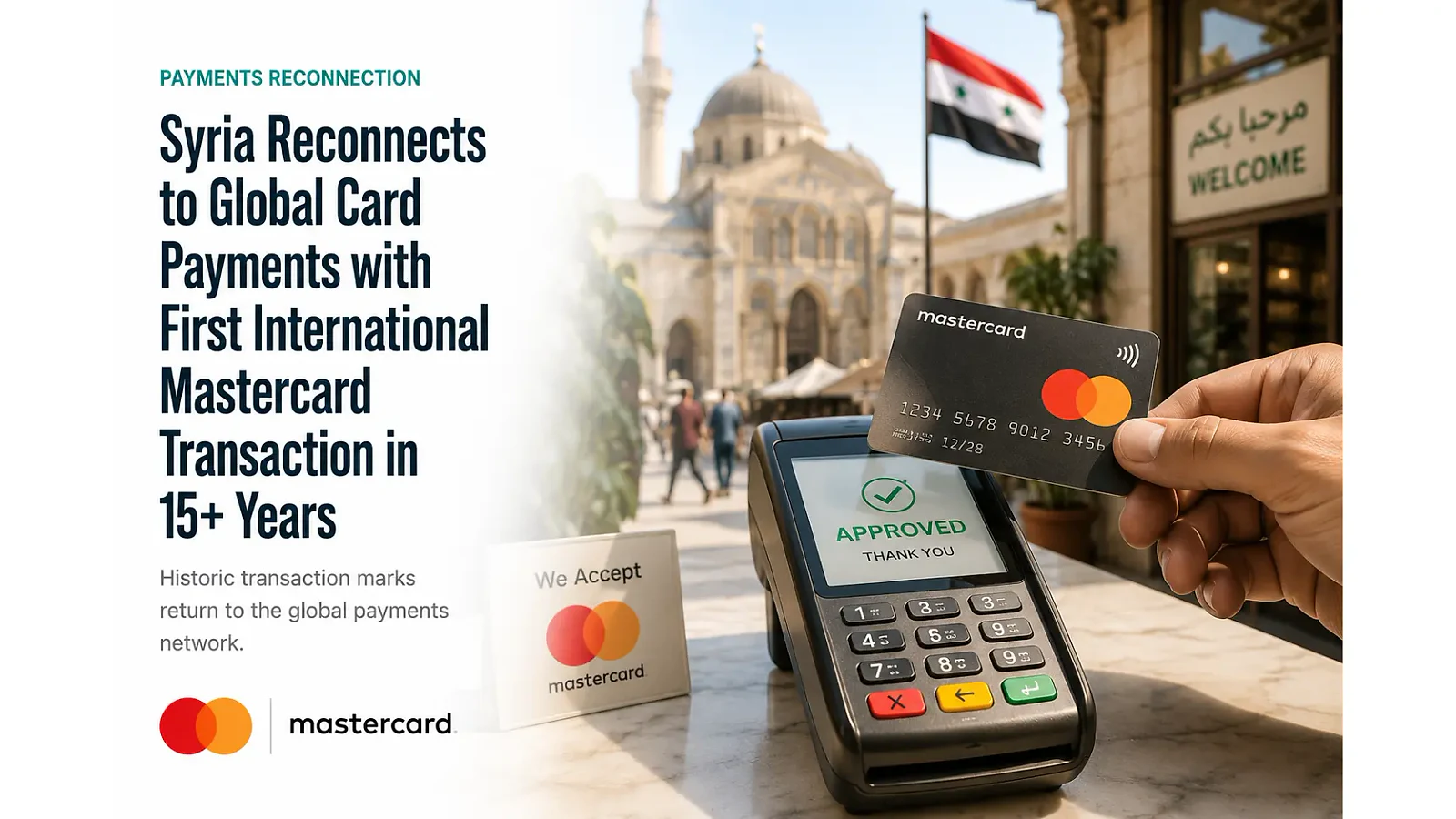
QNB Syria has processed an international Mastercard payment in Syria for the first time in more than 15 years, establishing that the country's payment infrastructure can once again complete a transaction initiated on a global card network.
Mastercard announced the transaction on August 27 after what it described as a technical reconnection of Syria's payments ecosystem to its network. QNB says the end-to-end payment cycle ran from an internationally issued Mastercard used at a local point-of-sale terminal through authorisation and merchant receipt of funds through the banking system.
The transaction is more consequential than an agreement to re-enter the market because it demonstrates production connectivity. It does not, however, mean international cards are already accepted universally across Syria.
One transaction proves operability, not nationwide coverage
Mastercard said the first point-of-sale transaction took place at an eligible approved local merchant. QNB says eligible merchants including hotels, restaurants and government entities can accept international Mastercard credit-card payments through its terminals.
“The completion of Syria’s first international card transaction in more than 15 years is an important step in modernizing the country’s payments ecosystem,” Central Bank of Syria Governor Mohammed Safwat Raslan said in Mastercard's announcement.
The network described the payment as the foundation for broader international card acceptance. That wording is important. The event confirms that the technical and banking chain works for at least one live transaction; it does not establish nationwide merchant acquiring coverage, transaction limits or participation by every Syrian bank.
Financial reintegration changes what payment networks can connect
The payment launch follows a substantial change in Syria's external financial environment. On August 24, the United States removed Syria from its list of state sponsors of terrorism after a congressional review, removing a major obstacle that had continued to deter banking and investment even after broader sanctions were eased.
Reuters reported on August 27 that both Visa and Mastercard had initiated international card activity in Syria. Mastercard's transaction was executed with QNB Group, while Visa conducted a live test with Fransabank and Paymera. Reuters also reported that Syrian President Ahmed al-Sharaa used a Visa card in Damascus as part of the launch.
For payments infrastructure, the important point is that sanctions and country-risk designations are not abstract policy constraints. They determine whether international banks, acquirers and networks can connect local merchants to global payment systems without taking unacceptable legal and compliance risk.
Card connectivity is economic infrastructure
International card acceptance can affect tourism, corporate travel, government services and merchant access to foreign customers. It also reconnects local acquiring infrastructure to global fraud controls, issuer authorisation and settlement processes.
Syria still faces substantial constraints. Payment networks and banks will need to manage remaining sanctions, anti-money-laundering requirements, merchant underwriting and correspondent-banking risk. Broader acceptance will also depend on how quickly terminals, acquiring relationships and eligible merchant categories expand.
The cleanest measure of progress from here will be transaction scale: number of active merchants, participating banks, card volume and coverage outside the initial launch locations.
For now, the August transaction establishes a specific state change. Syria has moved from being effectively disconnected from international card acceptance to having demonstrated an end-to-end Mastercard payment on live infrastructure.
The sequence from policy change to live payment
Date — Development — Infrastructure significance
Aug. 24 — US removes Syria from state-sponsor-of-terrorism list — Reduces a major external banking and investment constraint
Aug. 26–27 — QNB/Mastercard complete end-to-end international card transaction — Demonstrates live acquiring and settlement connectivity
Aug. 27 — Visa and Mastercard activity publicly launched — Begins broader network re-entry
The short interval does not mean the technical work happened in three days. Mastercard and Syrian authorities described months of preparation, and card-network re-entry depends on merchant acquiring, bank connections and compliance controls established before the first public transaction. The policy change altered the risk environment in which those systems could be activated.
For merchants, the meaningful operational change is access to international purchasing power. For networks and banks, the challenge is the opposite side of the transaction: ensuring that issuer authorisation, sanctions screening, fraud controls, settlement and merchant funding can operate consistently as coverage expands. That is why a single successful payment is an important milestone but only the first measurable point in a much larger infrastructure rebuild.