Stripe, Visa, Mastercard, and Coinbase Near Joint Stablecoin Platform
The four biggest names in global payments are reportedly finalizing a consortium to launch a joint stablecoin platform, with Coinbase's potential participation threatening to undercut Circle's core distribution advantage for USDC.
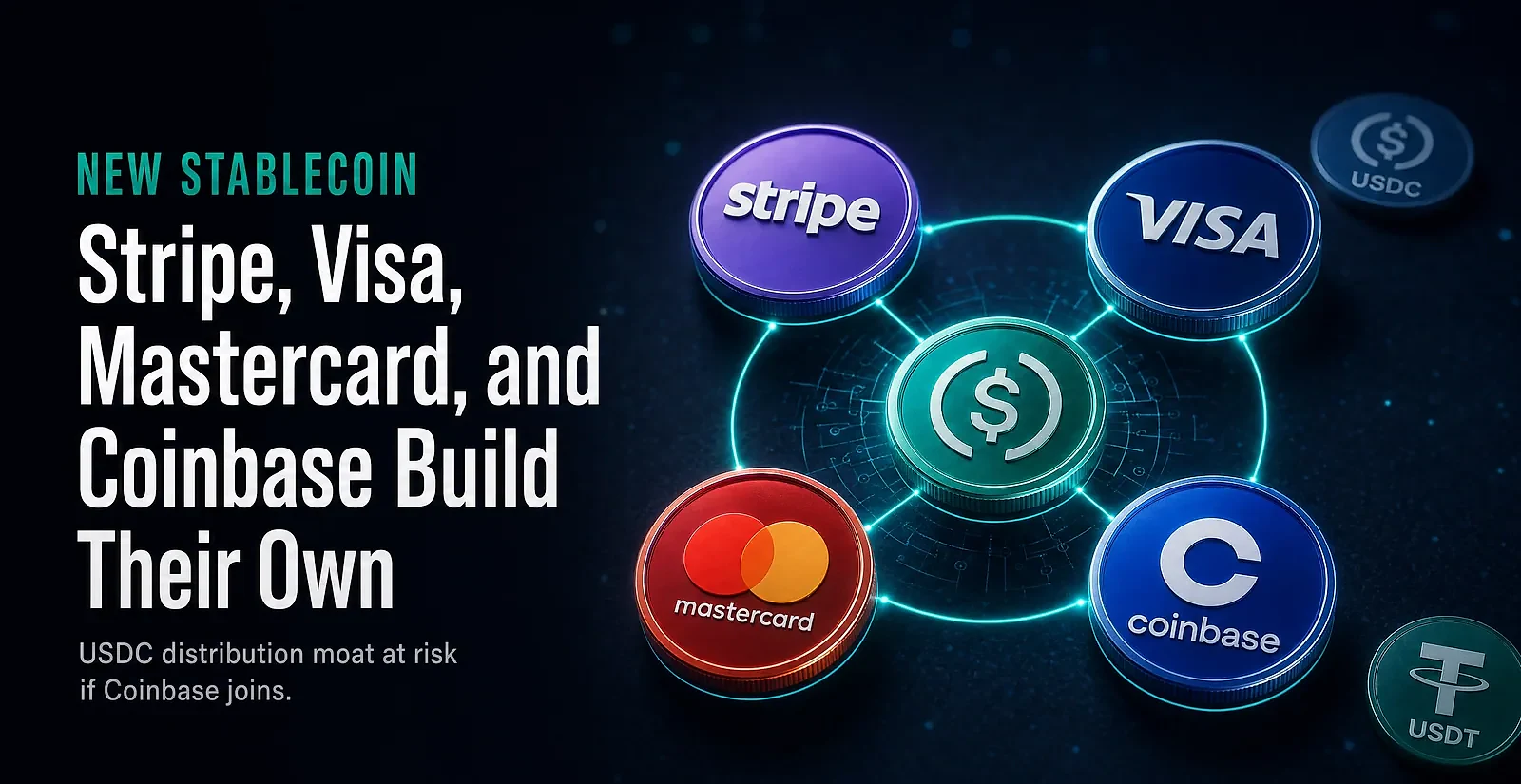
Stripe, Visa, Mastercard, and Coinbase are nearing the formation of a joint stablecoin consortium that would compete directly with Circle and Tether, according to reporting by CoinDesk and The Information published June 2 to 4, 2026. The initiative combines each company's accumulated stablecoin infrastructure into a single governance structure, and its potential launch would mark the first time the payments industry's dominant networks have moved collectively to own the digital dollar layer rather than distribute it.
The Consortium Takes Shape
The CoinDesk report, published June 2, cited three people familiar with the plans who described Stripe, Visa, and Mastercard as close to launching a joint stablecoin platform. The Information followed on June 4 with a more definitive framing: the four companies are planning to form a consortium specifically to issue a new stablecoin that would challenge Circle and Tether, which together account for approximately 80% of stablecoin market share. No official name, governance structure, or launch date has been confirmed by any of the companies.
The strategic logic is straightforward. Each of the four companies has spent the past 18 months independently building stablecoin infrastructure. A joint platform would let them consolidate that infrastructure into a single clearing-house-style interface capable of routing trillions of dollars in payment volume while controlling the stablecoin that underpins those flows. The result would be a vertically integrated payment stack: issuance, settlement, card acceptance, and blockchain infrastructure all governed by the same consortium.
Analysts at Bankless described the consortium framework as making the separate settlement announcements from Mastercard and Visa easier to interpret: "The notion isn't particularly farfetched and thus we may begin to see more networks follow in Mastercard's stead here as they prepare themselves for this platform's launch."
What Each Player Brings
The consortium's architecture draws on four distinct capability stacks, each critical to making a new stablecoin viable at global scale.
Partner — Key Asset — Scale / Detail
Stripe — Bridge acquisition — $1.1B acquisition; white-label stablecoin issuance and wallet infrastructure
Stripe — Tempo blockchain — EVM-compatible L1, 100,000+ TPS, sub-second finality; incubated with Paradigm
Visa — Stablecoin settlement pilot — $7B annualized run rate, 9 blockchains, 50% quarterly growth as of April 29, 2026
Visa — Stablecoin card volume — Processes approx. 70 to 90% of all stablecoin card spending globally
Mastercard — BVNK acquisition — $1.8B deal (mid-process); stablecoin infrastructure across 130+ countries
Mastercard — NY BitLicense — Received May 2026; clears regulatory path for digital asset services in New York
Mastercard — Network settlement — 6 stablecoins and 8 blockchains added to settlement as of June 3, 2026
Coinbase — USDC distribution — Holds approx. $19B of USDC, representing more than 25% of all tokens in circulation
Stripe's contributions anchor the infrastructure layer. Patrick Collison's company acquired Bridge for $1.1 billion, giving it white-label stablecoin issuance capabilities that enterprise clients can deploy under their own brand. Collison then co-incubated Tempo alongside Paradigm, producing an EVM-compatible Layer-1 blockchain with more than 100,000 transactions per second and sub-second finality. Tempo has no native token; gas fees are denominated in stablecoins. Visa and Mastercard are already running stablecoin settlement on Tempo, as of the Visa April 29 expansion and the Mastercard June 3 announcement respectively.
Visa brings the demand side. By April 2026, the company's stablecoin settlement pilot had reached a $7 billion annualized run rate across nine blockchains, up 50% quarter over quarter. Its card programs process roughly 70 to 90% of all stablecoin-linked card spending globally, according to Cryptic Media's May 2026 analysis. Bridge-enabled, Visa-branded stablecoin cards are live in 18 countries with planned expansion to more than 100 countries by year end.
"Visa is committed to meeting businesses where they operate, and increasingly, that's onchain. Expanding our work with Bridge gives us one more way to bring the speed, transparency and programmability of stablecoins directly into the settlement process. This milestone gives our partners greater choice in how they move value, and it reinforces Visa's role as a trusted network connecting stablecoins and the global payments ecosystem." - Cuy Sheffield, Head of Crypto, Visa, March 3, 2026 [1]
Mastercard received its New York BitLicense in May 2026, and on June 3 announced network-level stablecoin settlement supporting six regulated stablecoins including USDC, Ripple's RLUSD, and Paxos-issued PYUSD, across eight chains including Ethereum, Solana, Arbitrum, Base, Polygon, Canton, Tempo, and XRPL. The $1.8 billion BVNK acquisition, announced in March, remains subject to regulatory approval and is expected to close by year end.
The Distribution Math for USDC
Coinbase's potential participation is the pivotal variable in this story. Circle's business model depends heavily on USDC's size in circulation: reserve income on the assets backing USDC drove $2.64 billion of Circle's 2025 revenue. Coinbase, through its revenue-sharing arrangement with Circle since 2023, holds approximately $19 billion worth of USDC on behalf of its users, representing more than 25% of all tokens outstanding as of Q1 2026. That agreement provides Coinbase with 100% of interest income on USDC held on its own exchange, and a 50-50 revenue split on USDC circulating elsewhere. The arrangement is up for renewal in August 2026.
Brian Armstrong addressed the renewal question at Coinbase's Q1 earnings call:
"The contracts that we have in place with Circle are set. We expect to continue to go forward with our relationship with Circle under those same terms." - Brian Armstrong, CEO, Coinbase, May 2026 [2]
That statement, however, preceded the consortium reports. Coinbase's participation in a platform that issues a competing stablecoin would give the company its own issuance economics rather than a revenue share on someone else's product. It would also provide substantial negotiating leverage as the August renewal approaches, whether or not Coinbase ultimately walks away from Circle. The distribution moat that has made USDC the dominant regulated stablecoin rests on Coinbase's willingness to maintain it. That willingness now appears uncertain.
Why Tether May Be Safer in the Short Term
The consortium's near-term competitive focus is likely on USDC rather than USDT. Tether's growth has been concentrated in emerging markets including Latin America, Sub-Saharan Africa, and Southeast Asia, where Visa and Mastercard network penetration is considerably lower than in developed markets. USDT volume also skews toward peer-to-peer transfers, remittances, and decentralized exchange activity rather than card payments or institutional settlement, the use cases that Stripe, Visa, and Mastercard are best positioned to capture.
Stablecoin — Circulating Supply (June 2026) — Primary Use Case — Consortium Risk
USDT (Tether) — Approx. $145B — P2P, emerging markets, DEX trading — Lower; limited card network exposure
USDC (Circle) — $75.5B — Card programs, institutional, U.S. payments — High; Coinbase distribution dependency
Consortium token (proposed) — TBD — Card settlement, enterprise, B2B payments — N/A; new entrant
Circle's strongest position is in the regulated, card-linked, enterprise-facing segment of the stablecoin market, precisely the segment the consortium would target. Tether's strength lies in markets and use cases less accessible to the consortium partners. That asymmetry suggests a period in which Circle bears most of the competitive pressure while Tether's market position remains relatively stable.
The Clearing-House vs Issuance Question
Early reporting described the platform in two overlapping frames: as a settlement and clearing-house-style infrastructure and as a stablecoin issuance consortium. These are meaningfully different in scope and regulatory implication. A clearing house routes stablecoin volume through a common interface, improving interoperability without issuing a new token. An issuance consortium creates a net-new digital dollar that competes directly with USDC and USDT on market share.
The Information's June 4 report leaned toward the issuance framing, describing the companies as planning to issue a new stablecoin to challenge Circle and Tether. The LinkedIn summary from The Information's reporter Yueqi Yang confirmed: "They are seeking to challenge the dominance of Circle and Tether, the two biggest issuers that make up 80% of market share." [3]
A consortium-issued stablecoin backed by Stripe's Bridge infrastructure, settled across Visa and Mastercard networks, and distributed through Coinbase's exchange would enter the market with advantages no prior stablecoin has had: built-in card acceptance at hundreds of millions of merchant locations, enterprise settlement on the world's two largest payment networks, and a distribution partner who currently holds 25% of the leading rival's supply in circulation. The governance question, specifically whether Patrick Collison, Visa's Ryan McInerney, Mastercard's Michael Miebach, and Brian Armstrong can maintain coherent joint governance over a shared monetary instrument, has no precedent in payments history.
Market Reaction: CRCL and COIN
Markets reacted to the CoinDesk report on June 3 with broad declines across named participants. Circle Internet Group shares dropped as much as 4% at the open. Coinbase Global fell 1.4% amid broader crypto weakness, with Bitcoin declining 2.8% to around $66,800 on the day. Visa and Mastercard also each fell more than 2% in morning trading, suggesting that investors initially read the report as a distraction or execution risk for the incumbent card networks rather than a straightforward positive.
StockTwits sentiment data from the period showed chatter around Circle jumping 40% in 24 hours, with the tone trending bearish. Coinbase message volume increased by over 150% in the prior month. The market's net read was negative for USDC's competitive position: the consortium's construction, if completed, restructures the distribution economics that Circle has relied upon since its 2023 revenue-sharing agreement with Coinbase.
What to Watch for the Official Announcement
Several conditions must resolve before the consortium becomes operational. Mastercard's BVNK acquisition remains subject to regulatory review and is expected to close by year end. Coinbase's participation is described as under evaluation, not confirmed. No entity has acknowledged the reports publicly. The August renewal of the Coinbase-Circle revenue-sharing agreement will serve as a credible indicator of Coinbase's direction: departure from the current terms would signal active preparation for alternative stablecoin infrastructure.
On the settlement side, Mastercard's June 3 expansion and Visa's April 29 expansion have already positioned both networks to handle the stablecoin settlement function regardless of whether a consortium token is issued. The clearing-house layer is effectively live. The issuance question is what remains open, and the answer will determine whether Circle faces a structural competitor backed by the global payment oligopoly or simply a shared settlement interface that leaves the dollar token market largely intact.
For now, the payment rails industry has drawn the clearest possible line: it intends to own the stablecoin layer, not merely route it.
References
[1] Visa, "Visa and Bridge Expand Collaboration, with Plans to Bring Stablecoin-Linked Cards to Over 100 Countries," March 3, 2026. https://investor.visa.com/news/news-details/2026/Visa-and-Bridge-Expand-Collaboration-with-Plans-to-Bring-Stablecoin-Linked-Cards-to-Over-100-Countries/default.aspx
[2] StockTwits via Yahoo Finance, "CRCL, COIN Stocks Dip After Report Suggests Coinbase Is Mulling Entry Into New Stablecoin Platform Backed By Stripe, Visa, Mastercard," June 3, 2026. https://finance.yahoo.com/markets/crypto/articles/crcl-coin-stocks-dip-report-141605001.html
[3] The Information (via LinkedIn), "Stripe, Visa, Mastercard, Coinbase to Form Consortium to Issue New Stablecoin," June 4, 2026. https://www.theinformation.com/briefings/stripe-visa-mastercard-coinbase-form-consortium-issue-new-stablecoin
[4] Visa, "Visa Accelerates Stablecoin Momentum: Adding Five Blockchains for Settlement," April 29, 2026. https://investor.visa.com/news/news-details/2026/Visa-Accelerates-Stablecoin-Momentum-Adding-Five-Blockchains-for-Settlement/default.aspx
[5] Mastercard, "Mastercard expands settlement capabilities to include stablecoin, intraday, holiday and weekend options," June 3, 2026. https://www.mastercard.com/us/en/news-and-trends/press/2026/june/mastercard-expands-settlement-capabilities-to-include-stablecoin.html
[6] Mastercard, "Mastercard to acquire BVNK to connect on-chain payments and fiat rails," March 2026. https://www.mastercard.com/us/en/news-and-trends/press/2026/march/Mastercard-to-acquire-BVNK-to-connect-on-chain-payments-and-fiat-rails.html