Stablecoin Market Cap Hits $322 Billion, Exceeds FX Reserves of 95 Countries
The combined market capitalization of all stablecoins reached a new all-time high of $322 billion on May 26, 2026, surpassing the official foreign exchange reserves of 95 sovereign nations, including the United Kingdom, Canada, and the United Arab Emirates. The milestone arrives as Iran war risk and US Treasury yield anxiety push global capital toward programmable dollar instruments.
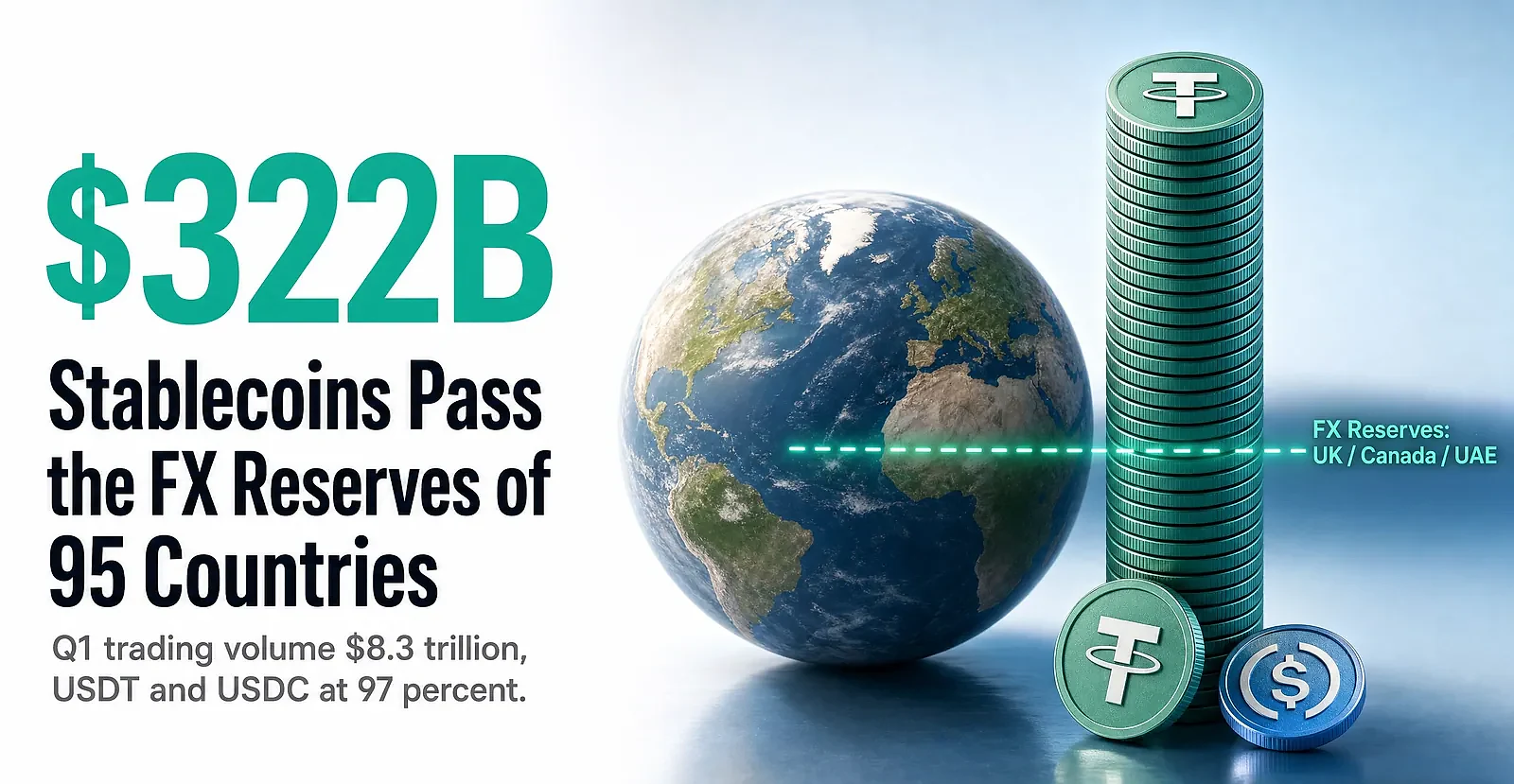
The combined market capitalization of all stablecoins reached a new all-time high of $322 billion on May 26, 2026, exceeding the official foreign exchange reserves of 95 sovereign nations, including the United Kingdom, Canada, Poland, and the United Arab Emirates, according to data first reported by CoinDesk. The milestone positions stablecoins as a systemic force in global finance that regulators can no longer frame as a peripheral experiment. [1]
A Sovereign Scale Reference
Foreign exchange reserves are the primary monetary buffer that central banks maintain to stabilize national currencies and finance essential imports. At $322 billion, the stablecoin market now exceeds that buffer for 95 of the world's nations. Only 14 countries retain larger official FX reserve positions, led by China, Japan, Russia, India, Taiwan, and Germany. The comparison is a scale reference: stablecoin market cap reflects tokens in active circulation across wallets, exchanges, and DeFi protocols, while FX reserves are sovereign assets held for specific monetary policy purposes. But the scale is meaningful, illustrating how rapidly private digital dollar instruments have grown relative to the monetary defenses of most governments. [2]
Top Stablecoins and Key FX Reserve Comparisons
Asset / Reserve — Approximate Value — Note
Total stablecoin market cap — $322 billion — All-time high, May 26, 2026
Tether (USDT) market cap — ~$187 billion — ~58% of stablecoin market
USD Coin (USDC) market cap — ~$77 billion — ~24% of stablecoin market
All other stablecoins — ~$58 billion — ~18% of stablecoin market
China FX reserves — ~$3.2 trillion — Largest sovereign holder
Japan FX reserves — ~$1.2 trillion — Second largest
India FX reserves — ~$680 billion — Larger than stablecoin market
United Kingdom FX reserves — Below $322 billion — Surpassed by stablecoin market
Canada FX reserves — Below $322 billion — Surpassed by stablecoin market
UAE FX reserves — Below $322 billion — Surpassed by stablecoin market
USDT and USDC together account for roughly 97% of all daily stablecoin trading volume, with USDT holding 86% of stablecoin trading volume in Q1 2026 and USDC holding 10%, according to CEX.IO research. The remaining 4% is distributed across yield-bearing variants, algorithmic instruments, and a growing roster of non-dollar stablecoins. [3]
Q1 2026: $8.3 Trillion in Trading, 75% of All Crypto Volume
The $322 billion supply milestone did not arrive in isolation. Q1 2026 stablecoin trading volume reached $8.3 trillion, representing 75% of all cryptocurrency trading volume, the highest share on record and above the prior peak of 72% in Q3 2022, according to CEX.IO data. Total on-chain stablecoin transaction volume surpassed $28 trillion in Q1 2026, a 51% increase over Q4 2025. [3]
"The stablecoin market has crossed a threshold that puts its scale in sovereign terms. At $322 billion, more dollars are now held in stablecoins outside traditional banking channels than 95 sovereign governments hold in their official foreign exchange reserves." - Stablecoin Insider, May 26, 2026 [2]
The Q1 volume composition also revealed a structural shift within the duopoly. For the first time since 2019, USDC overtook USDT in organic, bot-adjusted transaction volume, capturing roughly 63% of adjusted stablecoin volume, the highest share ever recorded for Circle's token. USDT's organic volume declined 17% quarter-over-quarter while USDC's rose 59%, reflecting institutional and DeFi flows increasingly routing through the regulated dollar stablecoin. [3]
Macro Context: Iran War Premium and Treasury Yield Anxiety
The timing of the $322 billion milestone is inseparable from the macroeconomic environment that surrounded it. The 30-year US Treasury yield breached 5.14% in late May 2026, reaching levels last seen in 2007, driven by resurging inflation pressures partly linked to oil supply disruption from the US-Iran conflict that began in late February 2026. [4] The Federal Reserve's ability to cut rates remained constrained, creating a simultaneous squeeze on duration assets and risk appetite across traditional markets.
Stablecoins absorbed fear flows from multiple directions. Iranian citizens facing a banking system constrained by sanctions and wartime disruption used crypto as a capital flight mechanism: on-chain researchers documented a 700% spike in outflows from Nobitex, Iran's largest crypto exchange, in the days following the initial strikes. [5] Global participants seeking dollar-denominated stability without Treasury duration exposure drove sustained supply growth from roughly $312 billion in March to $322 billion by late May. [6]
BIS Warning, Currency Substitution, and Geopolitical Implications
The Bank for International Settlements has framed stablecoin growth as a double-edged development for the global financial system. Its research, including BIS Paper No. 170 on currency substitution, documents that increases in stablecoin flows are associated with subsequent domestic currency depreciation, deviations from covered interest parity, and widening wedges between stablecoin-implied and official exchange rates in segmented markets. When citizens of a high-inflation economy shift local currency savings into dollar-pegged stablecoins outside the domestic banking system, they reduce local currency demand and erode the central bank's conventional monetary tools. Capital that would previously have remained within domestic banking systems is instead circulating on blockchain rails beyond the reach of any single sovereign framework. [2]
The regulatory response is unfolding across three jurisdictions simultaneously. The GENIUS Act in the United States is advancing a federal payment stablecoin framework due by July 2026. The European Central Bank continues its debate over whether a euro-denominated stablecoin is necessary to resist dollar stablecoin dominance in eurozone commerce. Tether's sovereign stablecoin partnerships, including the GEL₮ Georgian lari token, signal that non-dollar supply may grow as a structural second story within the overall market. [2][6]
The Non-Dollar Watch Story
At present, USD-denominated stablecoins account for approximately 99% of total stablecoin supply. Non-dollar instruments, including euro, yen, and Swiss franc-pegged tokens, remain a small fraction of the market. But the trajectory of regulatory attention, ECB commentary, and sovereign stablecoin partnerships suggests the composition question will intensify as supply approaches year-end projections of $420 billion. [2]
The chain wars dimension compounds the supply story. Base, Coinbase's layer-2 network, processed 62% of total global on-chain stablecoin transaction volume in Q1 2026, exceeding all other chains combined, according to Coinbase Q1 financial disclosures. [7] At $322 billion, the stablecoin market is no longer a satellite of the crypto ecosystem. It is a parallel monetary layer, one that has now exceeded the primary monetary defenses of most sovereign governments on earth, while processing transaction volumes that rival traditional payment networks and absorbing geopolitical risk flows that legacy banking rails cannot readily accommodate.
References
[1] CryptoRank / BitcoinWorld, "Stablecoin Market Cap Hits Record $322 Billion, Surpassing Reserves of 95 Countries," May 26, 2026. https://cryptorank.io/news/feed/a84bb-stablecoin-market-cap-record-322-billion
[2] Stablecoin Insider, "$322 Billion: Stablecoin Market Cap Surpasses FX Reserves of 95 Nations," May 26, 2026. https://stablecoininsider.org/stablecoin-market-cap-hits-record-322-billion-surpassing-fx-reserves-of-95-nations-including-the-uk-and-canada/
[3] CEX.IO, "Stablecoins in Q1 2026: Rising Similarities With the 2022 Bear Market," April 1, 2026. https://blog.cex.io/ecosystem/q1-2026-stablecoin-report-35459
[4] CNBC, "30-year Treasury yield tops 5.19%, highest since before 2007," May 19, 2026. https://www.cnbc.com/2026/05/19/treasurys-yields-inflation-traders-fed-interest-rates.html
[5] Phemex, "How War Affects Bitcoin: Geopolitical Risk Framework 2026," March 15, 2026. https://phemex.com/blogs/geopolitical-risk-crypto-bitcoin-wars-conflicts
[6] CF Benchmarks, "Conviction in the Crossfire: Geopolitical Risk, Regulatory Breakthroughs and the Bitcoin Catch-Up Trade," April 3, 2026. https://www.cfbenchmarks.com/blog/conviction-in-the-crossfire-geopolotical-risk-regulatory-breakthroughs-and-the-bitcoin-catch-up-trade
[7] Coinbase, "Q1 2026 Financial Results," May 7, 2026. https://investor.coinbase.com/news/news-details/2026/Coinbase-Q1-Financial-Results-Show-Resilient-Financial-Performance-Driven-by-New-All-Time-High-Crypto-Trading-Volume-Market-Share/default.aspx