Solana SDP and Pay.sh: The $2 Trillion Stablecoin Engine Becomes the Agentic Payment Layer
Solana's Solana Developer Platform gives enterprises and financial institutions a single API gateway to stablecoin issuance, payments, and trading on Solana rails. Pay.sh, launched May 5 with Google Cloud, extends that stack to AI agents, letting Gemini, Claude, Codex, and OpenClaw pay per API call in USDC with no billing accounts required.
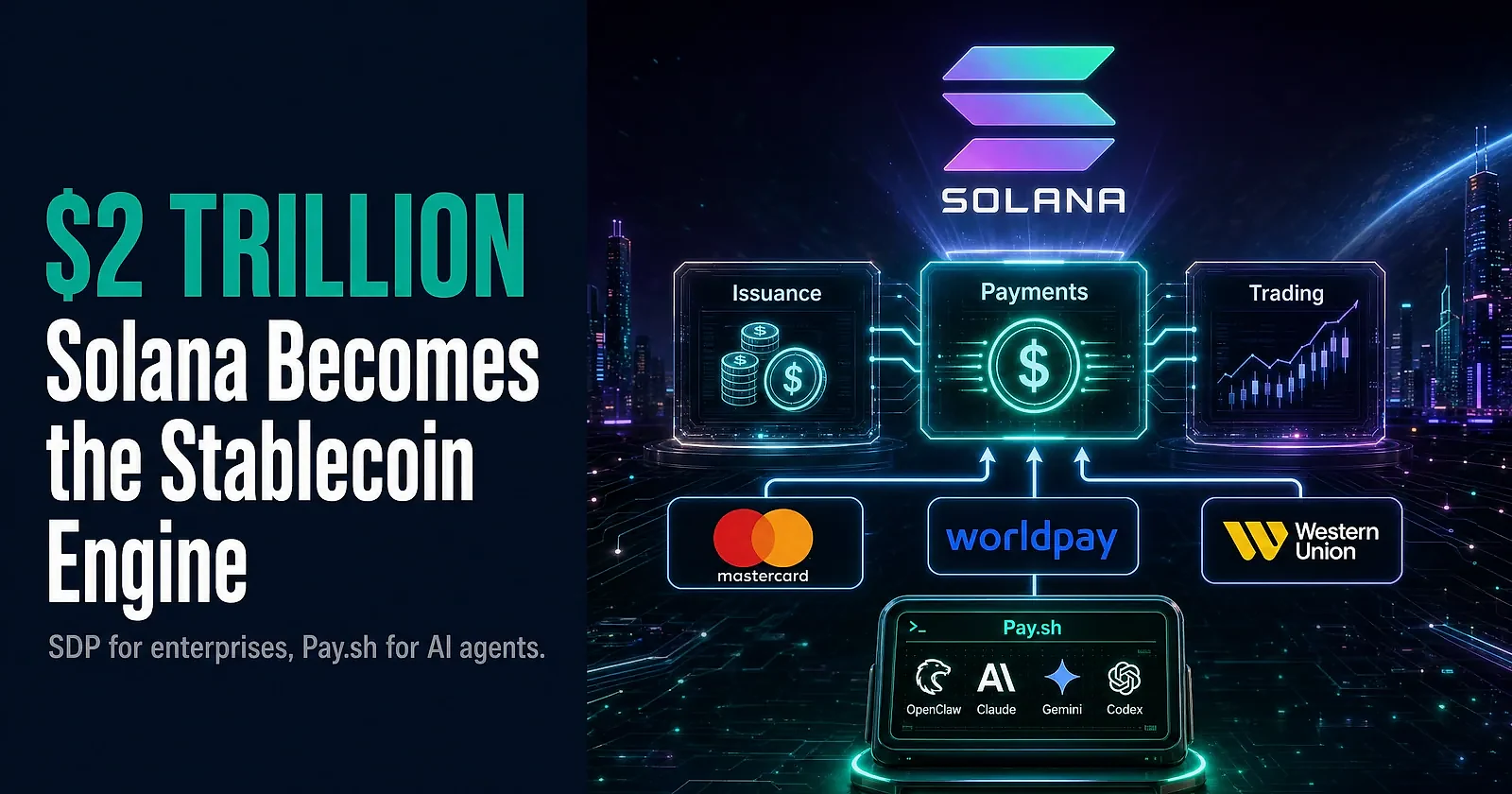
Solana processed roughly $2 trillion in stablecoin transfers in Q1 2026, surpassed Ethereum in total real-world asset holders for the first time, and in the span of six weeks unveiled two interlocking infrastructure products that together position the network as the primary settlement layer for both enterprise payments and autonomous AI agents. The two products are the Solana Developer Platform (SDP), launched March 24, and Pay.sh, launched May 5 in partnership with Google Cloud. [1][2]
SDP: One API to Rule Enterprise Blockchain
The Solana Foundation launched SDP on March 24, 2026, describing it as an AI-ready developer platform that aggregates more than 20 infrastructure providers into a single, unified API-driven interface. The platform targets banks, payment processors, and other financial institutions that need to ship blockchain-powered products without assembling their own node, custody, compliance, and ramp stacks from scratch. [2]
SDP is organized around three core modules. The Issuance module enables enterprises to issue a tokenized deposit, a GENIUS Act-compliant stablecoin, or a tokenized real-world asset. The Payments module orchestrates fiat and stablecoin flows across on-ramp, off-ramp, and on-chain transactions, supporting B2B, B2C, and P2P use cases. The Trading module, covering atomic swaps, vaults, and on-chain FX, is planned for later in 2026. Issuance and Payments went live at launch. [2]
SDP Module — Status — Key Capabilities
Issuance — Live — Tokenized deposits, GENIUS-compliant stablecoins, RWAs
Payments — Live — Fiat on/off-ramps, stablecoin B2B, B2C, P2P
Trading — Planned 2026 — Atomic swaps, vaults, on-chain FX
The infrastructure layer behind SDP spans four categories: node providers (Alchemy, Helius, QuickNode, Triton), custody wallets (Anchorage Digital, BitGo, Coinbase, Fireblocks, among others), compliance tools (Chainalysis, Elliptic, TRM), and ramp services (Bridge, MoonPay, Lightspark). SDP is also usable out of the box with AI coding platforms including Claude Code by Anthropic and Codex by OpenAI. [2]
Three of the largest names in global payments signed on as early users at launch. Mastercard is using SDP for stablecoin settlement; Worldpay for merchant payments and settlement; and Western Union for cross-border payments. Their adoption is a signal that enterprise appetite for a single compliant on-ramp to Solana rails is real.
"The next phase of digital asset innovation will be defined by practical use cases that integrate seamlessly with existing financial systems. As an early user of Solana Developer Platform, we're helping enable direct stablecoin settlement for customers on select blockchain networks, beginning with Solana, combining the speed and programmability of blockchain with the reliability, security and global reach of the Mastercard network."
- Raj Dhamodharan, Executive Vice President, Blockchain and Digital Assets, Mastercard [2]
Malcolm Clarke, VP Digital Assets at Western Union, framed SDP as an extension rather than a replacement: the platform adds an API-driven on-chain layer that orchestrates fiat and stablecoin flows end-to-end without displacing Western Union's existing cross-border network. Ahmed Zifzaf, Head of Crypto Partnerships at Worldpay, said the platform opens paths to onchain settlement and tokenized assets for merchants, pointing toward new commerce models. [2]
The Q1 2026 Numbers Behind the Platform
SDP launched against a backdrop of accelerating activity on Solana's stablecoin and RWA rails. Developers building on the network reported approximately $2 trillion in stablecoin transfers during Q1 2026, with more than $300 million in monthly payment volume. [3] Non-USD stablecoin senders on Solana grew nearly 3x year-over-year as of April 1, 2026, driven primarily by EURC (euro) and BRZ (Brazilian real), according to Dune Analytics data. [4]
Metric — Value — Source / Date
Q1 2026 stablecoin transfer volume — ~$2 trillion — MEXC, Feb 2026
Total stablecoin supply on Solana — $17 billion — Artemis, March 2026
RWA total value on Solana — $2 billion+ — Solana Ecosystem Roundup, April 2026
RWA holders on Solana — 182,000 (record) — RWA.xyz, March 2026
RWA lending deposits — $1.2 billion — Solana Ecosystem Roundup
Non-USD stablecoin senders YoY growth — Nearly 3x — Dune Analytics, April 1, 2026
RWA onchain equity spot volume share — 94% of all-time — Solana Ecosystem Roundup
The RWA milestone is particularly striking: Solana surpassed Ethereum in total RWA holders for the first time in early March 2026, with the figure reaching 182,000 by month end, a record for the network and a reversal that even analysts tracking the two chains did not anticipate this quickly. RWA growth on Solana expanded roughly 10x over the prior 12 months. [1]
Pay.sh: AI Agents Get a Solana Wallet and a Marketplace
While SDP addresses the enterprise onboarding problem, Pay.sh addresses a parallel friction point: how autonomous AI agents pay for the external API services they need to function. The Solana Foundation and Google Cloud launched Pay.sh on May 5, 2026, building it on two open machine-native payment protocols: x402, incubated by Coinbase, and MPP (Machine Payment Protocol). [1][5]
The mechanics are straightforward. An AI agent, running on Gemini, Claude, Codex, or OpenClaw, connects a Solana wallet as its identity and payment instrument. The wallet can be funded in roughly 60 seconds using either a credit card or stablecoins. The agent then browses a marketplace of more than 75 APIs, views real-time pricing, and executes calls instantly, paying in USDC with settlement on Solana completing within seconds. No billing accounts, no subscription setup, no API keys. The payment itself serves as the authorization. [5]
The Google Cloud partnership is the load-bearing element. Pay.sh operates as an API proxy layer on Google Cloud infrastructure and offers authorized access to first-party Google endpoints: Gemini (AI inference), BigQuery (data warehouse), Vertex AI (model access), and Cloud Run (container applications). Beyond Google's own services, the platform aggregates more than 50 community API providers across e-commerce, data and intelligence (Dune Analytics, Nansen), communications, blockchain infrastructure (Helius, Alchemy, The Graph), and other categories. [5][6]
API Category — Examples — Access Model
Google Cloud first-party — Gemini, BigQuery, Vertex AI, Cloud Run — Authorized, native integration
Blockchain infrastructure — Helius, Alchemy, The Graph — Community providers
Data and intelligence — Dune Analytics, Nansen — Community providers
Communications — Email, SMS, voice APIs — Community providers
E-commerce — Buying, selling, fulfillment tools — Community providers
Pay.sh is described by Vibhu Norby, Chief Product Officer of the Solana Foundation, as a gateway service designed to bridge the gap between autonomous agents and enterprise infrastructure. [5] The platform is fully compatible with Circle's Agent Stack, which launched the same week, reinforcing USDC as the settlement asset of choice for agentic payments across multiple infrastructure providers.
Connecting the Agentic Chain
Pay.sh does not exist in isolation. It builds directly on the x402 protocol, the same open standard underlying Coinbase's Agentic Market and now natively integrated into Amazon Bedrock AgentCore Payments. The pay-per-request model it operationalizes was also the design logic behind Stripe's Machine Payment Protocol (MPP) work and Coinbase Base MCP agentic tooling. Bankless described the Google Cloud integration as a phase shift: cloud hyperscalers are no longer observing the agentic economy from the outside; they are inside the payment flow. [6]
OpenClaw, one of the supported AI interfaces on Pay.sh, is notable as an NCN-relevant signal: agentic systems built on non-Anthropic, non-OpenAI toolchains are already plugging into Solana stablecoin rails. The credentialed agent identity layer, providing agents with a wallet, email address, starter credits, and connection token, is being assembled by infrastructure providers in the Pay.sh ecosystem including ATXP and Tektonic, a sister company of Clawpump that serves as Pay.sh's institutional data layer. [6]
The convergence of SDP and Pay.sh means Solana now offers a continuous stack: an enterprise can onboard via SDP, issue a stablecoin, wire it into their payment flows, and expose those same rails as Pay.sh API endpoints that AI agents can call in real time, at sub-cent cost, settled in seconds. With $2 trillion in quarterly stablecoin volume already flowing through the network and the world's largest payment companies and cloud providers live on its rails, the infrastructure argument is no longer theoretical.
References
[1] Solana Foundation, "Solana Ecosystem Roundup: March 2026," April 5, 2026. https://solana.com/news/solana-ecosystem-roundup-march-2026
[2] Solana Foundation, "Solana Foundation Launches Solana Developer Platform," March 24, 2026. https://solana.com/news/solana-developer-platform
[3] MEXC, "Solana Launches Payments Hub as Stablecoin Transfers..." February 27, 2026. https://www.mexc.co/news/814116
[4] KuCoin / RootData, "Solana non-USD stablecoin users surge nearly 3x, with EURC and BRZ leading growth," April 2, 2026. https://www.rootdata.com/news/597494
[5] Coinpedia, "Solana and Google Cloud Launch Pay.sh for AI Agent Payments Using USDC," May 6, 2026. https://coinpedia.org/news/solana-and-google-cloud-launch-pay-sh-for-ai-agent-payments-using-usdc/amp/
[6] Bankless, "The Week Solana Brought Google to x402," May 9, 2026. https://www.bankless.com/read/the-week-solana-brought-google-to-x402