Socure raises $156 million and buys Fravity as identity infrastructure moves toward AI-agent risk
The $5.2 billion-valued identity company is adding Fravity's agentic fraud and compliance workflows to RiskOS as financial institutions prepare for automated actors as well as automated fraud.
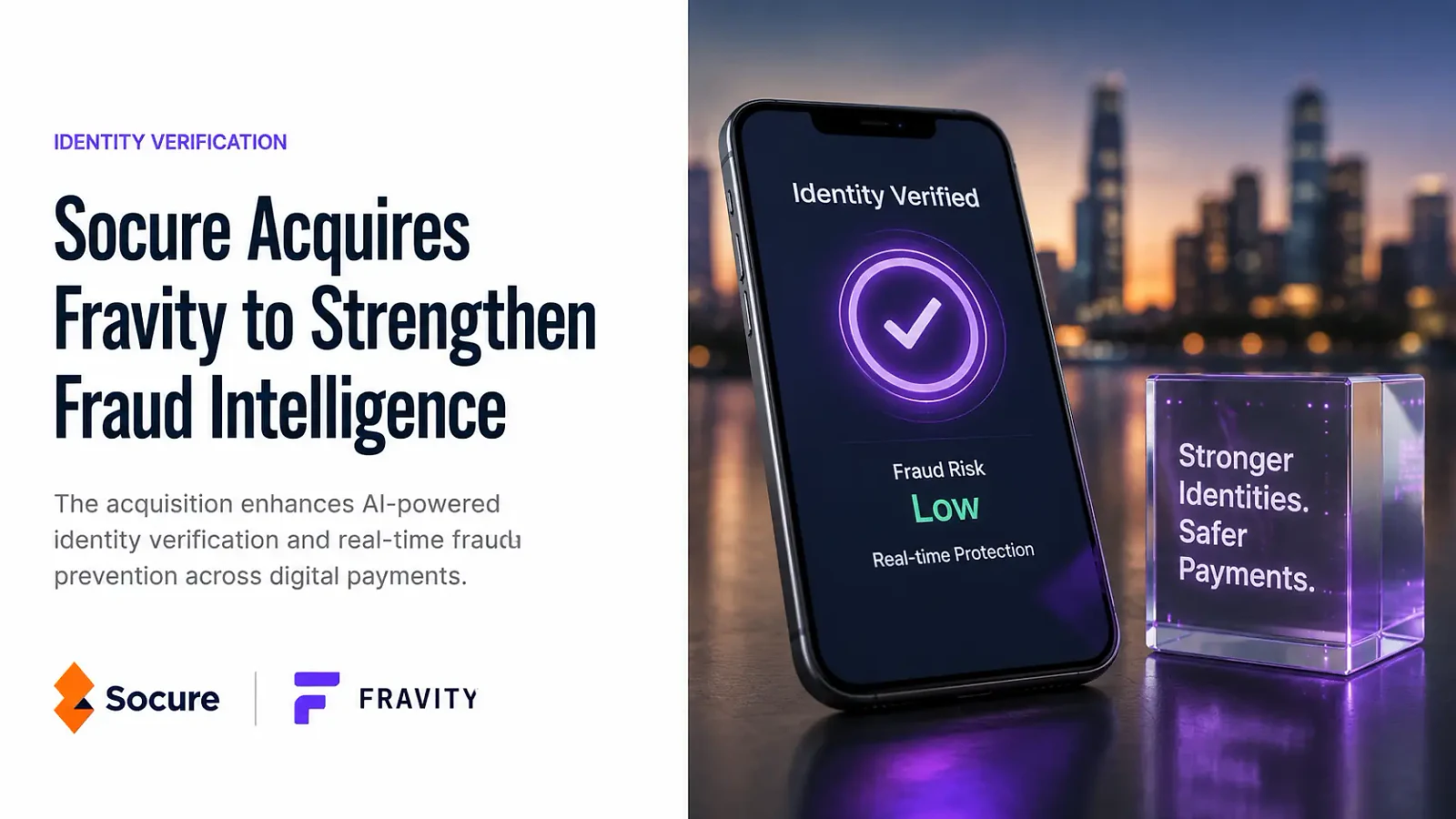
Socure has raised $156 million in a Series E extension that values the identity-verification company at $5.2 billion and acquired Fravity, an agentic operations platform designed to automate fraud, risk and compliance work.
Reuters reported the financing amount on August 27. Socure and lead investor Summit Partners separately confirmed the $5.2 billion valuation, the acquisition and that the investment includes both primary capital and a secondary employee tender offer. The companies did not disclose the price paid for Fravity or the split between new growth capital and employee liquidity.
The transaction is relevant to payments because identity is becoming a control layer not only for people and businesses, but potentially for software agents acting on their behalf.
Fravity moves automation deeper into risk operations
Socure's existing RiskOS platform combines identity and risk signals for fraud and compliance decisions. Fravity adds agentic workflows intended to automate operational work that follows a risk alert, including evidence collection and case handling.
Socure says Fravity's first-party agent-building capabilities will be integrated natively into RiskOS. Reuters reported that the resulting functionality will be branded RiskOS Agents.
The acquisition does not show autonomous AI agents approving consumer payments at scale. It shows an identity and fraud provider investing in agent-based automation inside the risk process itself.
That distinction matters because agentic commerce creates two separate problems. Financial institutions need to detect fraud generated or accelerated by AI, and they also need to determine whether a legitimate software agent is authorised to act for a customer.
Identity becomes a delegated-authority problem
Traditional payment security asks whether the cardholder, account owner or merchant is legitimate. Agent-mediated commerce adds another layer: whether an agent is genuine, who it represents and what that agent is permitted to do.
Summit Partners framed that issue directly in its investment thesis, arguing that verifying “the identity of the agent itself — not just the human it represents” is an emerging frontier.
That creates requirements around verifiable intent, transaction limits, permission scope and revocation. A payment credential can prove access to an account; it does not by itself prove that an AI agent had authority to make a particular purchase.
Socure's network gives the company a potentially important position in that control layer. It says it serves more than 3,000 customers across 190-plus countries. Company disclosures from earlier in 2026 said 2025 annual recurring revenue finished at $315 million and that Socure completed more than 5 billion identity verifications during the year.
Those are historical company metrics, not measures of Fravity adoption.
The funding is large, but not all of it is growth capital
The $156 million financing should be described carefully. Reuters reported that it includes primary funding and a secondary tender offer for employees. Without a disclosed split, the full amount cannot be treated as new cash going onto Socure's balance sheet.
The valuation rose from $4.5 billion at Socure's earlier Series E financing roughly five years ago to $5.2 billion in the new extension.
The more strategically important development is the combination of capital and product expansion. Socure is positioning identity verification, fraud intelligence and automated investigations inside a single risk operating layer.
As AI agents begin initiating more commercial actions, payment infrastructure will need controls that sit above the payment method itself. Identity, intent and permissioning may become as important to agentic commerce as card credentials and token standards are to human-initiated payments.
Socure's Fravity deal is evidence that vendors are building toward that control layer. The next proof point will be production data showing agents being authenticated, constrained and monitored in real financial transactions.
The transaction combines scale with a new automation layer
Metric — Figure — Qualification
Financing — $156M — Reuters; includes primary capital and employee secondary
Valuation — $5.2B — Company/investor confirmed
Previous Series E valuation — $4.5B — Approximately five years earlier
Customers — 3,000+ — Company-reported network
Countries — 190+ — Company-reported footprint
2025 ARR — $315M — Historical company metric
2025 identity verifications — >5B — Historical company metric
Those numbers explain why the acquisition is more than an early-stage agentic-AI experiment. Fravity's automation is being inserted into a risk platform already used across a large institutional network. That creates an opportunity to train and deploy workflows against a broad set of fraud and identity signals, although customer scale does not prove adoption of the new agents themselves.
The key commercial question is whether agent-based case work reduces investigation cost without weakening governance. Financial institutions need audit trails, escalation rules and human review for high-risk decisions. In that setting, the most useful agent may not be one that autonomously approves or rejects a transaction, but one that assembles evidence, applies policies and presents a decision-ready case to an authorised reviewer.