Robinhood Chain TVL Hits $540M as Ethena's USDe Overtakes Robinhood's Own USDG
Robinhood Chain's TVL has topped $540 million, but the meaningful August shift is stablecoin demand: Ethena's USDe is driving the inflows while USDG has stopped growing. The September 30 end of subsidized gas will show whether Robinhood can turn early retail activity into durable onchain demand.
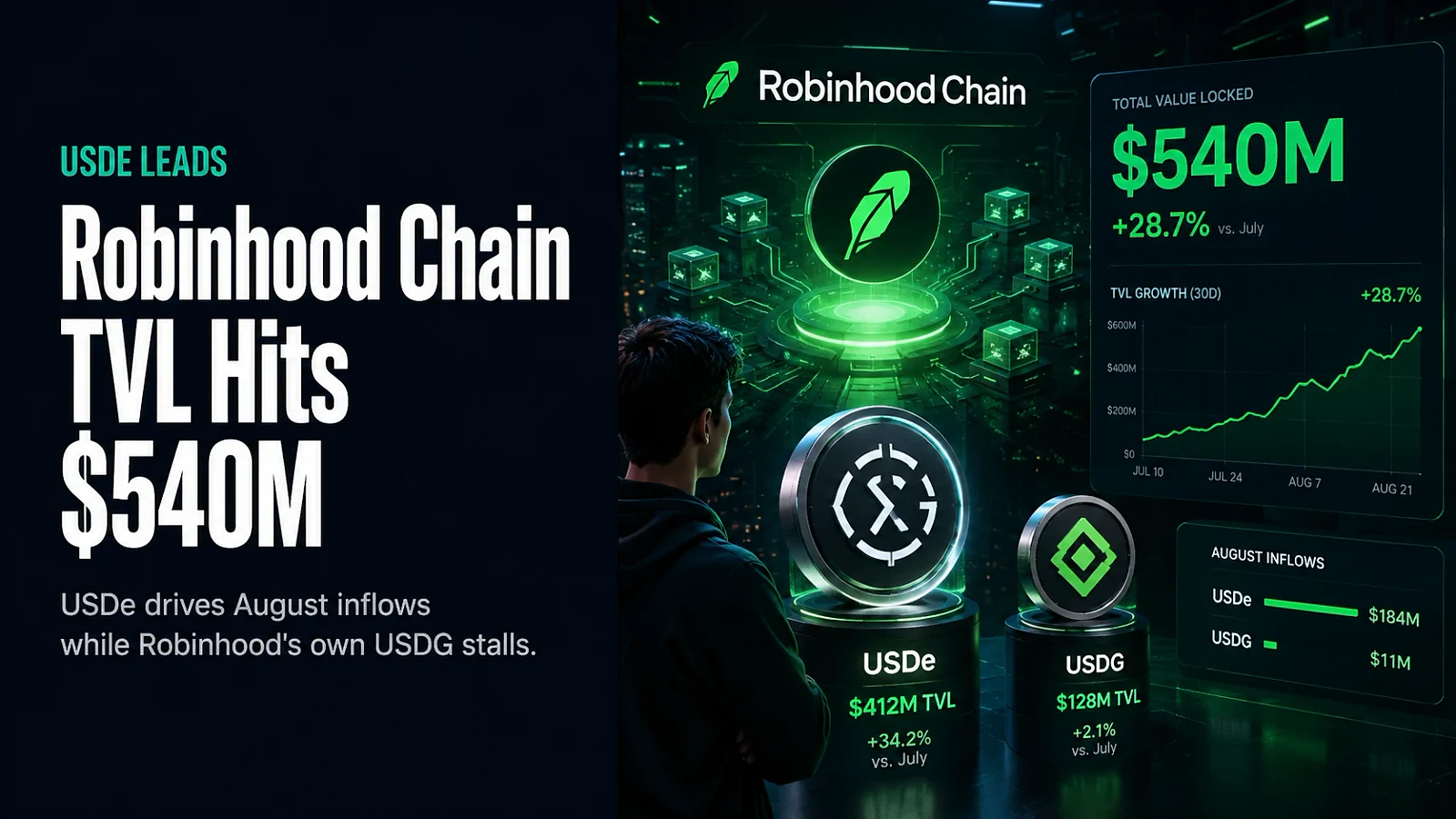
Robinhood Chain has pushed past $540 million in total value locked, up more than 45% in August, in a sharp early validation of the brokerage's distribution-led blockchain bet. But the composition of that growth is a strategic embarrassment: Ethena's USDe is now the chain's dominant stablecoin growth engine, while Robinhood's house dollar, USDG, has largely stopped expanding. [1]
The network was launched on July 1 as a permissionless Layer 2 for financial services and tokenized real-world assets, yet August's ledger points somewhere else. Stablecoins have reached roughly $640 million, up more than 22% month to date, while the tokenized RWA segment is only $32 million, or 6% of TVL. [1][2]
The USDe flip is about momentum, not just a label
USDe rose almost 50% from the start of August to $286 million, representing 44% of the stablecoin supply reported on Robinhood Chain. USDG, by contrast, has remained in a $330 million to $350 million range through most of the month after commanding 92.7% of supply in the chain's first week. [1]
That means the supplied figures need a careful reading. USDG still appears slightly larger in absolute dollars at the time of the August snapshot, so USDe has not literally passed it by outstanding balance. The flip is more consequential in market behavior: USDe has overtaken USDG as the source of incremental stablecoin demand and the asset setting the chain's DeFi liquidity narrative. In Robinhood's own venue, the stablecoin users are adding is not the one the company put at the center of its product stack.
Stablecoin composition, August 18 — Onchain value — Share of chain stablecoins — August direction
USDe — $286M — 44% — Nearly 50% growth from the start of August
USDG — $330M-$350M — About 52%-55% — Essentially flat through most of August
Other stablecoins — Implied $4M-$24M — About 1%-4% — Residual from rounded reported totals
Total stablecoin market cap — About $640M — 100% — More than 22% month-to-date growth
The distinction matters because USDG is the dollar-backed asset Robinhood chose for Robinhood Earn, its in-app lending offer. Eligible users lend USDG from a self-custody wallet at an estimated 7% APY through Morpho, with Ethena named among the supporting partners. [2] That should have created a home-field distribution advantage. Instead, traders and collateral users have accumulated Ethena's dollar faster.
USDe is not a conventional bank-reserve stablecoin. Ethena describes it as a delta-neutral synthetic dollar: the protocol pairs volatile backing assets with short derivatives of roughly matching notional size so price moves are generally offset. USDe itself should not be confused with the reward-accruing staked version, sUSDe, but the wider Ethena design is familiar to DeFi users seeking dollar liquidity and crypto-native yield exposure. [5]
A large TVL number, a smaller RWA thesis
The headline growth is real, but it does not yet prove that tokenized equities are the network's product-market fit. Tokenized RWAs increased 120% month over month to $32 million, a strong absolute gain. Their share of TVL nevertheless fell from nearly one-third on July 7 to 6%, because stablecoin capital has grown much faster. [1]
Robinhood Chain trajectory — Date or period — Reported result — What it shows
RWA share of TVL — July 7 — Nearly one-third — Tokenized assets were initially a prominent share of the base
DEX volume peak — July 12 — $877.6M in one day — The chain briefly ranked second globally, behind Solana
Daily active users — July 21 — About 245K-323K — Activity briefly surpassed Base
Cumulative DEX volume — First four weeks — More than $9B — Rapid turnover after the July 1 launch
TVL — August 18 — More than $540M, +45% in August — Stablecoins are now the central balance-sheet driver
The early activity profile makes that gap less surprising. More than 80% of cumulative DEX volume was memecoin trading, while tokenized equities accounted for only 4% of activity, according to reporting on the Base comparison. [4] Galaxy Research independently put memecoins at 79.2% of DEX volume as of July 27 and described one breakout token, CASHCAT, as worth multiples of every tokenized RWA on the network combined at its peak. [3]
CASHCAT and its imitators did not create Robinhood Chain's liquidity from nothing, but they supplied the fastest reason to transact. They also showed the difference between what the chain was designed to host and what its users currently want to trade. That is not necessarily a permanent verdict on Stock Tokens, lending or collateral markets. It is, however, a warning against equating high DEX volume with adoption of the regulated-finance use case.
“Builders go where users are. Users go where the apps work and add value. That flywheel is the moat,” Base head of global growth Xen Baynham-Herd said in the network's response to Robinhood's early surge. [4]
September 30 is the real test
Robinhood's distinctive advantage is demand-side distribution: Galaxy estimates the company has nearly 28 million global customers, and the Chain's first weeks paired that reach with a 90-day gas subsidy for Robinhood Wallet users. [3] The program is due to end September 30, 2026, creating the first clean test of whether activity persists when a key part of the on-ramp is no longer subsidized.
Gas subsidy timeline — Milestone — Why it matters
July 1, 2026 — Public mainnet launches — Robinhood begins its first 90 days of covered wallet transaction costs
July-August 2026 — Memecoin-heavy activity and stablecoin inflows accelerate — Headline volume benefits from an unusually cheap user experience
September 30, 2026 — Subsidy ends — First profitability and retention test for Robinhood-native demand
The subsidy cliff will not answer every question. Much of the speculative flow has used third-party launchpads and bots rather than Robinhood Wallet, so it is a test of Robinhood-routed behavior more than every transaction on the permissionless chain. [3] Still, it is the date that matters for investors watching the chain wars covered in NewCurrency's analysis of Circle's Arc, a shrinking stablecoin market and PYUSD's own growth problem.
For now, the clearest August verdict is not that Robinhood Chain lacks users. It is that users have arrived for liquid dollars and fast speculation, and they have favored Ethena's synthetic dollar at the margin. USDG's static supply makes the contrast impossible to ignore: a brokerage can distribute a chain, but it cannot decree which stablecoin DeFi wallets choose to hold.
References
[1] The Cryptonomist, "Robinhood Chain Growth Surges With Stablecoins Leading," August 18, 2026. https://en.cryptonomist.ch/2026/08/18/robinhood-chain-growth-august/
[2] Robinhood, "Robinhood Accelerates Global Expansion with Robinhood Chain Mainnet, Stock Tokens, Agentic Trading and New Suite of DeFi Products," July 1, 2026. https://robinhood.com/us/en/newsroom/robinhood-accelerates-global-expansion-robinhood-chain-mainnet-stock-tokens-agentic-trading/
[3] Galaxy Research, "Will Robinhood Chain Succeed Where Coinbase's Base Stumbled?," August 19, 2026. https://www.galaxy.com/insights/research/robinhood-chain-launch-analysis-base-comparison-memecoins-distribution-thesis
[4] Bitcoin.com News, "Base Says Its Distribution Edge Can Outlast Robinhood Chain's Early Surge," July 31, 2026. https://news.bitcoin.com/featured/base-robinhood-chain-distribution-edge-pollak-armstrong/
[5] Ethena Docs, "How USDe Works." https://docs.ethena.fi/overview/how-usde-works