Robinhood Chain Mainnet Goes Live with 2,000 Stock Tokens, Agentic Accounts, and 120 Country Reach
Robinhood has put its Arbitrum-based Layer 2 into public mainnet from London, tying 2,000-plus Stock Tokens, wallet distribution, DeFi access, perpetual futures and an agentic trading roadmap into one global product stack. The launch is ambitious, but product eligibility still changes sharply by jurisdiction and by asset class.
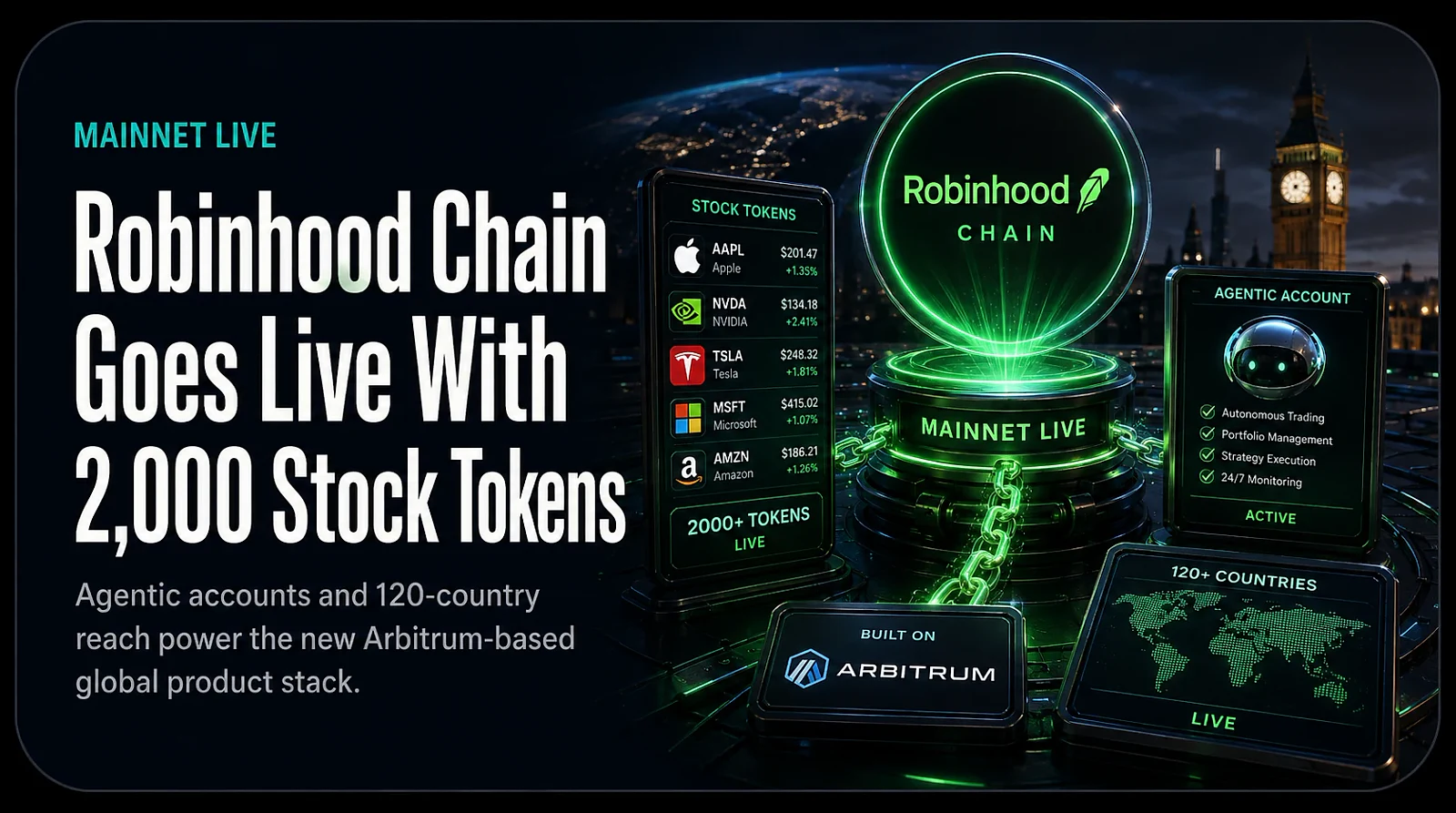
Robinhood used a London launch event on July 1, 2026 to put Robinhood Chain into public mainnet and widen its bet that a broker can also be a wallet provider, chain operator and interface for AI-directed finance. The Arbitrum-based Layer 2 arrived alongside a new generation of 2,000+ Stock Tokens, available through Robinhood Wallet in 120+ countries, a materially broader distribution plan than the roughly 200-token European rollout a year earlier. [1][2]
The announcement at the Old Royal Naval College, branded “The World is Flat,” is not simply a blockchain launch. Robinhood is assembling the brokerage, custody-adjacent wallet experience, public execution rail, decentralized-finance access and agentic-control layer in one product family. Stock Tokens are not available to US persons, and several offerings remain in rollout or are restricted by jurisdiction, but the combination gives Robinhood a more vertically integrated global stack than its original trading app. [1][2]
A Chain Built Around Distribution
Robinhood Chain is a permissionless, AI-native Layer 2 built using the Arbitrum platform and aimed at financial services and tokenized real-world assets. It has fast block times and lending and borrowing primitives from launch. Uniswap is deploying a dedicated automated market maker as the primary public liquidity protocol, while Pleiades is providing a proprietary AMM venue; Alchemy, BitGo and Chainlink are part of the initial infrastructure and data layer. [1][2]
The strategic distinction is distribution. Coinbase has paired Base with developer-facing agent tooling, while Robinhood starts with a large brokerage and wallet audience then supplies the chain, tokenized assets and transaction venues underneath. The parallel with AI-wallet efforts such as Alipay's is the effort to place an intelligent interface between a consumer and increasingly complex financial rails. Robinhood's version is more trading-centric: its own named wallet, its own Layer 2 and a defined suite of onchain markets sit below the agent.
Robinhood Chain launch stack — Launch measure — What is live or rolling out
Stock Tokens — 2,000+ US stocks and ETFs — New global catalogue, following about 200 at the June 2025 launch and a further 500 added in October 2025
Geographic reach — 120+ countries — Robinhood Wallet access for eligible non-US users, subject to jurisdictional restrictions
Expanded perpetual markets — 7 named instruments — GOLD, SILVER, QQQ, EUR/USD, WTI, Brent crude and EWY, with up to 10x leverage in Europe
Named chain, wallet and venue integrations — 10 — Chainlink, Alchemy, BitGo, Uniswap, Ledger, Trust Wallet, Rialto, Lighter, Arcus and 1inch
Stock Tokens Move Beyond the App
The new Stock Tokens are tokenized debt securities issued by Robinhood Assets (Jersey) Limited, providing economic exposure rather than legal or beneficial ownership rights in the underlying shares. Eligible users can trade them around the clock directly on Robinhood Chain, use them as lending-pool assets or collateral, and reach spot liquidity through Uniswap, Rialto, Lighter, Arcus and 1inch. Forbes reported that the new tokens are designed to work across third-party wallets including Ledger and Trust Wallet, a sharp change from the older app-confined European product, now labeled Classic Stock Tokens. [1][2]
That open distribution is the important commercial test. A catalogue measured in thousands matters, but composability determines whether the tokens become a durable settlement asset or merely a different wrapper for foreign equities. Robinhood is explicitly pursuing the former: onchain transfers, DeFi collateral and external-wallet support make the asset useful after it leaves the brokerage interface. The company still retains the sensitive issuance, eligibility and redemption architecture, so “permissionless” infrastructure does not erase securities-law boundaries. [1][2]
Perpetuals, Wallet and Dollar Yield
Robinhood Wallet is the handoff point between the new chain and decentralized venues. Eligible users in selected jurisdictions can access perpetual futures on Lighter through the wallet, while the European expansion adds commodity, ETF and foreign-exchange contracts in waves, with up to 10x leverage. Those products are available 24 hours a day, seven days a week, but they are not a universal launch: the Lighter arrangement and individual contract availability carry country restrictions. [1][5]
The more consequential balance-sheet-adjacent product is Robinhood Earn. The service is rolling out to eligible US app users as a decentralized lending offering for dollar-backed USDG, the Global Dollar Network stablecoin, through Morpho. Robinhood advertises an estimated 7% APY and insurance for covered cyber or smart-contract-exploit losses, while making clear that users lend from a self-custody wallet and remain exposed to substantial loss risk. [1][2]
USDG matters because it gives the product stack a native dollar asset rather than making the wallet merely a route to third-party tokens. If Robinhood can couple Stock Token collateral, USDG lending and onchain trading, it has the beginnings of an internal financial loop that spans brokerage-like exposure and DeFi liquidity. That would be a direct strategic counterweight to an exchange-led model centered on a separate chain and stablecoin ecosystem.
The Agentic Layer Is the Risky Differentiator
Robinhood introduced Agentic Trading and its Agentic Credit Card on May 27, initially with equities trading in beta. The structure uses the company's Trading MCP, lets a customer fund a separate agentic account, provides trade notifications and allows the customer to disconnect the agent. The July 1 product package extends that thesis to crypto with Agentic Accounts planned for eligible US traders, who will set capital allocation and safety guardrails while connecting an AI model of their choice. [3][4]
“The idea behind agentic trading…[is] every capability a human can do will be available to an AI agent,” Vlad Tenev, Robinhood’s chief executive, told CNBC after the London launch. [3]
That ambition creates Robinhood Chain's clearest differentiator and its clearest operational risk. Automation can scan data and act quickly, but it can also misunderstand instructions or operate on incomplete information. Robinhood's disclosures put responsibility for agent-directed trades on the customer, a useful reminder that an AI account is an execution tool, not an investment adviser. [1][4]
Global Expansion, With Limits
The launch also formalized geographic moves around the core products. Robinhood became available to Canadian residents after acquiring WonderFi, plans a UK crypto-trading launch, and said Robinhood Singapore had secured a capital-markets-services licence from the Monetary Authority of Singapore, a step toward future brokerage services. [1][5]
Taken together, the London package gives Robinhood a credible answer to the question of where retail finance goes when securities, wallets, stablecoins and agents converge. The chain is now live, but the next proof points are less theatrical: whether 2,000 Stock Tokens gain external liquidity, whether USDG Earn retains users through market stress, and whether agents add useful automation without increasing customer harm.
References
[1] Robinhood, “Robinhood Accelerates Global Expansion with Robinhood Chain Mainnet, Stock Tokens and Agentic Trading,” July 1, 2026. https://robinhood.com/us/en/newsroom/robinhood-accelerates-global-expansion-robinhood-chain-mainnet-stock-tokens-agentic-trading/
[2] Nina Bambysheva, Forbes, “Robinhood Launches Its Own Blockchain, New Stock Tokens And DeFi Products,” July 1, 2026. https://www.forbes.com/sites/ninabambysheva/2026/07/01/robinhood-launches-its-own-blockchain-new-stock-tokens-and-defi-products/
[3] Kai Nicol-Schwarz, CNBC, “Robinhood CEO: AI agents will have ‘capability’ of humans in trading,” July 2, 2026. https://www.cnbc.com/2026/07/02/robinhood-ceo-ai-agents.html
[4] Robinhood, “Robinhood is Now Open to Agents,” May 27, 2026. https://robinhood.com/us/en/newsroom/robinhood-is-now-open-to-agents/
[5] Reuters, “Robinhood expands perpetual futures offering in Europe, plans crypto launch in UK,” July 1, 2026. https://www.reuters.com/legal/transactional/robinhood-expands-perpetual-futures-offering-europe-plans-crypto-launch-uk-2026-07-01/