Ripple Expands RLUSD to 40+ Chains via Wormhole, Native Token Transfers Live
Ripple has activated Wormhole's Native Token Transfers framework to bring RLUSD natively to over 40 blockchain networks, including Ethereum L2s Base, Optimism, Ink, and Unichain, with a circulating supply now at $1.731 billion and reserves confirmed at $1.833 billion as of late May.
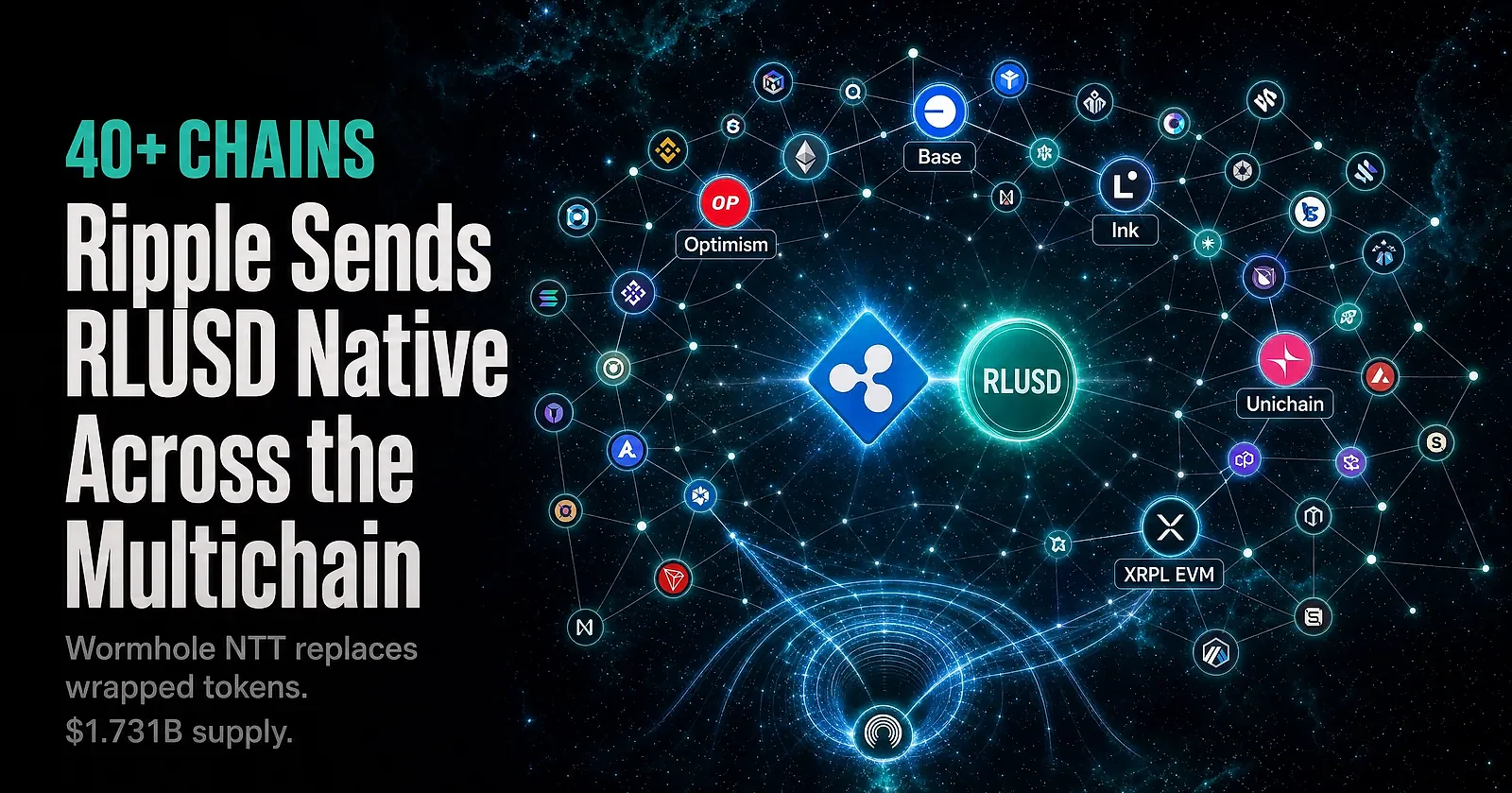
Ripple has completed the multichain activation of its RLUSD stablecoin, deploying the asset natively across more than 40 blockchain networks through Wormhole's Native Token Transfers (NTT) framework as of early June 2026. The rollout marks the first time a New York Department of Financial Services-regulated stablecoin has achieved broad multi-network presence without relying on wrapped token representations, a structural distinction that changes how institutional liquidity moves across chains.[1][2]
How Wormhole NTT Differs from Wrapped Bridges
The mechanism behind the expansion matters as much as its scope. Traditional cross-chain bridges lock the native token on the origin chain while a synthetic representation circulates on the destination, fracturing canonical supply and introducing bridge custody risk. Wormhole's Native Token Transfers framework allows Ripple to retain issuance and burn authority on each destination chain via Ripple-controlled smart contracts, meaning RLUSD on Base, Optimism, Ink, or Unichain is the canonical token itself, backed by the same segregated reserve pool.[1][2]
This approach mirrors Circle's Cross-Chain Transfer Protocol (CCTP), which achieves native USDC on each chain through a burn-and-mint model rather than lock-and-wrap. Both mechanisms produce a single unified supply figure and cleaner redemption mechanics. RLUSD's NTT integration launched across a broader simultaneous footprint: 40+ chains at once against CCTP's more gradual chain-by-chain rollout.
"BREAKING: $RLUSD is going multichain to Base, Optimism, Ink, and Unichain powered by Wormhole NTT." - Robinson Burkey, Wormhole [2]
Networks Now Live and Supply Metrics
The networks activated through the Wormhole NTT integration include Ethereum Layer 2s that represent the highest-activity institutional DeFi venues in 2026. Base, operated by Coinbase, and Optimism together account for a substantial share of L2 transaction volume. Ink, Kraken's Layer 2, and Unichain, built by Uniswap, complete the L2 set. The expansion also includes the XRP Ledger EVM sidechain, which gives Ethereum-tooling-compatible developers a route into XRPL liquidity while maintaining native connectivity to the underlying XRP Ledger.[1]
RLUSD's circulating supply stood at $1.731 billion at the time of the multichain activation, with reserve assets confirmed at $1.833 billion as of May 28, providing over-collateralization of approximately 5.9 percent above the 1:1 minimum requirement. The reserve buffer, held in U.S. dollar deposits and short-dated Treasury securities at BNY Mellon, is attested monthly by Deloitte. RLUSD now ranks as the 8th largest stablecoin globally by circulating supply, having grown from $132 million at its December 2024 launch to its current scale in roughly 18 months.[3]
Metric — Value
Circulating Supply — $1.731 billion
Reserve Fund Value (May 28) — $1.833 billion
Reserve Coverage Ratio — approx. 105.9%
Global Stablecoin Rank — 8th largest
Reserve Custodian — BNY Mellon
Reserve Attestation — Monthly, Deloitte
New Networks (NTT live) — Base, Optimism, Ink, Unichain, XRPL EVM
Total Network Count — 40+
Issuer Charter — NYDFS Limited Purpose Trust
Turkey Expansion and Geopolitical Context
Concurrent with the Wormhole rollout, Ripple announced institutional availability of RLUSD in Turkey through three new exchange partnerships: BiLira, Bitexen, and Bitlo. The expansion is geopolitically significant. Turkey operates one of the world's highest per-capita cryptocurrency adoption rates, driven in part by sustained lira depreciation and limited access to dollar-denominated savings instruments through conventional channels.[4]
RLUSD's entry into Turkey does not simply replicate existing dollar stablecoin corridors. Because RLUSD operates under NYDFS oversight and carries institutional-grade compliance features, it creates a regulated dollar-access pathway for Turkish institutions that previously had to rely on less-regulated alternatives. Jack McDonald, Ripple's Senior Vice President of Stablecoins, noted the demand signal directly: "RLUSD has rapidly gained traction in financial use cases, serving as a vital bridge for payments, tokenization, and collateral management."[4]
The Turkey corridor represents a different profile from Ripple's earlier Middle East expansions: a high-volume emerging market where demand is retail-adjacent but served through institutional channels, with BiLira, Bitexen, and Bitlo as the distribution layer.
Partner — Country — Role
BiLira — Turkey — Exchange and distribution
Bitexen — Turkey — Exchange and distribution
Bitlo — Turkey — Exchange and distribution
Istanbul Technical University — Turkey — UBRI research node, XRPL validator
Mastercard Settlement and Evernorth Holdings
The RLUSD multichain expansion coincides with Mastercard's June 3 activation of 24/7 settlement capabilities using RLUSD on the XRP Ledger, making RLUSD one of the first regulated stablecoins to serve as a real-time settlement layer for a major card network. The two developments illustrate how RLUSD is being built simultaneously into payment rails and DeFi infrastructure.[1]
Evernorth Holdings, an XRP-focused treasury company planning to list on Nasdaq under ticker XRPN, has separately indicated it will use RLUSD as an on-ramp for institutional DeFi on the XRP Ledger, adding another institutional demand source as the company scales its XRP treasury strategy.[1][5]
Comparison to USDC CCTP Strategy
Feature — RLUSD via Wormhole NTT — USDC via CCTP V2
Cross-chain mechanism — Native Token Transfers, burn-and-mint — Cross-Chain Transfer Protocol, burn-and-mint
Wrapped tokens used — No — No
Chain count at launch — 40+ simultaneously — Gradual expansion, 15+ native chains
Regulatory charter — NYDFS trust, OCC conditional approval — State MTLs, OCC conditional approval (Circle)
Reserve composition — Cash and short-term Treasuries only — BlackRock-managed gov. money market fund
Attestation — Monthly, Deloitte — Monthly, Deloitte
Primary institutional use case — Cross-border payments, XRP Ledger settlement — Broad institutional and consumer settlement
The structural difference in deployment scope reflects Ripple's strategy of using RLUSD to anchor XRP Ledger-adjacent liquidity pools while also accessing the broader Ethereum L2 ecosystem where most institutional DeFi volume currently sits. The simultaneous activation across 40 networks is operationally more aggressive than Circle's gradual CCTP expansion, though USDC retains a considerably larger total market cap at roughly $60 billion against RLUSD's $1.731 billion.[3]
References
[1] Crypto.news, "Ripple unlocks RLUSD access across 40 chains via Wormhole bridge," June 4, 2026. https://crypto.news/ripple-unlocks-rlusd-access-across-40-chains-via-wormhole-bridge/
[2] Wormhole, "Ripple USD (RLUSD) expands to L2s with Wormhole's NTT standard," December 2025. https://wormhole.com/blog/ripple-usd-rlusd-expands-to-l2s-with-wormholes-ntt-standard
[3] CoinStats, "Ripple USD (RLUSD) Fundamental Analysis May 2026," May 2026. https://coinstats.app/ai/a/fundamental-analysis-ripple-usd
[4] The Cryptonomist, "Ripple RLUSD stablecoin launch Turkey via BiLira, Bitexen," June 2, 2026. https://en.cryptonomist.ch/2026/06/02/ripple-rlusd-stablecoin-launch-turkey/
[5] Cohen and Company Capital Markets, "Evernorth to Go Public With Over $1 Billion in Gross Proceeds," October 2025. https://www.cohencm.com/news/evernorth-to-go-public-with-over-1-billion-in-gross-proceeds