Revolut Ships First Physical Crypto Card with LED Display to 70 Million Users
Revolut launched its first physical crypto debit card on May 18, 2026, a Dogecoin-themed card with an integrated LED display that converts more than 200 cryptocurrencies to fiat at checkout with no exchange fees, available across the UK and EEA to a global base of over 70 million users.
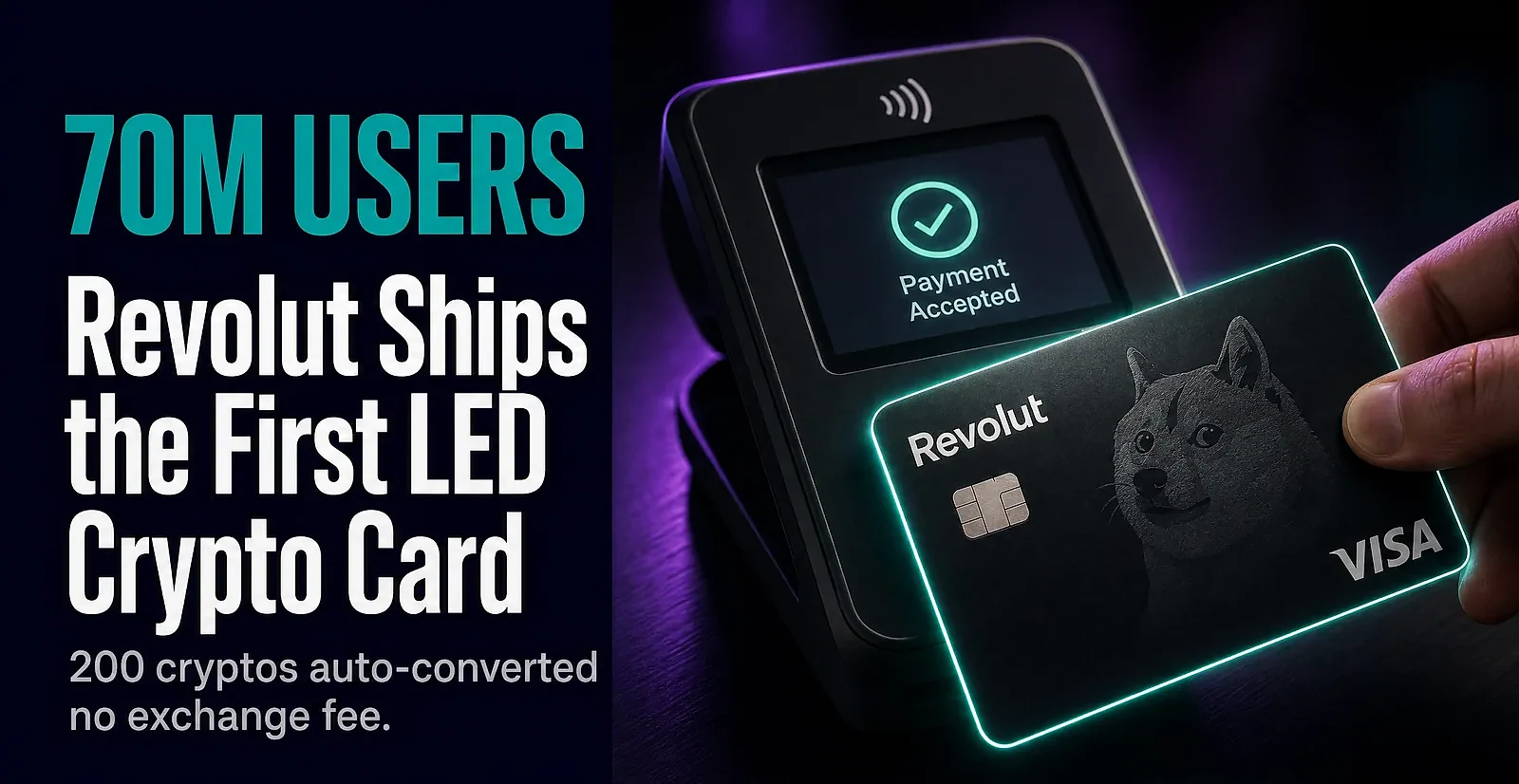
Revolut shipped its first physical crypto debit card on May 18, 2026, a Dogecoin-themed card with an integrated LED display that illuminates at the point of contactless payment. The card is accepted anywhere Visa and Mastercard are, automatically converts more than 200 cryptocurrencies to fiat at checkout with no additional exchange fees, and carries a £100,000 per-transaction limit with a cap of 100 currency exchanges within any 24-hour period. Initial availability covers the UK and European Economic Area, with exceptions for Hungary, Switzerland, and Portugal [1].
What the Card Does
The mechanics are straightforward. When a holder taps or inserts the card at a merchant terminal, Revolut converts the required amount from the user's crypto balance to the merchant's settlement currency in real time. The merchant receives fiat; no crypto integration is required on the seller side. The card links to the Revolut app's existing crypto wallet infrastructure, which already supports more than 200 digital assets, and integrates with Apple Pay and Google Pay for contactless and mobile payments. ATM cash withdrawals are also supported [1][2].
The LED display activates at contactless payment. The Dogecoin branding on the card is a marketing choice, not a functional constraint: the card can draw on any supported asset in a user's Revolut portfolio at checkout, not solely Dogecoin (DOGE). The broader strategic point is the underlying conversion infrastructure, which handles the settlement leg silently behind the consumer payment experience.
One friction point the card does not eliminate is tax. In most jurisdictions, spending crypto via a debit card constitutes a disposal of a cryptoasset, potentially triggering capital gains obligations. Revolut discloses this in product terms, but routine use across many small transactions creates a record-keeping burden absent from standard consumer banking. That gap between legal reality and frictionless-spending marketing remains an open problem for the category [2].
Regulatory Context
The launch is not a standalone product decision. It arrives in the wake of a full UK banking licence Revolut received in March 2026, after a five-year regulatory process, and a US banking charter application filed the same month [1][2]. On May 14, 2026, the Financial Conduct Authority (FCA) granted Revolut Trading a Variation of Permissions covering leveraged investment products, discretionary portfolio management, and private wealth advisory services [1][3]. The crypto card is one product within a broader push by co-founders Nik Storonsky and Vlad Yatsenko to convert Revolut from a fintech licence holder into a regulated full-service bank.
That regulatory trajectory matters for the crypto card specifically. A banking licence changes the relationship between Revolut and its customers in ways that a payment institution or e-money licence cannot: it enables deposit-taking, structured lending, and the credibility required for high-net-worth product lines. The crypto card launches into that expanded framework, making Revolut simultaneously one of the most regulated and most crypto-integrated institutions in Europe [3].
"Our partnership with Pyth is an important milestone in the journey to modernise finance. As DeFi continues to gain traction, Pyth's position as the backbone of the industry will help Revolut contribute to this transformation. By working with Pyth to provide our reliable market data to applications, Revolut can influence digital economies by ensuring developers and users have access to the precise, real-time information they need."
- Mazen Eljundi, Global Business Head of Crypto, Revolut [4]
Distribution Scale: The Defining Variable
The card's features are competitive but not unique. What distinguishes the Revolut launch is the addressable user base. Revolut reported more than 70 million global customers as of early 2026, having grown from 68.3 million at the close of 2025 [2]. That figure dwarfs every other dedicated crypto card issuer by a factor that makes head-to-head feature comparisons secondary.
Platform — Reported Users / Clients — Network — Annualized Volume — Notes
Revolut Crypto Card — 70M+ (platform) — Visa + Mastercard — Not disclosed — UK and EEA rollout, May 2026
RedotPay — 7M — Visa — Not disclosed — 130+ countries, virtual and physical
KAST — 1M+ — Visa — ~$5B — Stablecoin-native; $80M Series A 2026
Wirex — 7M+ — Visa + Mastercard — ~$1.3B annualized (BaaS) — $20B+ total processed to date
MetaMask Card — Not disclosed — Mastercard — Not disclosed — Non-custodial, self-sovereign
Sources: [1][2][4][5]
KAST raised an $80 million Series A at a $600 million valuation in early 2026 and reached one million users with approximately $5 billion in annualized transaction volume after 16 months [5]. Wirex serves more than 7 million customers across direct and Banking-as-a-Service platforms and reached $1 billion in annualized onchain stablecoin card volume in 131 days on its BaaS product [5]. RedotPay serves 7 million users across 130-plus countries and completed a $107 million Series B in late 2025 [5].
Revolut enters that field with a user base roughly ten times larger than RedotPay and Wirex combined. That arithmetic does not guarantee transaction volume: a Revolut user with a small crypto balance generates less volume than a KAST user running daily stablecoin remittances. But it creates a conversion funnel for crypto card adoption that existing providers cannot replicate at scale.
Competitive Frame: Exchange-Issued vs. Bank-Issued
Most crypto debit cards are issued by exchanges: Binance, Crypto.com, Coinbase, and Bybit all operate in that model, serving users who already hold crypto. Revolut's user base was built differently, as a multi-currency spending and travel account that acquired tens of millions of customers who may hold crypto but do not identify primarily as crypto users. The card reaches that population through an existing banking relationship, rather than requiring them to open a separate exchange account.
That distinction is what makes the Dogecoin theme surface-level marketing rather than strategy. The viral branding serves awareness among crypto-native audiences, but the card's commercial logic rests on Revolut's 70 million mainstream users discovering they can spend Bitcoin or Ethereum balances the same way they spend pound or euro balances. The LED display is a conversation starter at the point of sale. The real product is the regulatory-grade, bank-licensed infrastructure sitting behind it [1][2][3].
What Comes Next
Revolut's US banking charter application filed in March 2026 signals an intent to extend the card into the American market, where no major bank-licensed crypto debit card yet exists. The FCA permissions for leveraged investment products and private wealth advisory open additional product lines attachable to the same card infrastructure. Geographic exclusions at launch, covering Hungary, Switzerland, and Portugal, reflect local licensing complexity rather than strategic preference. Revolut has not disclosed timelines for those markets or for a US rollout [3].
References
[1] Peace Longe, "Revolut launches first physical crypto card," crypto.news, May 18, 2026. https://crypto.news/revolut-launches-first-physical-crypto-card/
[2] Blockhead, "Revolut Launches Physical Crypto Card With Dogecoin Theme, LED Display," Blockhead, May 19, 2026. https://www.blockhead.co/2026/05/19/revolut-launches-physical-crypto-card-with-dogecoin-theme-led-display/
[3] IFM Correspondent, "Eyeing full-service bank status, Revolut launches crypto card," International Finance, May 20, 2026. https://internationalfinance.com/fintech/eyeing-full-service-bank-status-revolut-launches-crypto-card/
[4] "Announcing our partnership with Pyth Network," Revolut Blog, January 8, 2025. https://www.revolut.com/blog/post/pyth-partnership-uk/
[5] "KAST Announces $80M Series A," KAST Blog, May 2026. https://www.kast.xyz/blog/kast-announces-80m-series-a; "Wirex Sets New Record As Fastest-Growing Stablecoin Infrastructure," Wirex, April 29, 2026. https://www.wirexapp.com/post/wirex-sets-new-record-as-fastest-growing-stablecoin-infrastructure