Revolut begins phased EURR rollout as euro stablecoin enters a mainstream banking app
EURR is being rolled out to selected customers in Denmark, Poland and Portugal, pairing Revolut's retail distribution with stablecoin issuance infrastructure supplied by Stripe-owned Bridge.
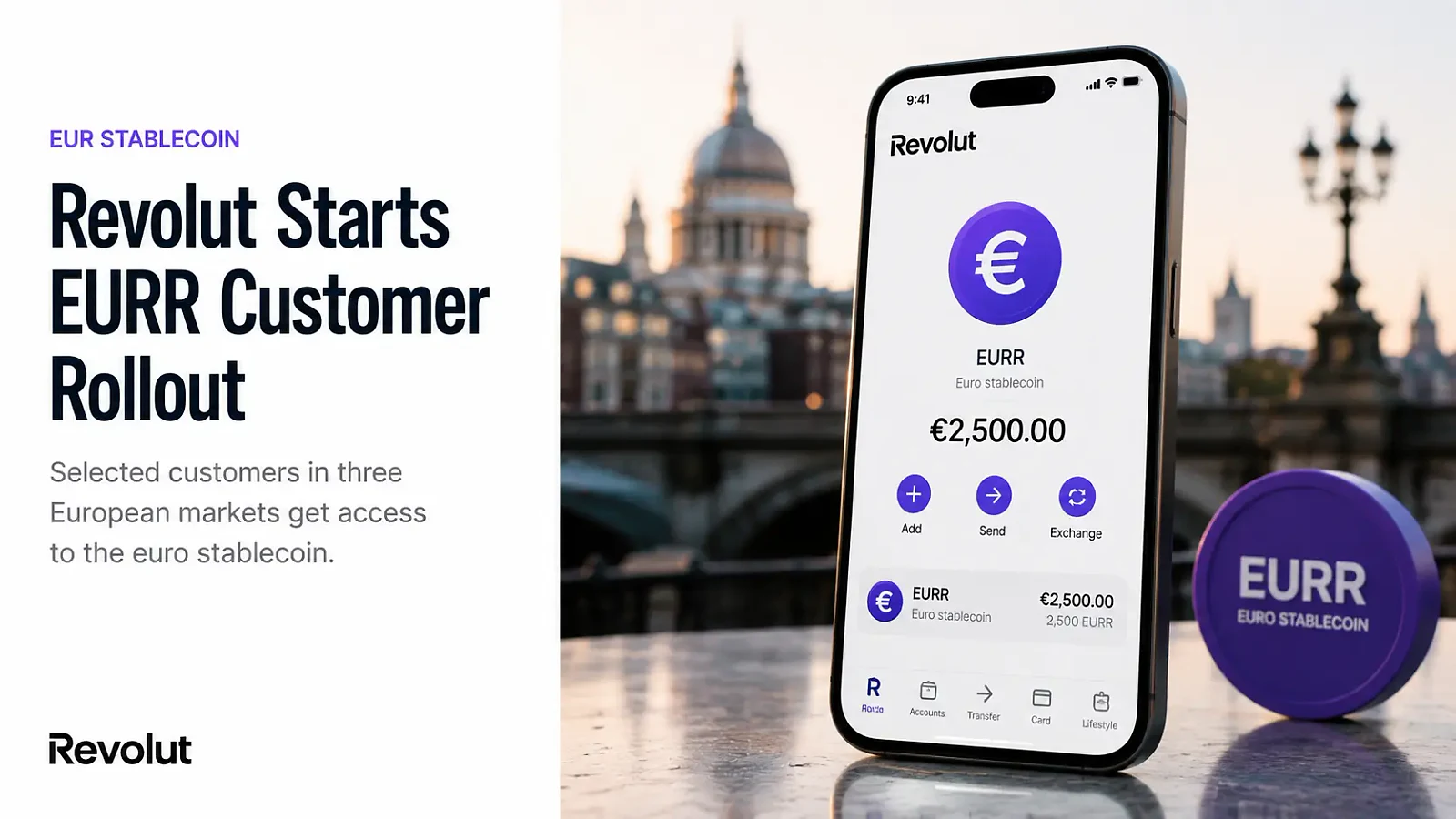
Revolut has begun a phased customer rollout of EURR, its euro-denominated stablecoin, to selected users in Denmark, Poland and Portugal, moving the product from an announced August test into limited customer availability.
The rollout was reported on August 26. Revolut had first announced EURR earlier in the month, saying phased testing would begin during August. The token is issued by Bridge Building, part of Stripe-owned Bridge, and is designed to maintain a value of €1 under the applicable European regulatory framework.
The more important development is therefore distribution, not the initial announcement. EURR is being embedded into an app used by tens of millions of retail customers rather than relying only on a crypto exchange or specialist wallet for access.
Revolut supplies distribution while Bridge supplies issuance
EURR illustrates a model that may become increasingly common among large fintechs: separate the customer relationship from the regulated stablecoin issuance stack.
Revolut provides the retail interface, conversion experience and distribution. Bridge Building issues the token. Revolut said the asset will support movement between euros, crypto, external wallets and supported blockchain networks.
That division can lower the barrier for a financial app to offer its own branded stablecoin experience without building every reserve, minting, redemption and compliance function internally.
Revolut's original announcement said more than 75 million customers used its app across over 40 markets. In its August 26 statement to The Block, the company described its retail base as about 80 million customers and said it had more than 16 million crypto users. Those company figures indicate distribution potential, not EURR adoption.
A large user base does not equal stablecoin usage
The rollout is deliberately limited. Initial access is restricted to eligible customers in three markets, and Revolut says wider availability across the European Economic Area is expected later in 2026.
The company has also said stablecoins denominated in other currencies are in development through separate regulatory pathways.
The missing numbers are the ones that matter most for judging product-market fit: EURR circulating supply, active holders, transaction volume and redemption volume. Without those metrics, the story should not be framed as mass stablecoin adoption through Revolut.
It is better understood as a distribution experiment with unusually large potential reach.
Non-dollar stablecoins need native distribution
Dollar stablecoins dominate global supply because they benefit from international demand for digital dollars. Euro stablecoins have a different challenge: creating enough utility and distribution to persuade users to hold a tokenised euro rather than conventional bank euros.
A mainstream financial app can change that equation. Users already have an account, identity checks, fiat balances and payment functionality. Adding a stablecoin inside that interface can make on-chain euro access a product feature rather than a separate crypto onboarding process.
That does not guarantee demand. Users still need a reason to move from an ordinary euro balance into EURR, whether for blockchain transfers, crypto settlement, programmable payments or external-wallet use.
The phased rollout will therefore be a useful test of whether distribution can solve one of the central problems facing non-USD stablecoins. Revolut has the customer interface and Bridge has the issuance infrastructure. The next evidence to watch is whether users actually move meaningful euro balances on-chain.
Rollout scale and adoption are different metrics
Measure — Current figure — What it tells us
Initial EURR markets — 3 — Denmark, Poland and Portugal
Revolut retail customers — ~80M — Potential distribution base, not EURR users
Revolut crypto users — ~16M — Existing crypto audience, not EURR holders
EURR target value — €1 — Product design
Wider rollout — Later 2026 — Company plan for additional EEA availability
The distinction is important for evaluating branded stablecoins. A fintech can have enormous distribution without meaningful token circulation if customers see no advantage in switching from ordinary fiat balances. Conversely, even a small initial token supply can be strategically useful if it creates rails for external-wallet transfers or future programmable payment features.
EURR also provides a live test of the “issuer-as-a-service” model. Bridge supplies regulated token issuance while Revolut supplies users and product distribution. That resembles card issuing or banking-as-a-service structures in which infrastructure and customer ownership sit with different firms. If the model scales, competition among stablecoin infrastructure providers may increasingly revolve around winning large distributors rather than building consumer brands of their own.