Plasma XPL Under Pressure: The Stablecoin Chain Native Token Question
With XPL's RSI hitting 14.67 on April 29 and a 2.5 billion-token unlock looming on July 28, Plasma's governance token is drawing scrutiny. But the real question is structural: does a stablecoin-first chain need a speculative native token at all?
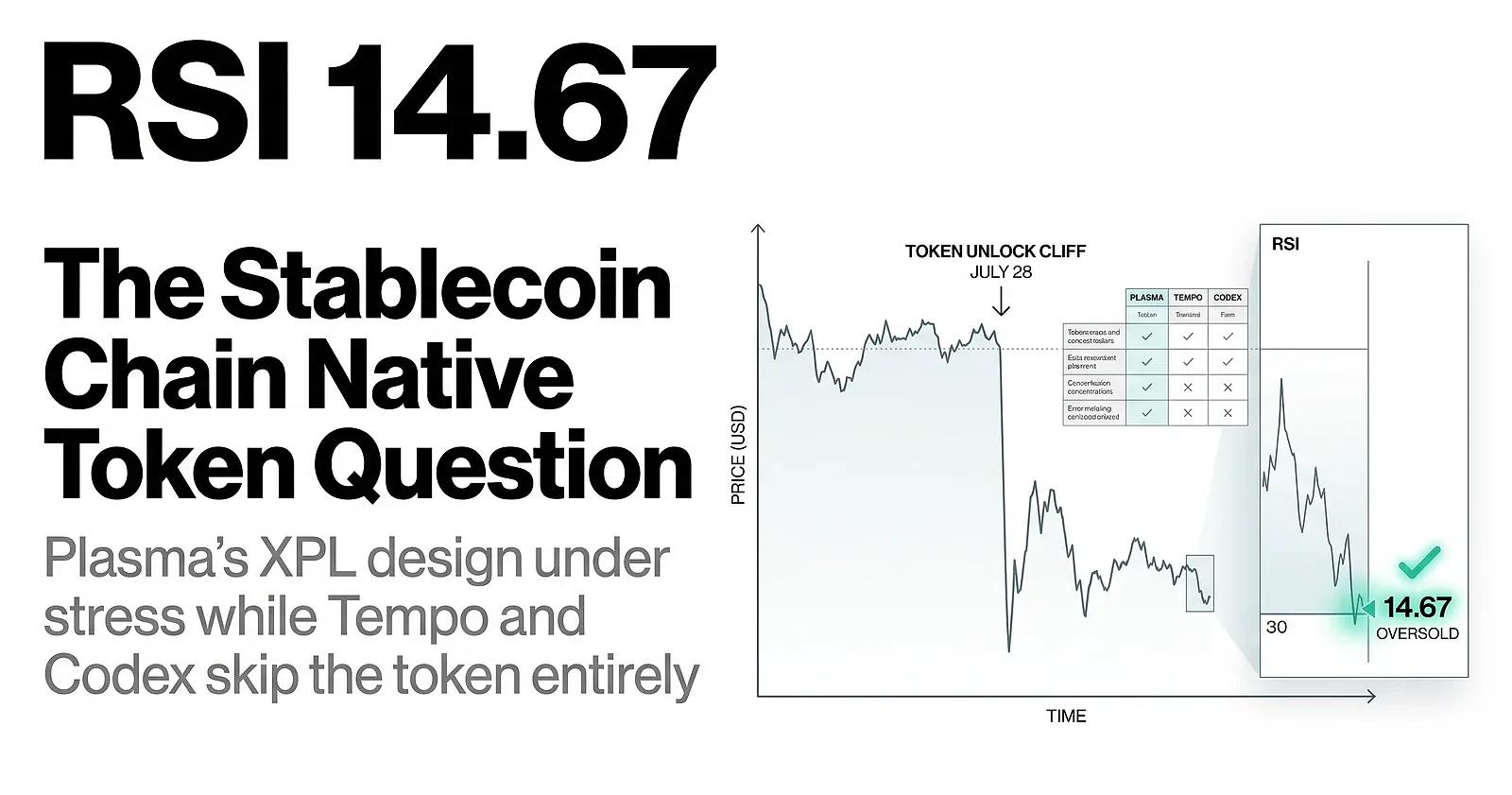
On April 29, 2026, Plasma's XPL token registered a Relative Strength Index of 14.67, one of the lowest readings among small-cap Layer 1 tokens tracked by CoinMarketCap, three days after a scheduled unlock on April 26 introduced fresh supply into a thin market. The data points are arresting, but the more consequential question they surface is architectural: in an era of stablecoin-native blockchains, what function does a speculative governance token actually serve?
A Snapshot of the Unlock Calendar
Plasma launched its mainnet beta and conducted its token generation event on September 25, 2025. The project distributed 10 billion XPL in total across four allocation buckets: the public sale received 10 percent, released in full or phased at TGE; the ecosystem and growth fund received 40 percent, vesting linearly over 36 months with 20 percent released at TGE; and both the team and investor tranches received 25 percent each, with a 12-month cliff followed by linear vesting over 24 months [1][2].
The April 26 unlock was part of Plasma's recurring monthly ecosystem distribution cycle. According to data from KuCoin and RootData, approximately 88.89 million XPL tokens entered circulation on that date, representing roughly 4.33 percent of the then-circulating supply and carrying a market value of approximately $10.79 million at prevailing rates [2]. The release arrived against a backdrop of weak altcoin sentiment, with capital rotating toward Bitcoin and Ethereum, amplifying the sell-side impact.
Unlock Event — Date — Tokens Released — % of Total Supply — Est. Market Value
Monthly Ecosystem Tranche — April 26, 2026 — 88.89M XPL — 0.89% — ~$10.79M
Team + Investor Cliff (begin linear vest) — July 28, 2026 — 2.5B XPL* — 25.0% — ~$220M+
Ecosystem Cumulative (36 months) — Sep 2028 — 4.0B XPL — 40.0% — -
*Begins linear release over 24 months; total team and investor allocation combined.
The July 28 event is the one commanding attention from longer-horizon observers. That date marks the expiry of the 12-month lockup for U.S. public sale participants as well as the cliff for both team and investor allocations. When linear vesting commences, a combined 2.5 billion XPL tokens representing 25 percent of total supply will begin flowing into circulation over the subsequent two years [1]. Community commentary on Binance Square has flagged the event as a potential supply overhang, with one widely circulated post noting the token is already approximately 95 percent below its all-time high [3].
The Deeper Structural Question
The technical pressure on XPL is real, but it is a symptom of a design tension rather than a verdict on the Plasma network itself. Plasma the chain is performing. In December 2025, the protocol cut ecosystem incentives by more than 95 percent while stablecoin supply held at approximately $2.1 billion and DeFi TVL remained at roughly $5.3 billion, metrics that place it among the largest chains by that measure [1]. Daily stablecoin transfer counts reached approximately 40,000 during that period. Zero-fee USDT transfers, enabled through a protocol-level paymaster, function without users needing to hold XPL at all. Gas can be paid in whitelisted stablecoins including USDT. The chain is working.
XPL's designed roles are governance and staking. Yet validator staking was still pending rollout as of early 2026, and governance mechanisms remain nascent. This gap, between a live and growing chain and a governance token whose utility has not fully materialized, is precisely the structural question the unlock calendar has brought to the surface.
"In the end, we're building a stablecoin chain, and that is highly dependent on network effects. You need to be omnipresent and have extremely wide reach from the B2B angle to the B2C side of things."
- Paul Faecks, CEO of Plasma, September 2025 [4]
Faecks made clear that the chain thesis centers on stablecoin adoption, not on token price. But the quote also illuminates the tension: a stablecoin chain optimized for network effects and frictionless payments may not naturally generate the speculative demand a governance token requires to hold value through successive unlock events.
How Competing Stablecoin Chains Handle the Token Question
The contrast with Plasma's principal competitors is instructive. Tempo, the stablecoin blockchain developed under the Stripe infrastructure umbrella, launched with an explicit policy of no native gas token. Transaction fees on Tempo are paid directly in TIP-20 stablecoins, with automatic conversion handling the mechanics under the hood [5]. There is no speculative token to unlock, no cliff event, no RSI to track on a governance asset. The chain's economic model is self-contained within stablecoin flows.
Codex, a Layer 2 built on the Optimism OP Stack and purpose-designed for enterprise stablecoin settlement, similarly foregoes a speculative native token. Gas fees are denominated in supported stablecoins, providing predictable costs for institutional counterparties [5]. Codex's value capture is embedded in transaction infrastructure rather than in the float of a separate token.
Chain — Native Speculative Token — Gas Payment — Token Unlock Risk
Plasma — Yes (XPL, governance/staking) — USDT or XPL optional — High; major unlocks through 2028
Tempo (Stripe) — No — Any TIP-20 stablecoin — None
Codex (OP Stack L2) — No — Stablecoin-denominated — None
This is not to argue that the Plasma model is incorrect. Governance tokens serve real functions in decentralized networks: they distribute decision-making power, align long-term validator economics, and can fund protocol development through treasury mechanisms. Plasma's argument is that XPL will gain utility as validator staking rolls out and governance matures. That argument may prove correct.
But the unlock schedule compresses the timeline for proving it. Each monthly ecosystem release and, far more acutely, the July cliff introduces supply that must be absorbed by demand that is partly aspirational rather than present. When that demand is absent, as the RSI reading of 14.67 suggests it was in late April, the gap is priced in abruptly.
Why the Framing Matters
Observers focused on the price decline risk missing the more durable question: can a stablecoin chain whose core utility proposition is explicitly token-agnostic (zero-fee USDT transfers requiring no XPL, stablecoin gas options removing the native token dependency) construct sufficient organic demand for a separate governance layer to absorb a multi-year vesting schedule?
Tempo and Codex answer that question by removing it from the design. Plasma answered it by including XPL and betting that governance and staking utility, plus the speculative premium a native token can attract, would outweigh the dilution cost of a 10 billion token supply schedule. With RSI at 14.67 and the July unlock approaching, the market is grading that bet in real time.
Plasma's chain-level fundamentals remain strong. The token mechanics, however, are under the most significant test they have faced since TGE.
References
[1] CoinMarketCap CMC AI, "Latest Plasma (XPL) News Update," May 3, 2026. https://coinmarketcap.com/cmc-ai/plasma-xpl/latest-updates/
[2] KuCoin News, "Plasma (XPL) Token Unlock: Analyzing the $10.79 Million Supply Influx," February 25, 2026. https://www.kucoin.com/news/articles/plasma-xpl-token-unlock-analyzing-the-10-79-million-supply-influx
[3] Binance Square (@BkkShadow), "Why are institutions daring to scoop up $XPL before the July unlock?," January 28, 2026. https://www.binance.com/en/square/post/35702111197921
[4] YouTube, "How Plasma Plans To Win The Trillion Dollar Stablecoin Battle" (interview with Paul Faecks), September 27, 2025. https://www.youtube.com/watch?v=it-4GpxtqUA
[5] CoinGecko Learn, "What Is Tempo? Stripe's Upcoming Payments Stablechain," December 11, 2025. https://www.coingecko.com/learn/what-is-tempo-stablechain