Plasma One Platinum Card Pairs Premium Rewards With 100,000-XPL Access
Plasma is putting its Visa Infinite Platinum card at the center of its consumer push, pairing stepped cashback and premium travel benefits with a promotional 100,000-XPL lock that lasts 12 months.
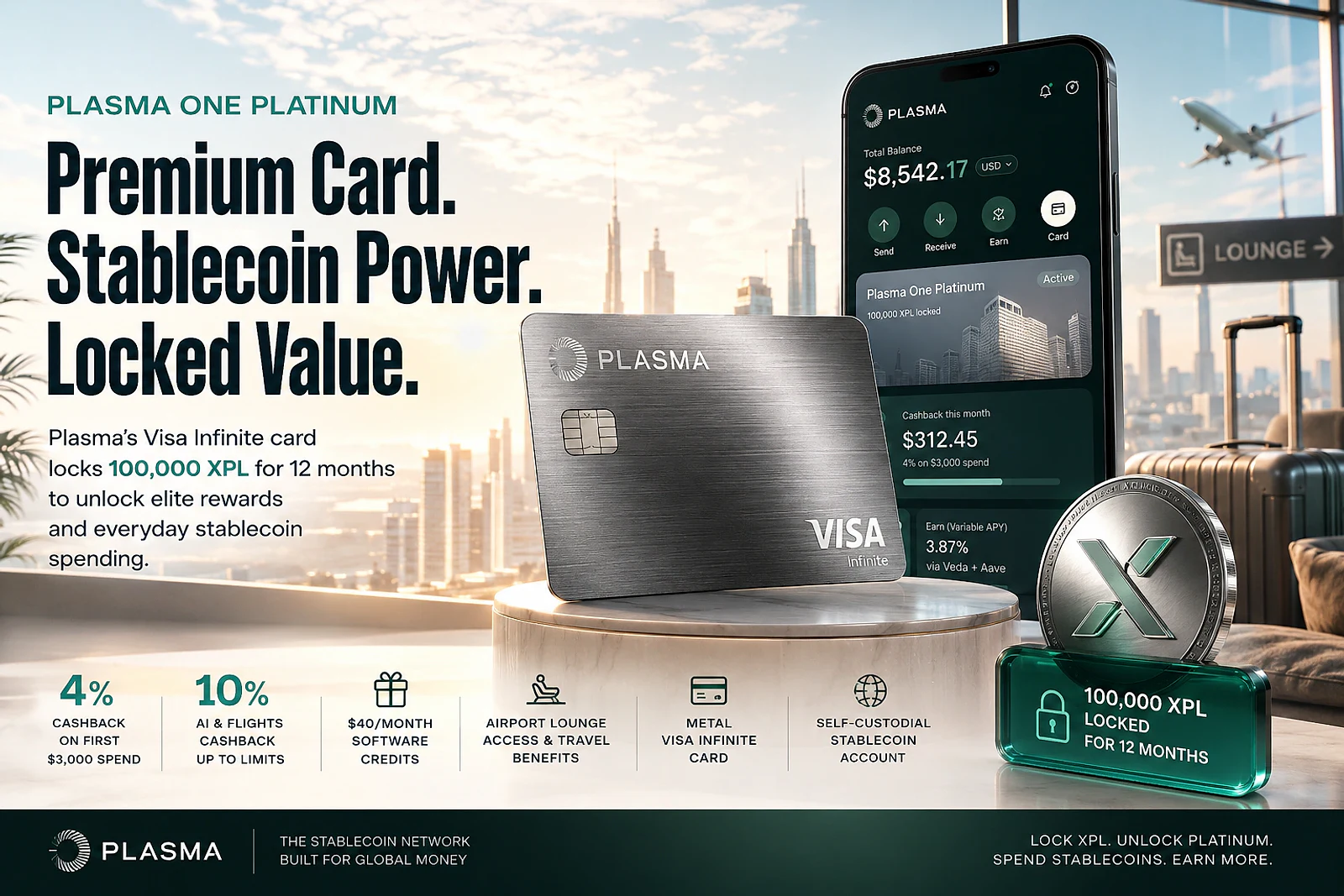
Plasma is putting its Plasma One Platinum Card at the center of its consumer push, using a premium Visa Infinite card to connect everyday stablecoin spending with demand for the network's XPL token. The current promotional entry price is a lock of 100,000 XPL for 12 months; Plasma says the standard requirement will become 150,000 XPL after the promotion ends. [1][3][4]
The proposition combines a self-custodial stablecoin account with stepped cashback, AI and travel rewards, software credits and premium card benefits. It also introduces a deliberate supply mechanic: every eligible customer must remove a large block of XPL from immediate circulation for a year. That does not guarantee price appreciation, but it gives card adoption a measurable connection to token demand.
Plasma founder and chief executive Paul Faecks distilled the team's public response to the finished card into one word.
“Beautiful.”
Paul Faecks, founder and CEO of Plasma [7]
Platinum Is a Rewards Tier, Not a Flat 4% Card
Plasma advertises a 4% base cashback headline, but the full schedule is tiered by monthly general spending. Platinum users receive 4% on the first $3,000 each month, 3% on the next $7,000, 2% on the next $5,000 and 1% above $15,000. The same principle applies to the elevated categories: the highest rate is capped rather than unlimited. [1][5]
Platinum benefit — Published rate or allowance — Important limit
General spending — 4% cashback — First $3,000 per month; then 3%, 2% and 1% bands
AI services — 10% cashback — First $500 per month; 5% on the next $500 and 1% beyond
Eligible flights — 10% cashback — Up to $3,000 of eligible spend per six-month period, or $300 per half-year
ChatGPT Plus — Up to $20 credit — Monthly subscription credit
Claude Pro — Up to $20 credit — Monthly subscription credit
Virtual cards — Up to three — Included with the tier
Physical card — Metal Visa Infinite — Premium card and travel benefits apply subject to terms
The flight cap produces a maximum published flight reward of $600 per year, assuming the cardholder uses the full eligible allowance in both six-month periods. Plasma also lists Visa Airport Companion lounge access, travel insurance and global eSIM benefits, although availability and coverage remain subject to program terms and location. [1][2]
The account's Earn feature should be kept separate from the card-reward headline. Plasma says users can opt into variable DeFi yield through infrastructure provided by Veda and strategies that currently use Aave. It is not a fixed 5% return on the first $500,000, and the return is neither guaranteed nor generated by the XPL lock itself. [2][8]
The 100,000-XPL Requirement Is Promotional
The card's most consequential condition is the token lock. Plasma's current promotional offer lowers Platinum access from the standard 150,000 XPL to 100,000 XPL. Once a customer locks the required amount, the position remains locked for a full 12 months with no early unlock, partial refund or pro-rata release. [3][4]
Lock term — Current Platinum condition
Promotional requirement — 100,000 XPL
Standard requirement after promotion — 150,000 XPL
Duration — 12 months
Early unlock — Not supported
Partial refund or pro-rata release — Not supported
Yield or interest on locked XPL — None
Governance or ownership rights — None granted by the lock
The distinction matters. Locking XPL grants access to the tier; it does not create an interest-bearing deposit, equity claim or governance position. Customers therefore retain token-price exposure while giving up liquidity for a year, and they should evaluate that cost independently from the rewards they expect to earn. [3]
Platinum Access Connects Card Adoption With XPL Demand
Research firm Kairos Research highlighted the supply-side arithmetic around the promotional requirement. Using a circulating-supply figure of 2.51 billion XPL at the time of its June analysis, Kairos estimated that every 2,500 Platinum upgrades would require locks equal to roughly 10% of that float, while 25,000 upgrades would require an amount equivalent to the entire cited float. It also observed that only about 400 wallets held at least 100,000 XPL at that point. [6]
Those figures are a scenario, not a forecast. Circulating supply changes, one person can control multiple addresses, exchange balances aggregate many customers and token holders can acquire XPL after the snapshot. Still, the mechanism is unusually direct: each successful promotional upgrade corresponds to 100,000 XPL committed for 12 months. If demand scales beyond today's large holders, prospective customers would need to source tokens from the market or other holders before they could qualify.
The standard 150,000-XPL requirement would make the same relationship stronger on a per-card basis, though potentially harder for customers to reach. Plasma is effectively testing whether a premium financial product can make token ownership useful without paying yield on the token itself. The rewards fund the consumer proposition; the lock gates access.
Self-Custody Underneath a Visa Experience
Plasma One is not structured like a conventional bank card tied to an insured checking account. Users fund a smart wallet with supported stablecoins, and Plasma describes the balance as self-custodial. The card then connects that wallet to Visa acceptance infrastructure for everyday spending. [1][2]
The service involves several parties. Rain, a Visa Principal Member, issues the card, while Bridge provides account services. Plasma provides the wallet, network and product experience. Stablecoin balances are not bank deposits and are not covered by deposit insurance, while optional Earn balances introduce smart-contract and DeFi protocol risk. [1][2][8]
That structure is central to the product's positioning. Plasma wants cardholders to receive a familiar premium-card experience while funds remain on stablecoin rails until they are spent. The test is whether the product can make the underlying blockchain invisible enough for mainstream use without obscuring the different custody and risk model.
Premium Design Is Doing Strategic Work
The Platinum push is not only a rewards announcement. The brushed-metal card, Visa Infinite branding and tightly framed lifestyle benefits give Plasma a physical object around which to market a digital network. Faecks' “Beautiful” post reinforces that design is part of the launch message rather than packaging added after the token mechanics. [1][7]
That matters because the XPL lock is substantial. A customer considering a 12-month commitment needs a product that feels more durable than a short-term points campaign. Plasma is using the card's design, concierge-style benefits and software credits to make the lock feel like membership in a premium financial tier. Whether that framing converts depends on the market value and liquidity cost of the required XPL, not merely the nominal cashback rate.
What to Watch
The first metric is conversion: how many customers actually lock XPL and activate Platinum, rather than join a waitlist or engage with the launch campaign. Plasma should be able to demonstrate the aggregate amount locked, the number of active cards and the geographic availability of the program without exposing customer identities.
The second is reward economics. A customer who spends $3,000 a month in the top general band can capture the headline 4% rate, but heavier spend moves into lower bands. The realized return must be compared with the opportunity cost and volatility of locking 100,000—or later 150,000—XPL for a year.
Finally, watch whether the promotional requirement ends on schedule and whether Plasma changes benefits after customers are locked. The card gives XPL a concrete access function, but the durability of that function will depend on transparent terms, consistent rewards and a stable user experience across Rain, Bridge, Visa and Plasma's own wallet infrastructure.
References
[1] Plasma, “Plasma One Platinum — The Platinum Card.” https://www.plasma.org/personal/platinum
[2] Plasma, “Plasma One Rewards.” https://www.plasma.org/plasma-one-rewards
[3] Plasma Help Center, “How does Platinum work?” https://intercom.help/plasma-6c43763cd799/en/articles/15506476-how-does-platinum-work
[4] Plasma Help Center, “Promotional Platinum offer.” https://intercom.help/plasma-6c43763cd799/en/articles/15506754-promotional-platinum-offer
[5] Plasma Help Center, “Cashback rates and spend bands by tier.” https://intercom.help/plasma-6c43763cd799/en/articles/15506768-cashback-rates-and-spend-bands-by-tier
[6] Kairos Research, “Plasma One's new Platinum card requires locking 100,000 XPL per cardholder,” June 13, 2026. https://x.com/Kairos_Res/status/2065804116635295838
[7] Paul Faecks, “Beautiful,” August 20, 2026. https://x.com/pauliepunt/status/2090424248896475244
[8] Plasma Help Center, “How do I earn on Plasma One?” https://intercom.help/plasma-6c43763cd799/en/articles/14285221-how-do-i-earn-on-plasma-one