PBOC Adds 8 Banks to Digital Yuan Roster, Taking Total Operators to 30
The People's Bank of China has added eight banks to its authorized e-CNY operator network, lifting the total to 30 institutions. The expansion reinforces Beijing's CBDC-first strategy as the United States and Europe build rules for regulated private stablecoin issuers.
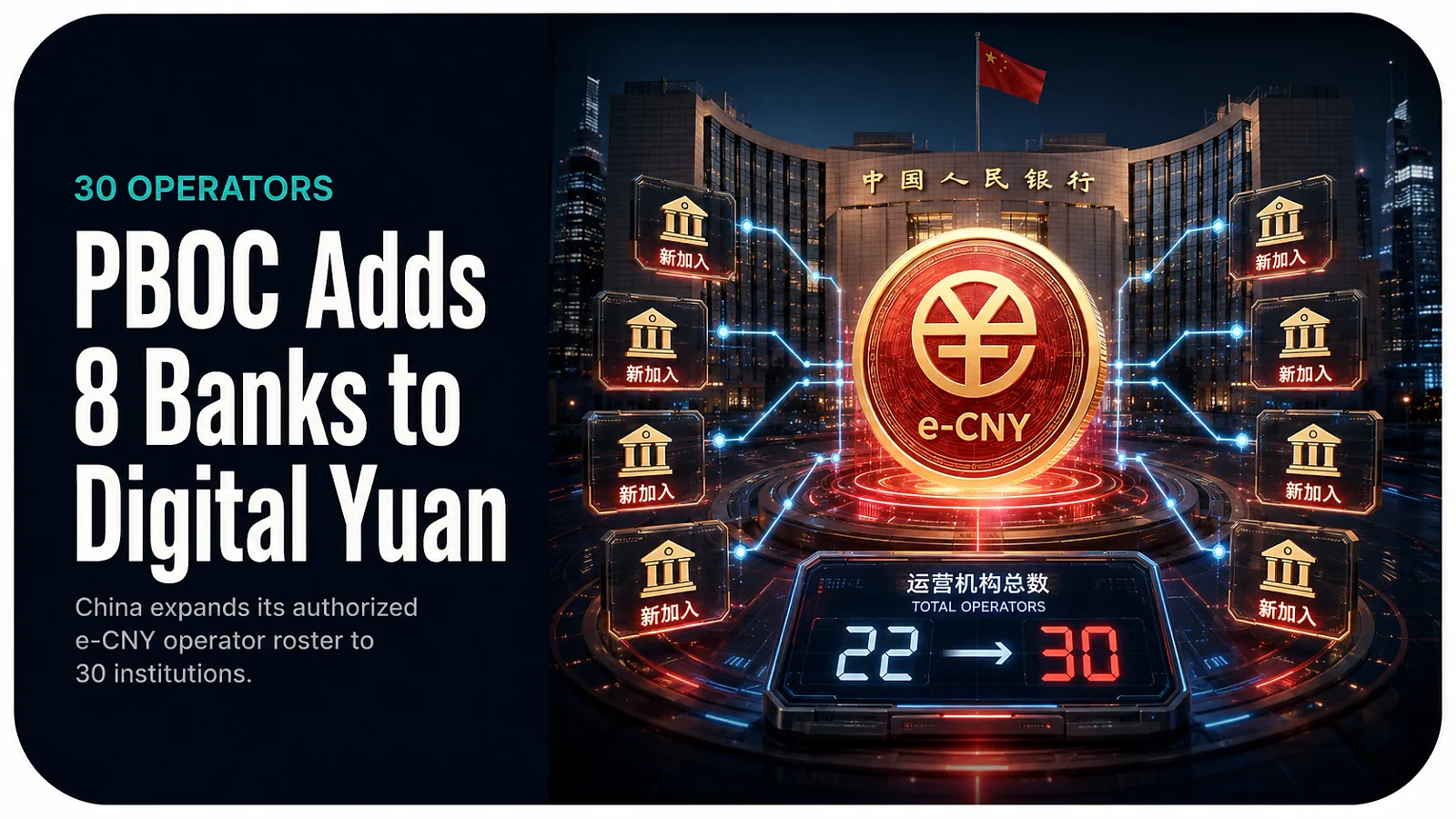
The People's Bank of China, or PBOC, has added eight banks to the authorized operating network for the digital yuan, taking the number of institutions permitted to run e-CNY business to 30. The announcement on Monday, August 17, moves Ping An Bank, Hengfeng Bank, China Bohai Bank and five city commercial banks into the central bank's distribution perimeter. Their customer-facing services will begin only after each completes operational and technical preparations. [1]
The decision is the second sharp enlargement of the network this year. China began 2026 with 10 authorized operators, added 12 in April and has now added another eight, a 200% increase in the roster over a little more than four months. The policy direction is clear: Beijing is widening CBDC access through supervised institutions, not opening a market-issued yuan stablecoin path.
Eight banks join the PBOC network
The newest cohort combines three national joint-stock commercial banks with five city commercial banks. It broadens e-CNY delivery beyond the original national incumbents and the first regional lenders approved in April. The PBOC said the move is intended to improve the inclusiveness of services and meet demand for secure, convenient and efficient digital yuan services. [1]
“They will start offering digital yuan services after operational and technical preparations have been completed.”
Xinhua, reporting the PBOC announcement [1]
The 30-institution roster includes banks and the two original internet-platform operators. The table shows the full progression from the initial group through the two 2026 additions. The April expansion had already lifted the operator count from 10 to 22, with six state-owned commercial banks, two joint-stock banks and two internet-bank operators forming the earlier base. [2]
Admission wave — Authorized operator list — Count
Initial roster — Industrial and Commercial Bank of China; Agricultural Bank of China; Bank of China; China Construction Bank; Bank of Communications; Postal Savings Bank of China; China Merchants Bank; Industrial Bank; WeChat Pay; Alipay — 10
April 2026 expansion — Bank of Beijing; Bank of Jiangsu; Bank of Nanjing; Bank of Ningbo; Bank of Suzhou; China CITIC Bank; China Everbright Bank; China Guangfa Bank; China Minsheng Bank; China Zheshang Bank; Huaxia Bank; Shanghai Pudong Development Bank — 12
August 17, 2026 expansion — Ping An Bank; Hengfeng Bank; China Bohai Bank; Bank of Shanghai; Bank of Hangzhou; Huishang Bank; Bank of Changsha; Guangxi Beibu Gulf Bank — 8
Total authorized operators — Initial roster plus April and August additions — 30
This is not equivalent to eight banks switching on a new retail payment product overnight. Authorization connects each lender to the PBOC's digital yuan system, while actual service is contingent on readiness. That distinction is material for adoption metrics: the roster count has changed immediately, whereas wallet availability, merchant acceptance and transaction volume may expand in stages.
A CBDC answer to the yuan stablecoin question
The expansion lands six months after Chinese authorities barred unauthorized offshore issuance of yuan-linked stablecoins. The February notice, issued by the PBOC and seven other agencies, also tightened controls around offshore tokenization connected to Chinese onshore assets. Regulators said yuan stablecoins can perform functions of fiat currency in circulation, placing monetary sovereignty at the center of the policy rationale. [3]
Read together, the two decisions describe an architecture. China is choosing e-CNY, a PBOC-controlled central bank digital currency, and delegating customer operations to explicitly authorized institutions. A privately issued offshore CNH token would put issuance, reserves and distribution in a different governance model. The August bank roster enlarges the former while the February restrictions constrain the latter.
Question — China's e-CNY route — Private yuan stablecoin route
Issuer — PBOC, through the central bank digital currency system — Private entity seeking to issue a yuan-linked token
Distribution — Authorized operators connected to the PBOC system — Market-led distribution outside the CBDC operator model
August policy signal — 30 authorized operators after the eight-bank addition — No new private yuan issuer announced
Regulatory posture — Permissioned bank and platform participation — Offshore issuance requires official approval [3]
An authorized operator can compete on wallets, service, merchant integration and regional reach, yet the monetary instrument remains within the central-bank framework. The model preserves a controlled issuance center as distribution endpoints rise.
The United States and Europe choose issuer regulation
The contrast is particularly clear in the same period that the United States continues to build the GENIUS Act framework for payment stablecoins. The law makes it unlawful for anyone other than a permitted payment stablecoin issuer to issue a payment stablecoin in the United States, making licensing and issuer supervision the organizing principle rather than central-bank issuance. [4] The relevant comparison is not that one system is regulated and the other is not. Both are regulated. The difference is where the regulated claim on money originates.
Europe has likewise placed private stablecoin issuance within a licensing and conduct framework under MiCA, including separate rules for asset-referenced tokens and e-money tokens. [5] Those approaches leave room for regulated private issuers and for institutional chains that can carry their tokens. China is building a different stack: a CBDC at the monetary core, with permissioned banks operating the access layer.
Market — Dominant policy architecture — Primary private-sector role
China — PBOC-issued CBDC with authorized e-CNY operators — Bank distribution and service delivery
United States — Regulated private payment stablecoin issuer regime — Issuance, reserves, redemption and distribution
European Union — MiCA-regulated private token issuer regime — Authorized issuance and crypto-asset services
Hong Kong, Japan and Korea — Hybrid and supervised digital-money experiments — Licensed or bank-led deployment between the two poles
Hong Kong illustrates why the map is not simply a China-versus-the-West split. Anchorpoint's HKDAP project is tied to the Hong Kong dollar, not the yuan, and sits in a separately supervised market. Japan and Korea also occupy the middle ground, where private-sector distribution and licensing can coexist with tighter banking and monetary oversight than the United States model.
A global payments architecture is separating
For investors, banks and payment companies, the structural takeaway is a two-track global architecture. The United States and Europe are constructing rules for regulated private stablecoins, increasingly expected to settle on institution-oriented networks. China is scaling a sovereign digital currency through a controlled roster of operators. Hong Kong, Japan and Korea will matter as the jurisdictions that test where those models can meet, interoperate or remain separated.
The PBOC's action is therefore bigger than a list of eight names. It completes a rapid move from 10 to 30 authorized e-CNY operators in 2026 and extends the system into more regional banking channels. It also supplies Beijing's clearest operational answer to speculation about a yuan stablecoin: the currency's digital expansion is proceeding through the e-CNY network, under the PBOC's control.
References
[1] Xinhua, “China's central bank adds 8 banks as digital yuan operators,” August 17, 2026. https://english.www.gov.cn/news/202608/17/content_WS6a82f788c6d00ca5f9a0ca72.html
[2] Xinhua, “China's central bank adds 12 banks as digital yuan operators,” April 2, 2026. https://english.www.gov.cn/news/202604/02/content_WS69ce6ecbc6d00ca5f9a0a3c4.html
[3] Reuters, “China steps up crypto crackdown, will vet real-world asset tokenization,” February 6, 2026. https://www.reuters.com/world/asia-pacific/china-vows-tighten-virtual-currency-restrictions-2026-02-06/
[4] U.S. Congress, “S. 1582, GENIUS Act,” July 18, 2025. https://www.congress.gov/bill/119th-congress/senate-bill/1582/text
[5] EUR-Lex, “European crypto-assets regulation (MiCA),” accessed August 17, 2026. https://eur-lex.europa.eu/EN/legal-content/summary/european-crypto-assets-regulation-mica.html