PayPal Restructures Around PYUSD as Stablecoin Supply Contracts to $2.7B
PayPal's Q2 results showed a larger payments network and a smaller PYUSD float. Revenue rose 5% to $8.682 billion and TPV reached $486.448 billion, while the stablecoin's supply fell about one-third from its March high as the company placed it inside a dedicated Payment Services & Crypto division.
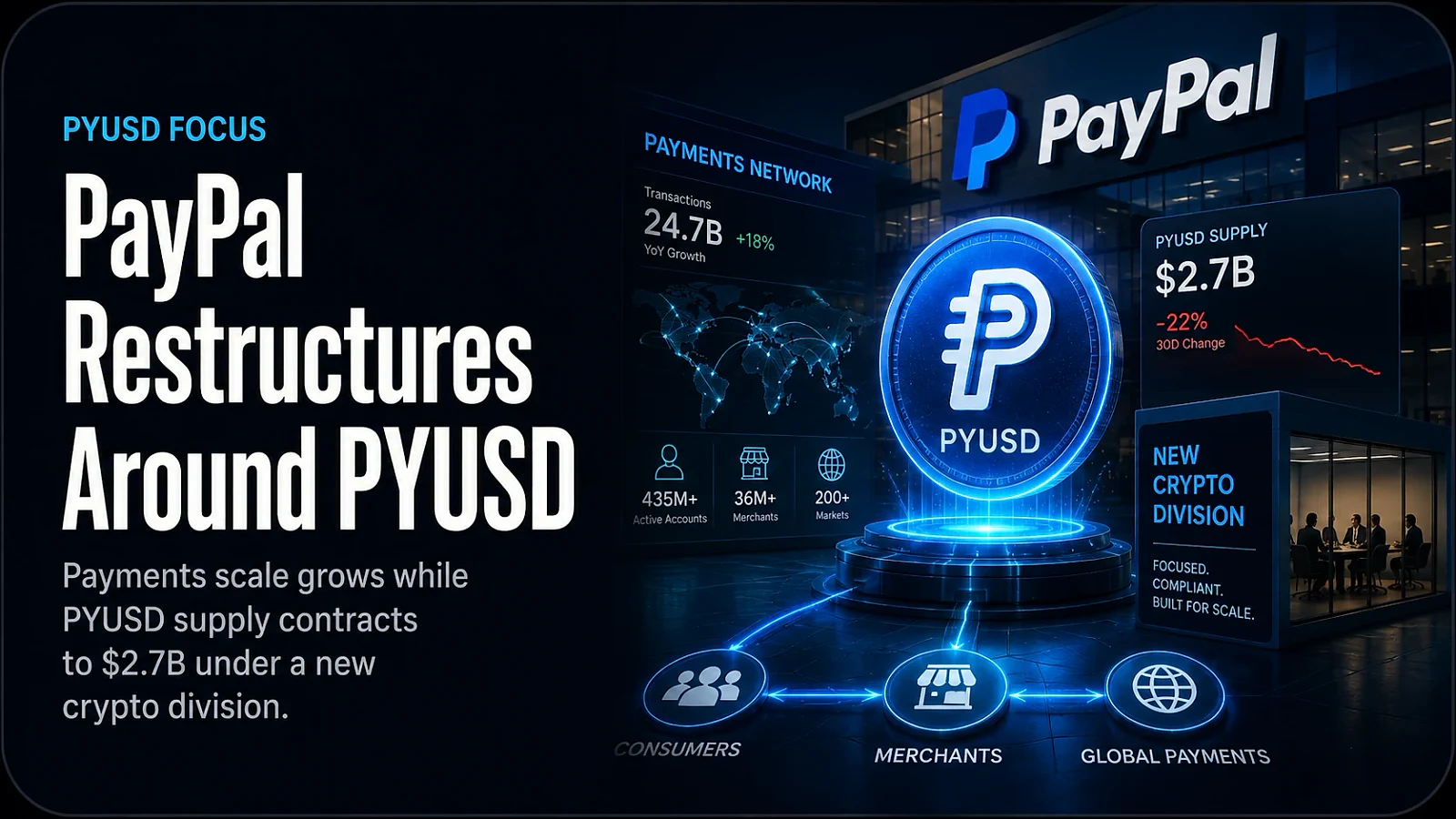
PayPal entered the second half of 2026 with a stronger core payments print but a sharply smaller stablecoin float. Second-quarter revenue rose 5% to $8.682 billion and Total Payment Volume reached $486.448 billion, while PYUSD supply stood near $2.7 billion in early August, about one-third below its March level near $4.1 billion.[1][4]
The contrast matters because PayPal has already elevated the token from a product feature to an organizational priority. Its new Payment Services & Crypto division combines PYUSD with Braintree, small and medium-sized business processing and value-added services, giving the stablecoin a reporting home alongside merchant infrastructure rather than leaving it as an add-on to Braintree.[2]
A Larger Payments Network, With Margin Pressure
The July 28 earnings release describes a company whose network is still expanding. PayPal processed 6.75 billion payments in the quarter, up 8% year over year, and ended with 439 million active accounts. Yet revenue growth did not translate into comparable earnings growth: transaction margin dollars increased only 1% to $3.9 billion, and GAAP net income declined 12% to $1.104 billion.[1]
PayPal Q2 2026 metric — Reported result — Year over year change
Net revenue — $8.682B — +5%
Total Payment Volume — $486.448B — +10%
Payment transactions — 6.750B — +8%
Active accounts — 439M — +0.3%
Transaction margin dollars — $3.900B — +1%
GAAP net income — $1.104B — -12%
Chief Executive Enrique Lores framed the result as evidence that the broader turnaround is moving, not completed.
“I'm encouraged by the progress we made this quarter. We moved with urgency to sharpen our transformation plan and advance our growth strategies across our three businesses.”
Enrique Lores, President and CEO of PayPal, July 28, 2026.[1]
That language is relevant to PYUSD. PayPal does not disclose crypto-specific revenue, payment volume, profit, user count or stablecoin settlement volume in its Q2 release. Investors therefore cannot yet assess whether the token is producing merchant economics, reducing cross-border payment costs or simply circulating through trading and liquidity venues. The new division makes the strategic ownership clearer; it does not yet make PYUSD's financial contribution measurable.
PYUSD Has Retreated From Its March Peak
The balance of outstanding PYUSD is the clearest available operating signal. A roughly $4.1 billion supply reported in March followed PayPal's broader distribution push, but available market data put the float near $2.7 billion by early August. That is an approximately 34% decline from the March reference level. The precise reading varies slightly by provider and time of day because the token trades close to $1, but the direction and scale of the decline are unambiguous.[4]
PYUSD supply timeline — Circulating supply — Change from March
January 2026 — Not separately disclosed — Not applicable
March 2026 reference level — About $4.1B — Peak reference
End of Q2 2026 — About $2.7B to $2.8B — About -32% to -34%
Early August 2026 — About $2.7B — About -34%
Supply is not a revenue measure, and a redemption does not by itself mean a customer has left PayPal. It does, however, determine the scale of the reserve base and is a practical gauge of how much dollar liquidity is sitting in the token. For an issuer and distributor that want stablecoins to become payment rails, a sustained reduction in outstanding balances is a more consequential signal than the token's stable price.
The Pullback Is Larger Than At the Leaders
The broader stablecoin market was not uniformly expanding in Q2, but PYUSD's contraction was much sharper than the two largest dollar tokens. USDC finished Q2 with $73.3 billion in circulation, down 4.8% from the $77.0 billion level at the end of Q1. USDT issuance, by contrast, rose about $446 million sequentially to approximately $184.6 billion even as Tether said industry market capitalization had decreased.[5]
Stablecoin — Starting comparison point — Latest Q2 or early-August level — Change
PYUSD — About $4.1B in March — About $2.7B in early August — About -34%
USDC — $77.0B at end Q1 — $73.3B at end Q2 — -4.8%
USDT — About $184.15B at end Q1 — About $184.60B at end Q2 — +0.2%
This does not establish that PYUSD has failed as a payments product. It establishes a demanding benchmark. A 34% reduction in the float is roughly seven times USDC's quarter-on-quarter decline, while USDT held its base essentially flat. PayPal will need to show that broader access and merchant integration can convert into persistent balances rather than incentive-sensitive liquidity.
The Reorganization Changes the Test
PayPal announced the three-business model on April 29, before the Q2 report, explicitly saying the new unit would unify processing and platform capabilities including Braintree, SMB processing, value-added services and crypto, including PYUSD, into a scalable merchant offering.[2] The timing is important: the Q2 earnings did not create a new PYUSD segment, but they are the first quarterly results through which investors can judge the strategy's early backdrop.
Distribution is not the immediate constraint. PayPal announced PYUSD availability across 70 markets in March. The token is natively issued by Paxos on Ethereum, Solana, Stellar and Arbitrum; its interoperability footprint also reaches chains including Aptos through PYUSD0 infrastructure. Those routes create more places for the asset to move, but chain availability alone cannot make the balance sheet grow.[3]
The unit is also being assembled during Lores's wider cost program. PayPal plans to cut about 20% of its workforce over two to three years as it pursues at least $1.5 billion of savings, according to reporting from Bloomberg. The management challenge is to simplify the company without cutting the merchant, compliance and product capacity needed to turn PYUSD into a payments network.[5]
PayPal's Q2 numbers support the case that Braintree, Venmo and the broader network still have reach. PYUSD's supply data show why the stablecoin has been put into its own division: it needs accountable product, merchant and distribution execution. The next proof point is not another chain announcement. It is whether a $2.7 billion float can begin growing again while generating a measurable role in the payment volumes PayPal already reports.[1][2]
References
[1] PayPal Holdings, Inc., “Second Quarter 2026 Earnings Release,” July 28, 2026. https://www.sec.gov/Archives/edgar/data/1633917/000163391726000080/pypl2q-26earningsrelease.htm
[2] PayPal Holdings, Inc., “PayPal Announces Strategic Reorganization to Accelerate Growth,” April 29, 2026. https://investor.pypl.com/news-and-events/news-details/2026/PayPal-Announces-Strategic-Reorganization-to-Accelerate-Growth/default.aspx
[3] PayPal, “PayPal Brings PayPal USD to Users Across 70 Markets,” March 17, 2026. https://newsroom.paypal-corp.com/2026-03-17-PAYPAL-BRINGS-PAYPAL-USD-TO-USERS-ACROSS-70-MARKETS; PayPal, “What is PayPal USD (PYUSD)?,” March 11, 2026. https://www.paypal.com/pw/cshelp/article/what-is-paypal-usd-pyusd-help1005; Aptos Foundation, “PayPal | Aptos Network,” October 13, 2025. https://aptosnetwork.com/ecosystem/directory/paypal
[4] CoinGecko, “PayPal USD Price,” accessed August 2026. https://www.coingecko.com/en/coins/paypal-usd; Stablecoin Insider, “PayPal's PYUSD Q2 2026 Report: Supply, Adoption, and Key Metrics,” July 9, 2026. https://stablecoininsider.org/paypals-pyusd-q2-2026-report-supply-adoption-and-key-metrics/
[5] Circle Internet Group, “Circle Reports Second Quarter 2026 Results,” August 5, 2026. https://www.circle.com/pressroom/circle-reports-second-quarter-2026-results; Tether, “Tether Posts Strong Q2 Performance,” July 31, 2026. https://tether.io/news/tether-posts-strong-q2-performance-generates-1-5b-net-operating-profit-maintains-4-11b-reserve-buffer-and-expands-gold-holdings-to-more-than-146-tons/; Bloomberg, “PayPal Plans Job Cuts as Fintech\'s New CEO Pursues Turnaround Strategy,” May 5, 2026. https://www.bloomberg.com/news/articles/2026-05-05/paypal-plans-job-cuts-as-fintech-s-new-ceo-pursues-turnaround-strategy