PayPal Q1 2026: Revenue Beat as Enrique Lores Plots 20% Workforce Cut and $1.5B Savings
PayPal delivered a Q1 2026 revenue beat of $8.35B against an $8.05B estimate, but soft Q2 guidance and a sweeping restructuring plan under new CEO Enrique Lores sent shares lower on May 5.
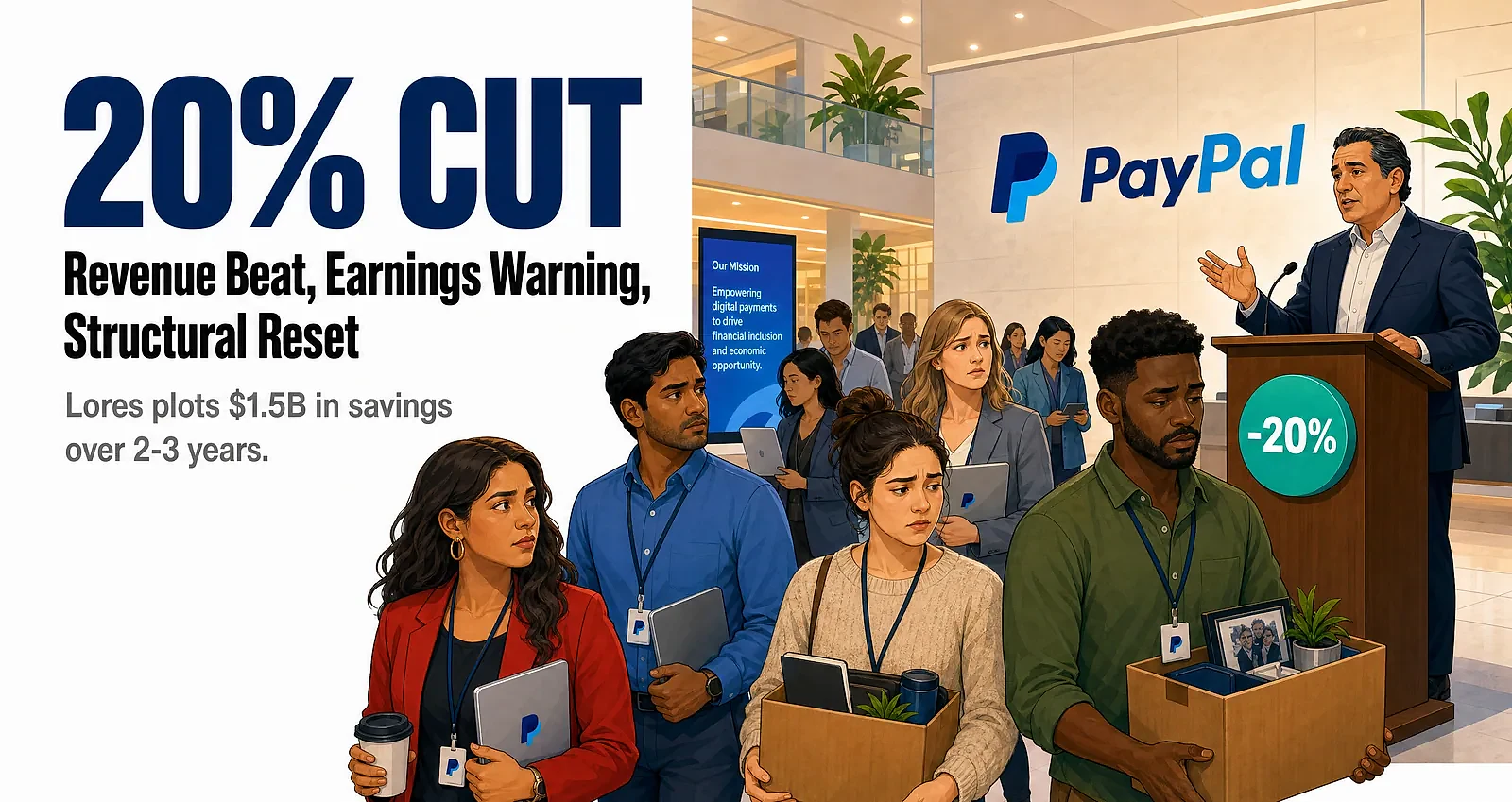
PayPal posted first-quarter 2026 results on May 5 that cleared Wall Street's top- and bottom-line estimates, yet a weaker-than-expected profit outlook for the second quarter and a structural workforce reduction plan overshadowed the headline numbers, pushing shares lower on the day.
Q1 2026 Results at a Glance
Revenue for the quarter came in at $8.35 billion, a 7.2% increase year-over-year and a clear beat versus the analyst consensus of $8.05 billion [1][2]. Adjusted earnings per share reached $1.34, topping the $1.27 consensus by $0.07, or roughly 5.5% [2][3]. Total Payment Volume (TPV) hit $464 billion, above the $447 billion estimate, driven by continued momentum in Venmo and buy-now-pay-later [1][3].
Metric — Actual — Estimate — Beat/Miss
Revenue — $8.35B — $8.05B — +$0.30B
Adjusted EPS — $1.34 — $1.27 — +$0.07
Total Payment Volume — $464B — $447B — +$17B
Transaction Margin (YoY) — +3% — - — vs. +7% prior year
Active Accounts (YoY) — +1% — - — Slow growth
Monthly Active Accounts (YoY) — +1% — - — Slow growth
Despite the beats, transaction margin dollars grew only 3% year-over-year, a notable deceleration from the 7% pace recorded in the same period of 2025 [1]. Active accounts and monthly active accounts each grew just 1% year-over-year, underscoring the challenge PayPal faces in converting its installed base into higher-frequency users rather than adding net-new customers at scale [1][3].
Q2 Guidance Disappoints
The sharper market reaction came from PayPal's forward guidance. The company projected a 9% decline in adjusted earnings for the second quarter of 2026, landing roughly 5 percentage points below what FactSet analysts had modeled [1]. Specifically, PayPal guided Q2 adjusted EPS to approximately $1.27 against a consensus of $1.33 [3]. That gap, modest in absolute terms, confirmed investor fears that PayPal's margin recovery is progressing more slowly than the turnaround narrative had implied.
Lores Stakes His Claim: 20% Workforce Reduction
The earnings call marked the most substantive public address yet from Enrique Lores, who assumed the chief executive role on March 1, 2026, after the board determined that progress under his predecessor was insufficiently rapid. Lores, best known for his decade-plus tenure running HP Inc., wasted little time signaling the scale of the operational reset he intends to execute.
"We are taking deliberate steps to sharpen our strategy, simplify our organization, and improve both our growth trajectory and cost structure by focusing our investments where we believe they will have the greatest impact. I am confident in our ability to put the company on a more durable path to long-term growth."
- Enrique Lores, PayPal CEO, Q1 2026 Earnings Call [4]
Speaking directly to analysts on the call, Lores was candid about what he found upon arrival. "PayPal needs to focus," he said. "We need to recommit to the fundamentals" [4]. He identified underinvestment in technology infrastructure as a central liability, citing the core checkout experience, Venmo financial services, and BNPL as areas where capital had been misallocated or withheld [4].
The operational plan attached to those words is considerable. According to Bloomberg and The Wall Street Journal, PayPal plans to eliminate approximately 20% of its workforce over the next two to three years [2][4]. With the company reporting roughly 23,800 employees at the end of 2025, that equates to more than 4,500 positions. The cuts are expected to generate at least $1.5 billion in run-rate savings over the same period, which management intends to redeploy into product modernization and artificial intelligence integration [2][4].
Growth Engines: Venmo, BNPL, Enterprise
Within the quarter, three business lines stood out as credible growth contributors. Venmo recorded its sixth consecutive quarter of double-digit payment volume growth, with TPV rising 14% year-over-year in Q1 2026. PayPal attributed the acceleration in part to a sustained Gen Z marketing push through university partnerships and rewards programs [1].
Buy now, pay later continued to outperform the broader sector. Venmo BNPL TPV grew 23% year-over-year, well ahead of industry benchmarks. PayPal is projected to command $30.86 billion in U.S. BNPL volume for 2026 as a whole, cementing its position as a leading provider in the segment [1].
Enterprise Payments, the third pillar Lores highlighted, reflects a deliberate push to compete for larger merchant contracts at a time when Stripe has aggressively expanded its share among high-volume clients. PayPal's ability to capture enterprise mandates will likely determine whether TPV growth can re-accelerate beyond single-digit percentages in future quarters.
PYUSD: Strategic Optionality, Not a Revenue Driver
PayPal's dollar-backed stablecoin, PYUSD, entered a new phase in March 2026 when the company expanded availability to 70 markets globally [5]. By that point, PYUSD had reached a market capitalization of approximately $4.1 billion, roughly five times its level a year earlier [5]. The expansion is designed to lower cross-border remittance costs and provide a dollar-denominated store of value in emerging markets, where currency volatility creates demand for stable assets.
PYUSD's growth trajectory positions it as a potential long-term enabler of PayPal's international TPV, particularly as stablecoin-settled payments gain regulatory clarity in the United States and Europe. However, the stablecoin is not yet a material contributor to revenue, and management did not quantify its impact on Q1 results. In a payments landscape increasingly influenced by stablecoin rails and programmable settlement, PYUSD represents PayPal's most visible bet on the infrastructure layer of the next payment cycle.
Structural Reset in a Competitive Field
The combination of a revenue beat, soft guidance, decelerating margin growth, and a restructuring plan of historic scale paints a coherent, if uncomfortable, picture: PayPal is a dominant franchise in structural deceleration, now being steered by an outsider CEO through a multi-year reengineering. Lores's playbook at HP, where he stripped cost and refocused the business on core hardware and print services, offers a template. Whether that template translates to a payments company competing with Stripe, Block, and an emerging generation of stablecoin-native fintech players remains the open question.
For Q1 2026, investors accepted the revenue beat as evidence that PayPal's installed base remains durable. But the market's reaction to Q2 guidance signals that the burden of proof is now on Lores to demonstrate that the $1.5 billion in savings will fund genuine competitive repositioning rather than simply defend a shrinking margin.
References
[1] eMarketer, "PayPal beats revenue but trims outlook," May 5, 2026. https://www.emarketer.com/content/paypal-s-q1-2026-earnings-points-venmo--bnpl--enterprise-payments-growth-drivers
[2] MarketBeat, "PayPal (PYPL) Earnings Date and Reports 2026," May 8, 2026. https://www.marketbeat.com/stocks/NASDAQ/PYPL/earnings/
[3] Public.com, "PayPal (PYPL) Earnings: Latest Report, Earnings Call and Financials," May 5, 2026. https://public.com/stocks/pypl/earnings
[4] Markets Day (@marketsday), "PayPal Q1 2026 Earnings: Strong Beat on Top and Bottom Lines," X, May 5, 2026. https://x.com/marketsday/status/2051643888952344795
[5] PR Newswire / PayPal Newsroom, "PayPal Brings PayPal USD to Users Across 70 Markets," March 17, 2026. https://newsroom.paypal-corp.com/2026-03-17-PAYPAL-BRINGS-PAYPAL-USD-TO-USERS-ACROSS-70-MARKETS