Open Standard Formalizes 140-Company Consortium, OUSD Launches on Solana This Year
Open Standard has formalized the 140-company initiative behind Open USD, appointing Bridge co-founder Zach Abrams as CEO and setting up a Solana-first stablecoin launch that redirects reserve earnings to partners.
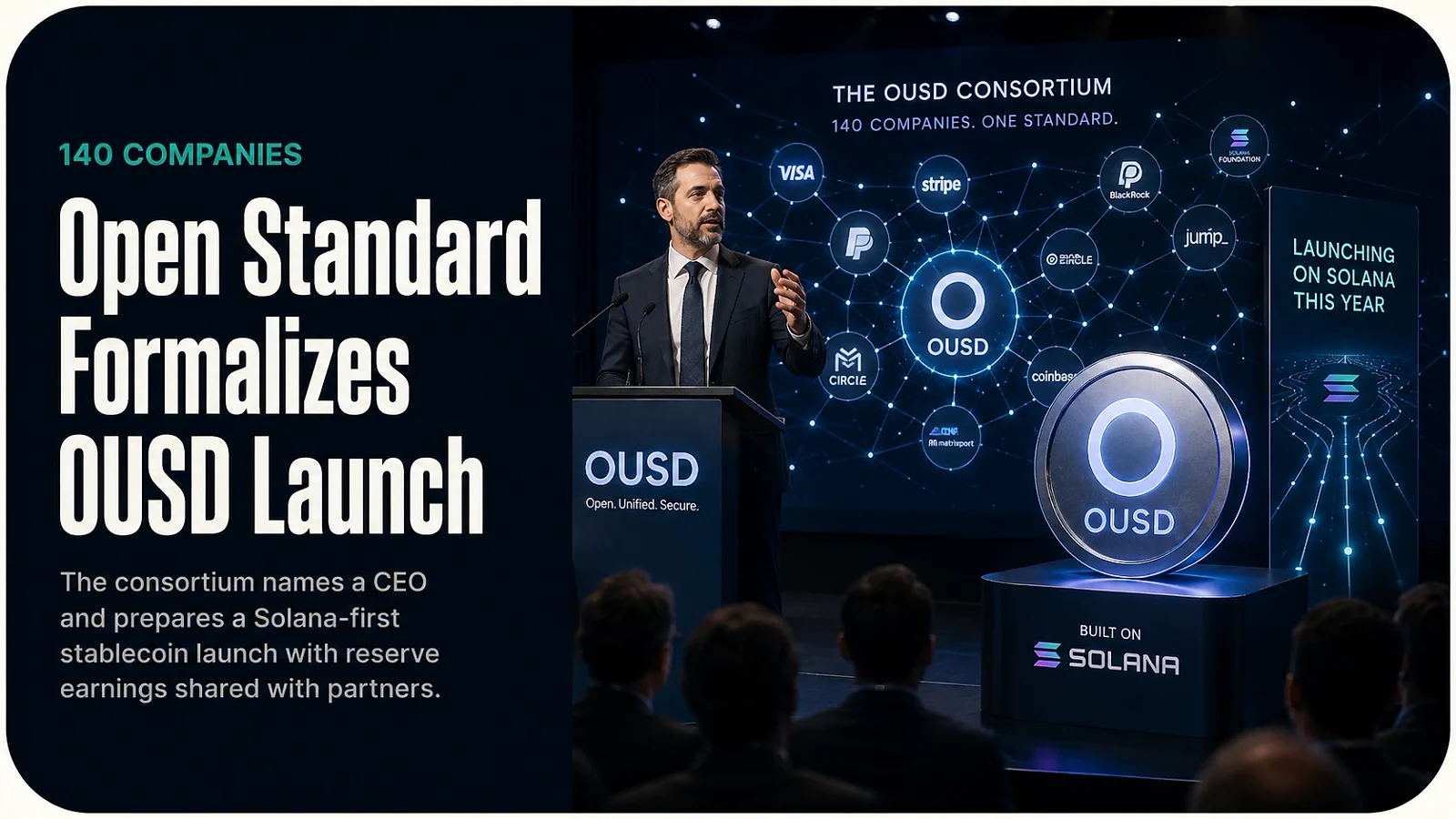
Open Standard has taken the 140-company stablecoin initiative that surfaced in June and put it inside a named, independent operating entity, with Zach Abrams, the Bridge co-founder acquired by Stripe, installed as founding chief executive. Its dollar token, Open USD, or OUSD, is expected to launch later in 2026, beginning natively on Solana before expanding to other chains. [1][2]
That is more than a branding update. The formal structure turns a loose set of prominent payments, technology, banking and crypto companies into a direct economic challenge to the issuer-led stablecoin model that made Circle's USDC a major institutional settlement asset. OUSD's pitch is simple: partners can mint and redeem at no cost, without volume caps, and retain nearly all of the reserve earnings generated by the token they distribute. [1][3]
The Entity Takes Shape
The roster includes Visa, Mastercard, American Express, Stripe, BlackRock, Coinbase, Google and Shopify, an unusual combination of card networks, financial institutions, merchant platforms and digital-asset companies. The August reporting gives that coalition a clear legal and operating center: Open Standard will run OUSD as an independent company rather than leave the project as a partner marketing arrangement. [1][2]
The distinction matters in payments. A token can have a long list of supporters but still depend on a single issuer's commercial priorities. Open Standard says its board will be made up of OUSD partners and that decisions are intended to serve the collective interest rather than one entity. That is the governance claim the consortium will now have to turn into specific operating rules, including who can join, how voting works, who oversees reserves and how disputes are resolved. [2]
Participant group — Selected Open Standard participants — Strategic contribution
Global card networks — Visa, Mastercard, American Express, Discover — Acceptance, settlement and issuer relationships
Financial institutions — BlackRock, BNY, Standard Chartered, U.S. Bank — Treasury, custody and regulated distribution pathways
Internet and commerce — Google, Shopify, DoorDash, Mercado Pago — Merchant and platform use cases
Digital-asset infrastructure — Coinbase, Solana, Base, Fireblocks, Bridge — Wallets, liquidity, chain access and developer tooling
Zach Abrams and the Bridge Connection
Abrams is the most consequential signal in the announcement. He co-founded Bridge, the stablecoin infrastructure company Stripe acquired for $1.1 billion in February 2025. Before becoming Bridge's co-founder, Abrams served as its chief technology officer, experience that now places a Stripe-trained operator at the center of a consortium that includes Stripe but is not controlled by it. [1][4]
“Existing stablecoins have great strengths, but to use them at scale, businesses need something that's open, low-cost, high-throughput, broadly accessible, and aligned to their interests.”
Zach Abrams, founding CEO, Open Standard [3]
The appointment does not prove that Stripe will dictate Open Standard's strategy. It does establish a practical link between the consortium's operating thesis and one of the payment industry's largest stablecoin infrastructure investments. Bridge's value to Stripe was its ability to give businesses a connective layer for digital-dollar payments. OUSD seeks to alter the asset economics at the same point in the stack: the companies bringing customers and volume are meant to share in the income from reserves instead of merely serving as distribution outlets.
The Consortium Model: Partners Keep Reserve Earnings
OUSD's commercial proposition is an inversion of the prevailing model. In a conventional issuer-led structure, the issuer controls the reserve pool and captures the related income, then may negotiate commercial arrangements with distributors. Under Open Standard's design, partners receive all reserve earnings less a small management fee for OUSD's operational costs. The company also says partners can mint and redeem without fees and with no artificial limits on volume. [2][3]
Economic or control point — OUSD and Open Standard — USDC and Circle issuer model
Minting and redemption — No-cost minting and redemption for partners, with no stated volume caps — Circle operates the USDC issuance and redemption system
Reserve economics — Partners receive nearly all earnings, less an operating management fee — Reserve income is captured by the issuer, with distribution arrangements set commercially
Governing center — Independent Open Standard with a partner-made board — Circle is the issuer and operating center for USDC
Core incentive — Reward businesses that distribute and build on the token — Build liquidity, trust and adoption around an issuer-managed dollar token
The comparison is an economic model, not a forecast of outcomes. OUSD has not disclosed its reserve composition, its management-fee rate, partner allocation formula or the precise controls that will govern redemption access. Those omissions are material because reserve income, liquidity management and compliance are where stablecoin promises become operating obligations. [2]
Yet the incentive is clear enough to create pressure. A large exchange, acquirer, merchant platform or payments processor has historically had to decide whether USDC integration produces enough customer value to justify helping Circle scale its reserve base. OUSD gives such a partner a second proposition: distribute the token and participate in the reserve income it helps create. For a consortium with many prospective channels, that is a much more direct customer-acquisition budget than marketing spend alone.
BNY chief product and innovation officer Carolyn Weinberg summarized the appeal in comments reported at launch.
“A stablecoin with neutral governance and shared economics is a unique combination that has potential to unlock the next phase of digital assets growth.”
Carolyn Weinberg, chief product and innovation officer, BNY [3]
Solana First
Beginning natively on Solana is another deliberate break with the expected institutional playbook. USDC built much of its early institutional footprint around Ethereum and then expanded broadly across chains. Open Standard is choosing a high-throughput network first, with multichain expansion planned after the initial release. [1]
Solana's role does not remove the need for integration into wallets, compliance systems, exchanges and payment processors. It does place low-cost, high-frequency transfer capacity at the starting point of OUSD's design. That fits the consortium's language about volume and global money movement, particularly for merchant settlement, payouts and internet-native business activity where transaction frequency matters as much as token liquidity.
The Two-Alliance World
Open Standard now enters a market where Circle has formalized an institutional alliance around Arc, its own blockchain. Circle is scheduled to take Arc to public mainnet on September 16 with a founding validator group that includes BlackRock, Visa and Mastercard. Arc is designed around USDC-native settlement and financial-market infrastructure. [6]
Institution — Open Standard and OUSD position — Circle Arc position — What the overlap says
Visa — OUSD consortium participant and initial VSP asset — Founding Arc validator — Visa is supporting multiple stablecoin and chain routes
Mastercard — OUSD consortium participant — Founding Arc validator — Mastercard preserves infrastructure optionality
BlackRock — OUSD consortium participant — Founding Arc validator — Asset-management distribution can serve both ecosystems
Circle — Direct competitor to OUSD's issuer model — Arc operator and USDC issuer — Circle is vertically integrating token and network
Visa's July launch of the Visa Stablecoin Platform, which begins with OUSD, gives the Open Standard side an enterprise entry point for minting, burning, holding, transferring and redeeming the forthcoming token. At the same time, Visa's Arc validator role gives it a stake in Circle's network. Mastercard's matching presence on both sides makes the message even harder to miss: the card networks have refused to make a winner-take-all choice. [5][6]
What This Means for USDC
USDC retains substantial advantages that cannot be replicated by an announcement: established liquidity, existing regulatory relationships, integrations, reserve reporting and a large installed base of institutional users. Open Standard's 140-company roster is not the same thing as 140 live distribution channels. A partner can endorse a framework well before it shifts treasury balances, checkout volume or settlement flows.
But OUSD attacks the part of USDC's moat that is most exposed to organized competition: distribution economics. The more enterprise partners view stablecoins as a revenue-sharing rail rather than a neutral utility, the more they will compare a Circle relationship with Open Standard's promise to retain nearly all reserve income. In that sense, OUSD is not asking every customer to abandon USDC. It is asking the intermediaries that bring customers to stablecoins to reconsider which dollar asset rewards them.
The competitive frame is therefore not simply OUSD versus USDC by circulating supply. It is Circle Arc's issuer-and-network integration versus Open Standard's partner-owned asset and Solana-first deployment. Both models seek institutional trust. They disagree over where control and reserve income should sit.
What to Watch
The first test is implementation, not membership. Open Standard needs to publish the legal issuer arrangement, reserve policy, redemption controls, management-fee terms and governance mechanics before businesses can judge whether neutrality is more than a slogan. It also needs to explain how a partner board can make rapid risk decisions during a market stress event.
The second is migration. Investors should watch whether VSP beta clients, exchanges, merchant platforms or major payment processors announce specific OUSD settlement, treasury or payout programs. Announcements that connect named participants to real volume will matter more than another expansion of the roster. Visa's VSP provides a visible channel to monitor, while Mastercard's recently completed BVNK acquisition adds another reason to monitor how the network connects its own stablecoin infrastructure to competing assets. [5]
Finally, Solana liquidity will be a practical referendum on the design. A native launch can be an advantage if OUSD arrives with usable wallets, market makers, fiat on-ramps and enterprise controls. Without them, the better economics will remain a proposal. The formation of Open Standard makes the 2026 stablecoin contest much clearer: the industry is no longer debating whether institutions will issue and move tokenized dollars. It is deciding whether the next dominant dollar will be owned by an issuer, a network, or the companies that distribute it.
References
[1] Milken Institute, "FinTech in Focus, August 18, 2026," August 18, 2026. https://milkeninstitute.org/content-hub/newsletters/fintech-focus/fintech-focus-august-18-2026
[2] Open Standard, "Introducing Open USD," June 30, 2026. https://joinopenstandard.com/blog/introducing-open-usd
[3] The Edge Malaysia, "Consortium including Visa, Mastercard jointly launch new global stablecoin," July 1, 2026. https://theedgemalaysia.com/node/808937
[4] TechCrunch, "Stripe makes $1.1B crypto bet as it closes on Bridge acquisition," February 5, 2025. https://techcrunch.com/2025/02/05/stripe-makes-1-1-billion-crypto-bet-as-it-closes-on-bridge-acquisition/
[5] Visa, "Visa Introduces Platform for Stablecoin Minting, Movement and Management," July 16, 2026. https://investor.visa.com/news/news-details/2026/Visa-Introduces-Platform-for-Stablecoin-Minting-Movement-and-Management/default.aspx
[6] Circle, "Circle Announces Founding Validator Cohort and Major Integrations for Arc Ahead of September 16 Mainnet Launch," August 5, 2026. https://www.circle.com/pressroom/circle-announces-founding-validator-cohort-and-major-integrations-for-arc-ahead-of-september-16-mainnet-launch