OnePay Lets Select US Customers Deposit USDC Into Checking as Dollars, Powered by Stripe's Bridge
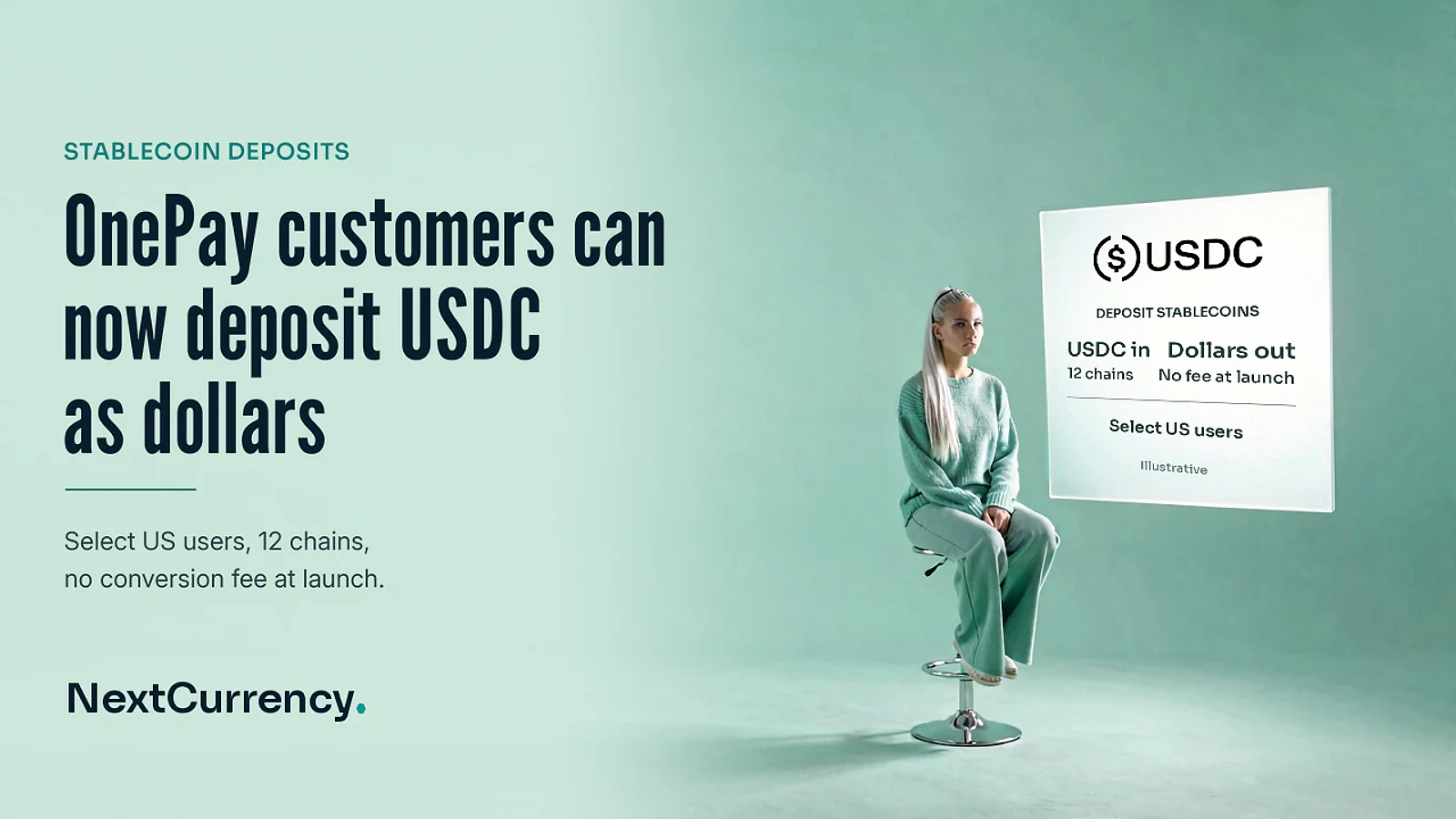
Select OnePay customers can send USDC on 12 blockchains, including Tempo, Base, Solana and Ethereum, and have it converted to US dollars in OnePay Checking, with no conversion fee at launch, OnePay says; Bridge handles compliance checks and conversion.
By Elena Marsh, Journalist, Stablecoins
OnePay, the US consumer fintech, has started letting select US customers fund OnePay Checking with stablecoins. A customer sends USDC from an external wallet or exchange to a deposit address, and the value is converted to US dollars and credited to the checking balance, OnePay said in an announcement dated 30 October 2026. The launch supports USDC on 12 blockchains, including Tempo, Base, Solana and Ethereum, and OnePay charges no conversion fee at launch.
The conversion runs on Bridge, the stablecoin orchestration platform owned by Stripe. Bridge creates and secures the deposit addresses, receives the incoming stablecoin, runs compliance checks and converts it to dollars; OnePay then credits the checking balance.
How the deposit flow works
According to OnePay, the option sits under "Deposit stablecoins" in the app's Cash Control section. There is no separate stablecoin balance: the customer holds dollars once the deposit lands.
Item — What OnePay says
Who can use it — Select US customers (not all customers)
Asset — USDC only at launch; other stablecoins may be evaluated later
Networks — 12 blockchains, including Tempo, Base, Solana and Ethereum
Fees — No OnePay conversion fee at launch; blockchain network fees are paid by the customer
Timing — "Within moments" in most cases; depends on the network and required checks
Provider — Bridge Building Inc, through an agreement with OneProgress Assets LLC
Banking — Coastal Community Bank or Lead Bank, Members FDIC
OnePay's disclosures also state that stablecoins are not insured by the FDIC or SIPC, are not a deposit, and that the dollars received are based on the stablecoin's value at the time of conversion and "may be less than you sent". The FDIC coverage applies to the checking account once dollars are credited, not to the USDC in transit.
An off-ramp built into a checking account
The product is aimed at people who are paid in stablecoins. OnePay names gig workers, freelancers and users of platforms that move money across borders, and says that until now converting that value meant a separate exchange, extra steps and fees.
The design matters for distribution. Most stablecoin off-ramps sit inside exchanges or crypto wallets, and the customer then moves dollars to a bank. Here the off-ramp is a deposit method on a consumer checking account, with the conversion handled by an infrastructure provider in the background. That is the same model Stripe has been selling to platforms through Bridge: stablecoins used as a funding rail, with the end user never holding a token balance.
It also shows how Stripe's stack reaches consumers without a Stripe-branded app. Tempo, the payments blockchain Stripe incubated, is one of the supported networks, alongside Coinbase's Base and the larger general-purpose chains.
What is not known yet
OnePay has not said how many customers are eligible, when access will widen beyond "select" customers, how long the no-fee period lasts or what fee may follow. It has not disclosed deposit volumes. OnePay calls stablecoin deposits "the first of several stablecoin-enabled experiences" it plans, without naming the others.
Sources
- OnePay, Introducing Stablecoin Deposits Powered by Stripe (30 October 2026)