Ondo USDY goes live on Tempo as USD1 becomes native on Canton
Two institutional blockchains added different forms of tokenised money this week: Treasury-backed USDY on payments-focused Tempo and native USD1 settlement on Canton.
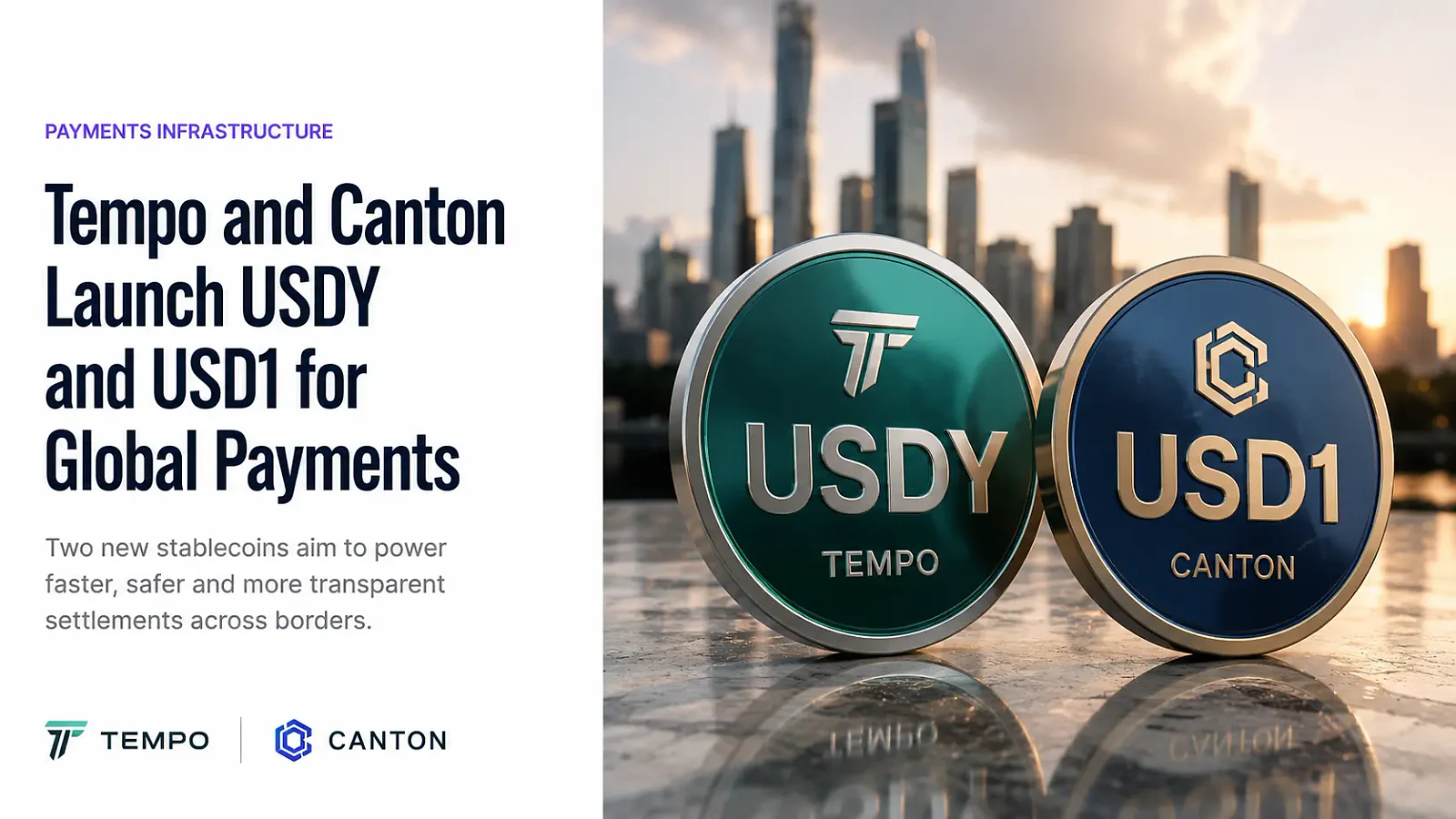
Two institutionally oriented blockchains added different forms of tokenised dollar liquidity this week, sharpening a competition over what kind of money should sit alongside on-chain financial assets.
Ondo Finance launched USDY on Tempo on August 27. USDY is a tokenised Treasury-backed product that distributes yield to eligible holders. Two days earlier, World Liberty Financial's USD1 became natively issued on the Canton Network, where it is positioned as a stable-value settlement asset for institutional workflows.
Both are technical launches. Neither announcement establishes meaningful transaction volume on the newly supported network.
Tempo adds yield-bearing liquidity to a payments-focused chain
Tempo is a payments-first Layer 1 incubated by Stripe and Paradigm. Ondo says USDY is now live on the network and can be used across treasury products, payment flows, lending markets and other applications where balances may otherwise sit idle between transactions.
USDY is backed by short-term US Treasuries and bank deposits and is structured to pass yield through to holders. Ondo's product data around the launch showed approximately $2.16 billion in total value locked, about $2.14 billion in value outstanding and roughly $2.19 billion in underlying assets as of August 24.
Those figures describe USDY as a product across its supported ecosystem. They do not mean $2.16 billion moved onto Tempo.
The integration nevertheless introduces an important design question for payment-focused blockchains: should idle settlement balances remain in non-yielding stablecoins, or can some corporate treasury liquidity sit in tokenised Treasury products until it is needed?
Canton adds a native stablecoin for the cash leg
On Canton, the model is different.
World Liberty Financial said USD1 is now issued natively on the network rather than arriving through a bridge. The stablecoin is issued by BitGo Bank & Trust and is intended to provide a dollar-denominated settlement asset that can move alongside tokenised financial instruments.
Canton highlighted atomic settlement as a central feature: a tokenised asset and the USD1 payment leg can settle within the same coordinated transaction under the network's privacy and permissioning controls.
Company materials list potential applications including collateral, lending, asset issuance and redemption, and cross-border settlement. Those are supported use cases, not evidence that institutions are already executing them at scale.
Institutional chains are competing for the money leg
Tokenisation discussions often focus on the asset side of a transaction: funds, bonds, equities, credit or real-world assets represented on-chain. But a tokenised market also needs money to pay for those assets.
The week's two launches illustrate competing answers.
Tempo now hosts a yield-bearing Treasury-backed token that could keep some treasury balances productive between payment events. Canton has added a stablecoin designed to act as a cash leg for institutional settlement. Other networks and banks are pursuing tokenised deposits or central-bank-money integrations instead.
The winner may differ by use case. A payment workflow values stable value, liquidity and immediate transferability. A treasury desk may care about yield on idle balances. A regulated securities market may prioritise settlement finality, privacy and the legal status of the cash instrument.
Deployment is not adoption
The most important constraint on both announcements is the absence of network-specific usage data.
USDY's existing billions of dollars in value do not establish Tempo adoption. USD1's overall circulation does not show how much liquidity is resident on Canton or how many institutional transactions have used it for atomic settlement.
That is the next test. Tokenised finance has reached the point where adding an asset to another chain is less informative than measuring whether the asset becomes part of real settlement, collateral or payment flows.
For now, Tempo and Canton have each added a different candidate for the money layer. The more consequential competition begins when transaction data shows which form of tokenised cash institutions actually use.
Two different answers to the on-chain money question
Asset — Network — Economic role — Evidence available now
USDY — Tempo — Treasury-backed, yield-bearing token — Live asset; product-wide TVL disclosed
USD1 — Canton — Fully reserved dollar stablecoin — Native issuance confirmed
Network-specific transaction volume — Both — Actual settlement/adoption — Not disclosed
The difference matters operationally. A yield-bearing token can be attractive for treasury balances but may involve eligibility, transfer and product-structure considerations that make it different from cash-equivalent settlement money. A payment stablecoin can be simpler for nominal settlement but typically does not pass reserve yield directly to the holder. Institutional systems may therefore use both rather than converge on a single instrument.
Atomic settlement on Canton also illustrates why native issuance matters. If the cash leg is available within the same governed environment as the asset leg, applications can coordinate both transfers without relying on an external bridge at the moment of settlement. Tempo's thesis is different: place yield-bearing dollar liquidity close to payment flows so balances can remain productive between transactions. Both architectures need usage data before either can claim market traction.