OCC Proposes Rules Restricting White-Label Stablecoin Platforms and Rewards
The Office of the Comptroller of the Currency has proposed its first comprehensive rulemaking under the GENIUS Act, targeting stablecoin-as-a-service platforms operated by Paxos, Stripe's Bridge, and Anchorage Digital Bank while restricting yield and reward payments tied to stablecoin holdings.
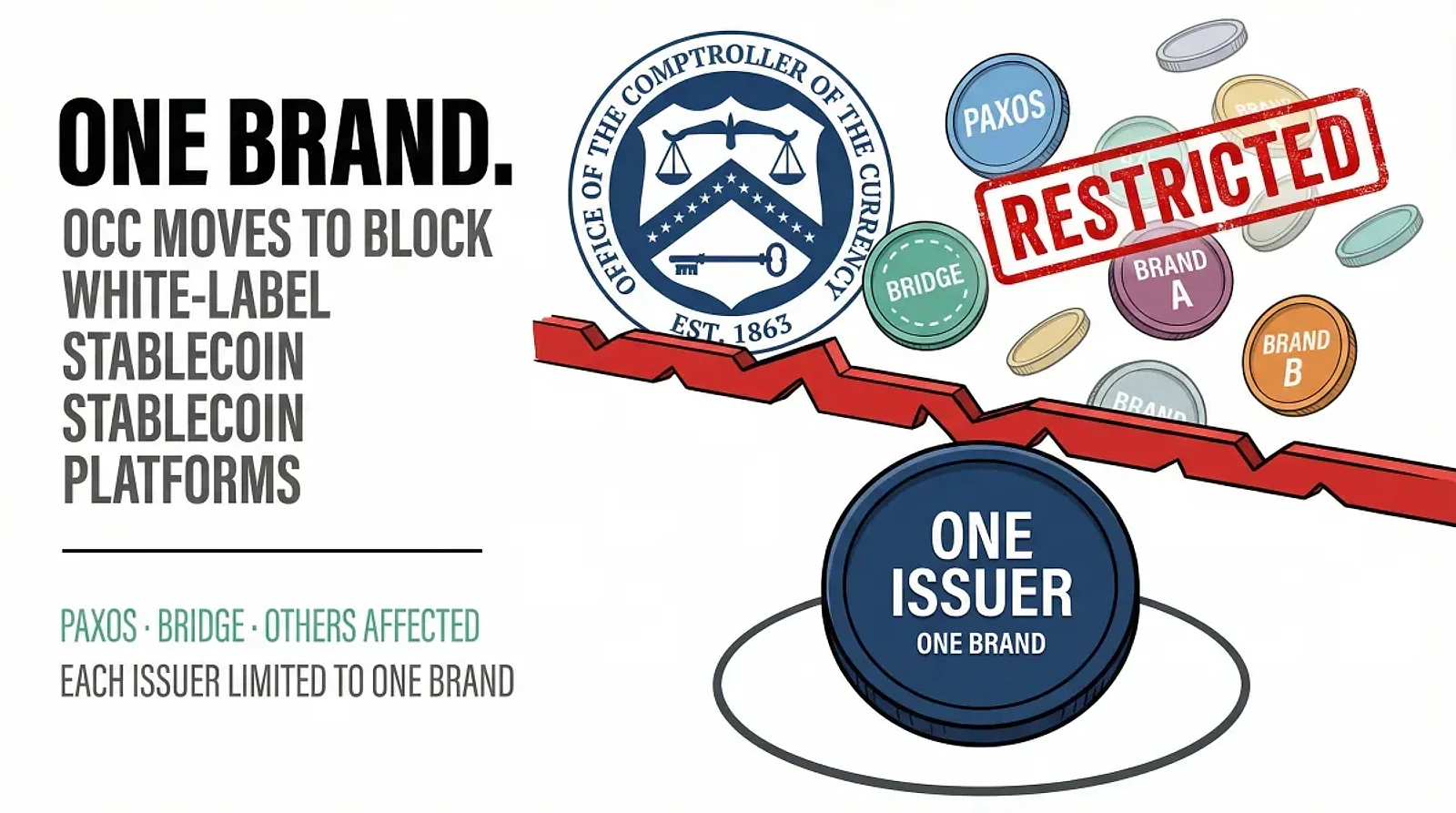
The Office of the Comptroller of the Currency (OCC) proposed a 376-page rule on February 26, 2026, that would restrict companies from launching branded stablecoins through white-label platforms and prohibit certain reward arrangements tied to stablecoin holdings. The proposed rulemaking represents the agency's first major effort to implement the GENIUS Act, the federal cryptocurrency law signed by President Donald Trump in July 2025, and directly targets stablecoin-as-a-service platforms operated by Paxos, Stripe Inc.'s Bridge, and Anchorage Digital Bank [1][2].
The banking industry has long warned that white-label stablecoin arrangements siphon deposits from traditional lenders. The OCC's proposal responds to those concerns by establishing a comprehensive prudential, operational, and supervisory framework for entities designated as "permitted payment stablecoin issuers" (PPSIs) under OCC jurisdiction [3][4].
Single-Brand Limitation and White-Label Constraints
The most disruptive provision under consideration is a restriction that would limit each licensed stablecoin issuer to a single brand of payment stablecoin. If codified, this rule would effectively dismantle white-label arrangements where a single issuer provides infrastructure for multiple co-branded partners [3][5].
The impact on existing business models would be immediate. Paxos, which currently issues PayPal Holdings Inc.'s PYUSD coin under a white-label arrangement, would face a direct challenge to its dual-brand issuance model. PYUSD's marketing strategy, which offers holders a 4% annual reward on customer balances, would also become untenable under the proposed interest prohibition [1][6].
"If you look in our proposal, which we released yesterday, we have hard wired a number of things into our proposal that we believe would tend to reduce the probability of deposit flight," said Jonathan Gould, Comptroller of the Currency, during testimony before the Senate Banking Committee [6].
The rule clarifies that "outstanding issuance value" for regulatory purposes means the total consolidated par value of all payment stablecoins issued by a given entity, including those issued under different brands or through white-label arrangements. Issuers may not treat co-branded programs as separate entities for the purpose of calculating reserve requirements, capital expectations, or reporting thresholds [5].
Interest and Yield Prohibition
The GENIUS Act prohibits a PPSI from paying interest or yield to holders "solely in connection with the holding, use, or retention" of a payment stablecoin. The OCC's proposed rule extends this prohibition through an anti-evasion presumption targeting arrangements with affiliates and related third parties [3][4].
Under the presumption, a stablecoin issuer is considered to be paying prohibited interest if two conditions are met: the issuer has an arrangement to pay interest or yield to an affiliate or related third party, and that affiliate in turn pays interest or yield to a stablecoin holder solely for holding the token. The breadth of the restriction is notable: it potentially encompasses balance-based rewards, rebates, loyalty tokens, profit-sharing arrangements, and other economic benefits tied to holding stablecoin balances [3][4].
The proposal does carve out limited exceptions. Merchants are not prohibited from independently offering discounts for stablecoin use, and issuers may share profits with non-affiliated white-label partners. However, the boundaries of these exceptions remain unclear and are explicitly flagged for public comment [3][4].
Reserve and Capital Requirements
Requirement — Detail
Reserve Ratio — 1:1 backing, identifiable reserves at all times
Eligible Reserve Assets — U.S. currency, demand deposits, Treasuries (93 days or less), reverse repos, qualifying money market funds
Ineligible Reserve Assets — Stablecoins, other crypto assets
Insured Deposit Minimum — 0.5% of reserves (up to $500M) for issuers above $25B
Concentration Cap — No more than 40% of reserves at any one institution
Daily Liquidity — At least 10% of reserves as demand deposits or Fed balances
Daily Liquidity Concentration — No more than 50% of daily liquidity at any one institution
Weighted Avg. Maturity — 20 days maximum across total reserve portfolio
Minimum Capital Floor — $5 million for de novo issuers
Redemption Window — Within 2 business days (7 calendar days if redemption demands exceed 10% of outstanding)
The OCC proposed two alternative approaches for reserve diversification: Option A follows a principles-based framework with an optional quantitative safe harbor, while Option B imposes mandatory quantitative limits on all issuers. Only one approach will be adopted in the final rule [3][4].
Capital elements for PPSIs would be limited to common equity tier 1 and additional tier 1 capital. Unlike traditional bank capital standards, the proposal would not permit tier 2 capital elements such as subordinated debt, reflecting the OCC's concern that stablecoin issuers might otherwise take on excessive leverage through fixed repayment obligations [3].
State-to-Federal Transition
State-regulated nonbank PPSIs that exceed $10 billion in outstanding stablecoin issuance must transition to OCC oversight within 360 days, obtain a waiver, or cease issuing new stablecoins on a net basis. The proposed rule adds structured intermediate deadlines: a notice to the OCC within 5 days and a completed capital analysis within 270 days of crossing the threshold [3][5].
A rebuttable presumption favoring approval applies if the state regulator has established a GENIUS Act-certified prudential digital-asset regime and has approved one or more issuers as of April 19, 2025 [7].
Industry Impact and Comment Period
The proposal poses more than 200 targeted questions for public input, and the OCC has signaled a willingness to consider significant deviations from the initial framework in several key areas, including the single-brand limitation, size-based tailoring for small and large issuers, and the scope of the anti-evasion presumption [3][4].
Comments are due 60 days after publication in the Federal Register. The rulemaking affects national banks, federal savings associations, state-level qualified issuers under OCC jurisdiction, and foreign settlement stablecoin issuers [2][8].
The regulatory framework will also trigger amendments to existing OCC regulations spanning capital adequacy standards (12 CFR 3), prompt corrective action (12 CFR 6), assessment calculations (12 CFR 8), and procedural rules (12 CFR 19). Separate coordinated rulemaking for anti-money laundering and sanctions compliance is expected to follow [4][8].
For stablecoin-as-a-service platforms that have built business models around multi-brand issuance and yield incentives, the proposed rule represents a fundamental structural challenge. The final contours of the regulation will determine whether white-label stablecoins remain a viable product category under federal law [3][4].
References
[1] Bloomberg, "Federal Bank Regulator Moves to Restrict US Stablecoin Rewards," February 26, 2026. https://www.bloomberg.com/news/articles/2026-02-26/federal-bank-regulator-moves-to-restrict-us-stablecoin-rewards
[2] ABA Banking Journal, "OCC releases proposed rule to implement payment stablecoin legislation," February 26, 2026. https://bankingjournal.aba.com/2026/02/occ-releases-proposed-rule-to-implement-payment-stablecoin-legislation/
[3] Simpson Thacher, "OCC Unveils First Comprehensive Federal Rulemaking for Stablecoin Issuers," February 27, 2026. https://www.stblaw.com/about-us/publications/view/2026/02/27/occ-unveils-first-comprehensive-federal-rulemaking-for-stablecoin-issuers
[4] Gibson Dunn, "OCC Proposes Comprehensive Stablecoin Regulatory Framework to Implement the GENIUS Act," March 3, 2026. https://www.gibsondunn.com/occ-proposes-comprehensive-stablecoin-regulatory-framework-to-implement-the-genius-act/
[5] Pillsbury Law, "Office of the Comptroller of the Currency Proposes GENIUS Act Rules for Payment Stablecoins," March 3, 2026. https://www.pillsburylaw.com/en/news-and-insights/office-comptroller-currency-genius-act-rules-payment-stablecoins.html
[6] Crane Data, "Bloomberg: OCC, Stablecoin Rewards," February 28, 2026. https://cranedata.com/archives/all-articles/11233/
[7] Jones Day, "The GENIUS Act in Action: The OCC Proposes Stablecoin Regulations," March 3, 2026. https://www.jonesday.com/en/insights/2026/03/the-genius-act-in-action-the-occ-proposes-stablecoin-regulations
[8] DWT, "OCC Proposes Stablecoin Issuer Regulation, Finalizes Rule on National Trust Banks' Powers," February 28, 2026. https://www.dwt.com/blogs/financial-services-law-advisor/2026/02/occ-stablecoin-rule-national-trust-banks-powers