MetaMask and Mastercard Launch Self-Custody Crypto Card Across the United States
MetaMask and Mastercard have launched a self-custody crypto card accepted at 150 million merchants, letting users spend directly from their wallet without transferring to a centralized exchange.
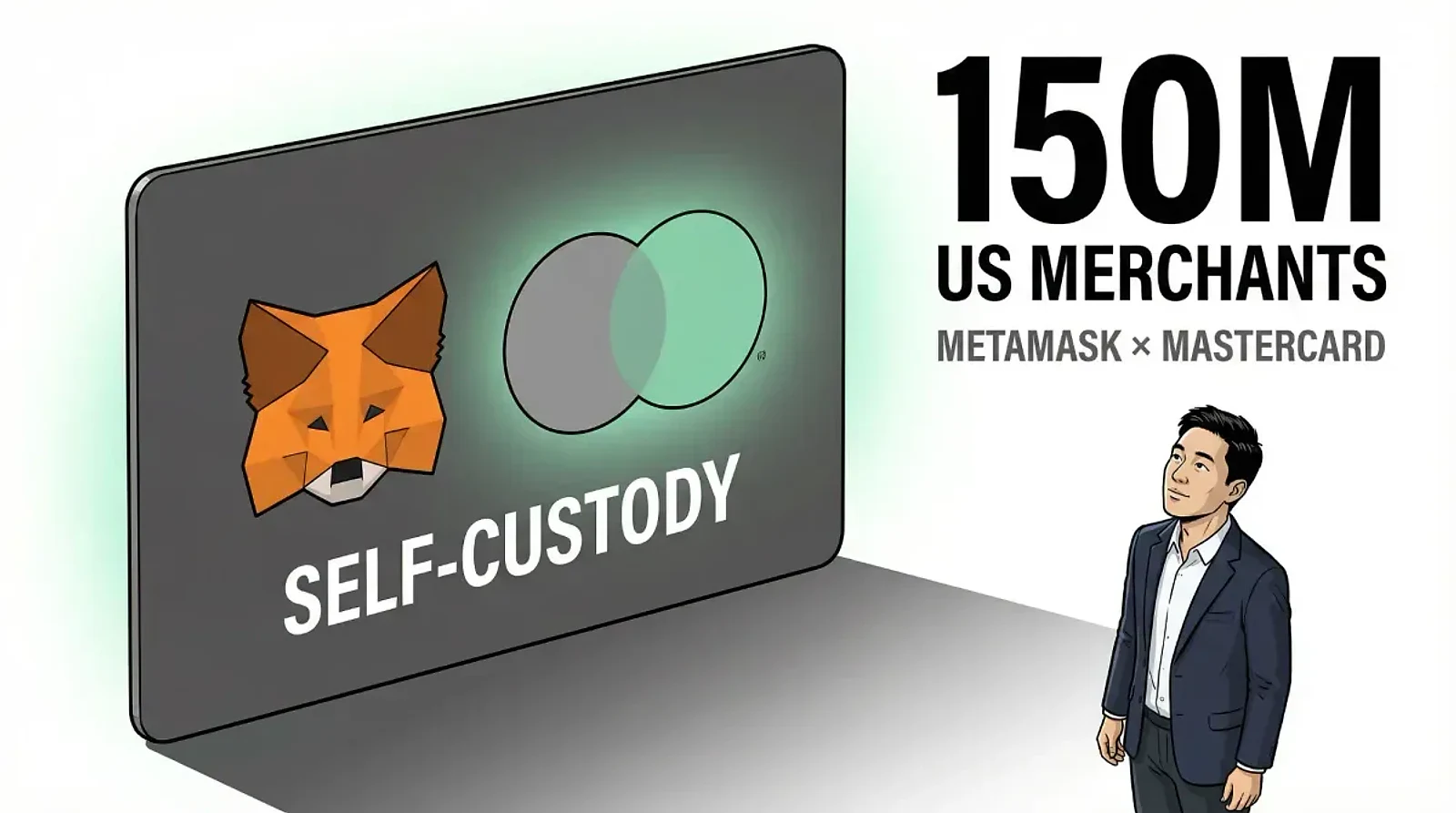
The most contested ground in digital payments is no longer which blockchain processes transactions fastest. It is which interface controls the moment a consumer decides to spend. MetaMask, the browser and mobile wallet operated by Consensys, and Mastercard have answered that contest with a product that puts the self-custody wallet directly on a payment card, accepted at every one of the 150 million Mastercard merchants worldwide, with no requirement to move funds onto a centralized exchange first [1][2].
The Product: Self-Custody at the Point of Sale
The MetaMask Card, launched across the United States in early 2026, is built on a four-party infrastructure: MetaMask as the wallet layer, Mastercard as the network, Cross River Bank as the FDIC-insured issuing bank, and Monovate (formerly Baanx) as the regulated card issuer [1]. The US waiting list opened in March 2025, and the card is now fully operational nationwide including New York, where regulatory friction had previously delayed rollout for some digital asset products [2].
The core differentiation from every custodial crypto card on the market is structural. Users retain possession of their digital assets inside the MetaMask wallet until the precise moment of purchase. There is no pre-loading requirement, no transfer to a centralized exchange, and no surrender of private key control prior to the transaction. Assets convert seamlessly via Mastercard's network at the point of sale [2][3].
"MetaMask shares our vision of empowering people to spend their crypto securely and seamlessly, anywhere Mastercard is accepted in the world." [1]
Sherri Haymond, Global Head of Digital Commercialization, Mastercard
The card ships in two configurations. The standard virtual tier is free and delivers 1% cashback paid in mUSD, MetaMask's Ethereum-based stablecoin issued by Bridge (a Stripe-owned company), minted via M0's decentralized infrastructure, and backed 1:1 by high-quality liquid dollar-equivalent assets [1]. The MetaMask Metal Card, priced at $199 per year, delivers a physical card, 3% cashback on the first $10,000 spent annually, zero foreign transaction fees, elevated spending and ATM limits, travel discounts through Entravel, and access to exclusive events [1][3].
Tier — Annual Cost — Cashback — Physical Card — Foreign Tx Fee — ATM Limits
Standard (Virtual) — Free — 1% in mUSD — No — Standard — $10k txn / $15k daily
Metal — $199 — 3% on first $10k/yr — Yes — None — Elevated
Sources: CoinMarketCap, Cryptonomist, Nasdaq/Zacks [1][3][2]
The card is compatible with Apple Pay and Google Pay, which extends its usability to contactless payments at any terminal that accepts those wallets. Supported assets in the US at launch include USDC and aUSDC. The broader MetaMask Card ecosystem supports USDT, wETH, EURe, and GBPe across European and Latin American markets [3].
Mastercard's Architecture: Infrastructure Over Speculation
Mastercard's strategic logic here is precise. By embedding itself into the self-custody wallet layer, the network captures transaction volume from a segment of digital asset holders who previously had no practical spending mechanism, without taking direct balance sheet exposure to cryptocurrency price risk [2]. The company is positioning itself as the infrastructure rail of digital commerce rather than a speculator on any particular asset class.
This positioning extends beyond the MetaMask partnership. Mastercard has created a new Director of Crypto Flows leadership role to build out cryptocurrency payment systems, and maintains existing infrastructure partnerships with Circle and Paxos for card-linked and wallet-based stablecoin systems [4]. A separate initiative called Agent Pay, demonstrated with Santander in the completion of Europe's first live payment initiated by an AI agent within a regulated banking framework, signals that Mastercard is simultaneously preparing its network for the next generation of autonomous payment flows [5].
"Mastercard's network is compatible with AI advancements, addressing risks of AI bypassing card networks." [5]
Yahoo Finance / Simply Wall St analysis of Mastercard's Agent Pay initiative
The Mastercard Crypto Card Program now supports 150 million-plus acceptance locations, across prepaid, debit, credit, and rewards configurations, for custodial exchanges, self-custody wallet users, and Web3 digital wallet users alike [4]. The MetaMask launch represents the highest-profile self-custody deployment on that program to date.
The Crypto Card Arms Race: Visa Holds More Than 90% of Volume
The MetaMask card lands in a market that has expanded from roughly $100 million in monthly spend in early 2023 to approximately $1.5 billion per month by late 2025, an annualized run rate approaching $18 billion [6]. Year-over-year growth in 2025 exceeded 100%, outpacing flat peer-to-peer crypto payment volumes.
Visa currently commands more than 90% of on-chain crypto card transaction volume, backed by 130-plus crypto card programs and early alignment with crypto-native issuers including Rain and Reap [6]. Rain reached more than $3 billion in annualized volume in 2025 (representing roughly 38 times year-over-year growth) before closing a $250 million Series C in January 2026 at a valuation near $1.95 billion [6]. Reap crossed $6 billion in early 2026 annualized volumes with a focus on corporate cards across Asia, the Middle East, and the US [6].
Revolut contributed more than $10 billion in 2025 crypto card volume, establishing the neobank model as a dominant distribution channel [6]. Visa's settlement infrastructure now runs USDC settlement for issuers in Latin America, Europe, and Asia on both Ethereum and Solana rails, with a US launch alongside regulated banks occurring in late 2025 in partnership with Circle on the Arc blockchain [6].
Mastercard is closing the infrastructure gap, supporting 130-plus programs and pursuing pilots for merchant-level stablecoin settlement with Circle, Paxos, and Nuvei through its Multi-Token Network for tokenized deposits and stablecoins [6].
Competitive Landscape: The Card Table in 2026
The principal alternatives to the MetaMask Card each address a different segment of the market.
Card — Network — Self-Custody — Top Cashback — Annual Fee — Key Differentiator
MetaMask Card — Mastercard — Yes — 3% (Metal tier) — $199 (Metal) — Non-custodial spend
Coinbase Card — Visa — No — Varies — None — Coinbase ecosystem, US/UK/EU
Crypto.com Card — Visa — No — Up to 5% CRO — None — CRO staking rewards tiers
Bybit Card — Mastercard — No — Up to 10% — None — Auto-Savings feature
Sources: Cryptonomist, Insights4VC [3][6]
Crypto.com's Visa card, covering 150-plus cryptocurrencies across the US, Europe, the UK, Canada, Australia, and parts of Asia, remains the incumbent rewards leader with up to 5% cashback in CRO for staked tiers [3]. Coinbase's Visa debit card targets beginners and existing Coinbase account holders, carrying no annual or spending fees [3]. Bybit's Mastercard, available across the European Economic Area and Australia, advertises up to 10% cashback and an Auto-Savings feature [3].
None of the custodial alternatives can match the self-custody proposition of the MetaMask Card. Ale Machado, MetaMask's staff product manager, frames the success metric plainly: the primary goal is for US users to be "spending from their self-custodial wallet without friction, without thinking about the crypto underneath" [1]. If that frictionless experience scales, it represents a genuine structural advance, not just another entry in the crypto card arms race.
What the Market Is Watching
The monthly transaction volume trend has been rising since December 2024, and the 2026 projections for crypto card spend run from a conservative $30 billion annualized to significantly higher in accelerated scenarios [6]. Visa's dominance in settlement infrastructure gives it a structural advantage that Mastercard is working to close through the Multi-Token Network and partnerships like MetaMask. The regulatory clarity arriving from the Genius Act's stablecoin framework and from New York's decision to permit the MetaMask card rollout are reducing friction for issuers and users simultaneously.
The self-custody card segment, previously served only by niche products like Gnosis Pay in the UK and EU, now has a US-scale product with mainstream brand recognition on both sides of the partnership. Whether the MetaMask Metal Card's $199 price point drives meaningful premium tier adoption will be one of the first real market signals that the self-custody model can compete for wallet share with the simpler, free custodial alternatives.
References
[1] CoinMarketCap, "MetaMask and Mastercard Launch Self-Custody Crypto Card Across US," February 27, 2026. https://coinmarketcap.com/academy/article/metamask-and-mastercard-launch-self-custody-crypto-card-across-us
[2] Nasdaq / Zacks, "Blockchain Meets Checkout: Mastercard Plays the Long Game," March 2, 2026. https://www.nasdaq.com/articles/blockchain-meets-checkout-mastercard-plays-long-game
[3] The Cryptonomist, "Best Crypto Cards for 2026," February 25, 2026. https://en.cryptonomist.ch/2026/02/25/best-crypto-cards-2026/
[4] Mastercard, "Making Everyday Purchases with Crypto Cards," Mastercard Crypto Card Program. https://www.mastercard.com/us/en/business/payments/consumer-payments/next-gen-payments/digital-asset-solutions/crypto-card-program.html
[5] Yahoo Finance / Simply Wall St, "Mastercard Crypto Card and Fintech Deals Reshape Long Term Earnings Story," February 26, 2026. https://finance.yahoo.com/news/mastercard-crypto-card-fintech-deals-211243633.html
[6] Insights4VC, "Stablecoin Cards in 2026: The State of the Market," January 22, 2026. https://insights4vc.substack.com/p/the-state-of-stablecoin-cards