Mastercard Launches Wallet Pay Across NFC, QR and Online Wallet Payments
Mastercard Wallet Pay connects digital wallets to Mastercard acceptance across NFC, QR and online payments, with partners across multiple regions.
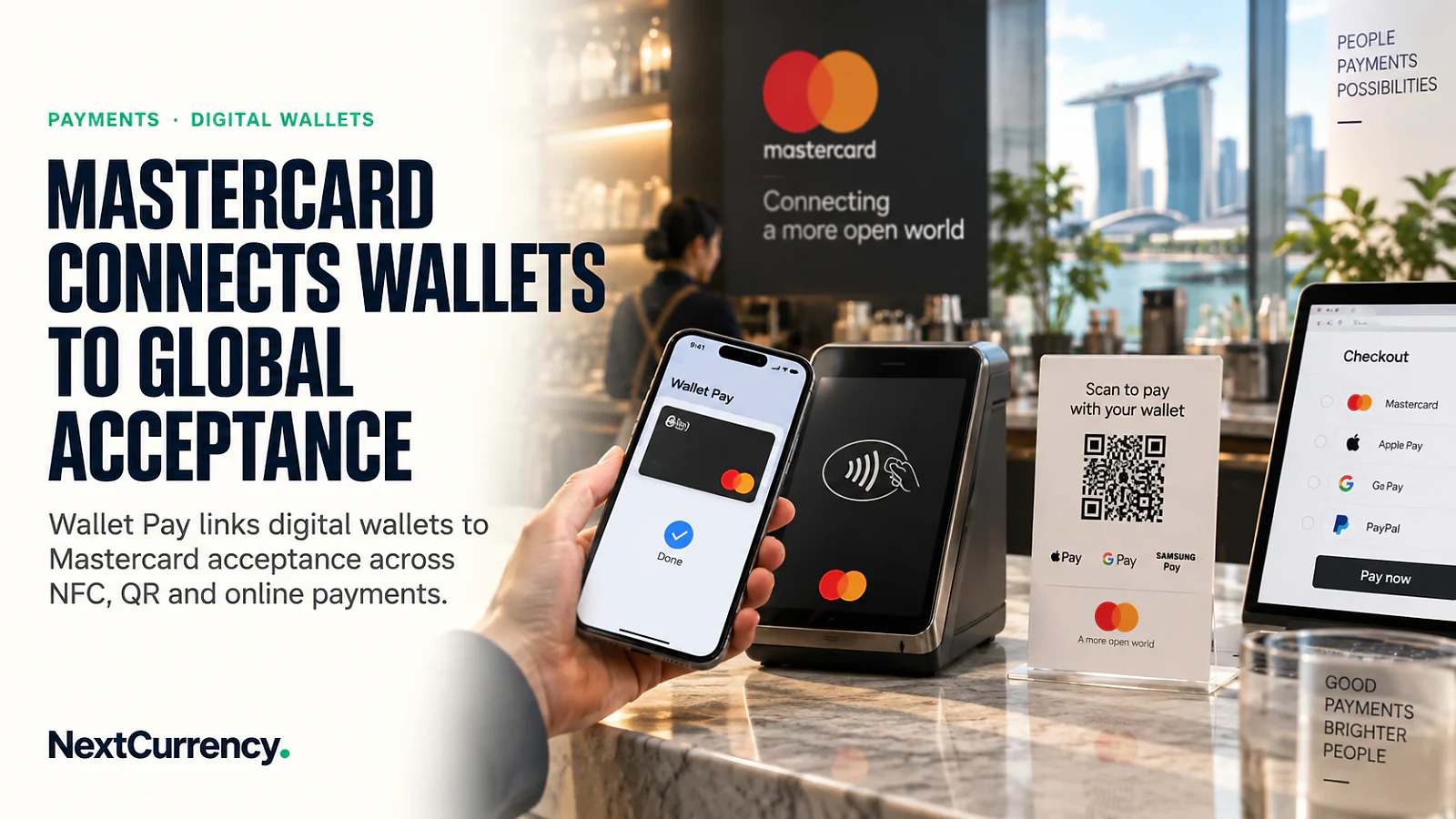
Mastercard has launched Wallet Pay, a portfolio of services intended to connect digital wallets to Mastercard acceptance across contactless payments, QR codes and online commerce.
The September 10 announcement names Alipay+ partner wallets including AlipayHK, Clip, GCash, KakaoPay, TNG eWallet and TrueMoney, alongside Axian, CRED, DaviPlata, Mercado Pago, MTN and TenPay Global. Mastercard describes those providers as using Wallet Pay to extend interoperability and reach across markets. Mastercard.
Mastercard is abstracting the wallet from the merchant
Digital wallets are fragmented by geography, funding method and payment technology. Some rely on QR codes, some on contactless credentials, and others operate primarily online or inside closed ecosystems.
Wallet Pay is designed to reduce the amount of that fragmentation a merchant has to understand. Instead of every wallet building separate acceptance at every merchant, Mastercard can connect wallet providers to a network that businesses already use.
That is the same distribution logic card networks have applied for decades: a consumer's account can differ by issuer and country while the merchant interacts with a standardized acceptance layer.
The difference is that Wallet Pay starts from a wallet rather than a conventional card account.
The launch is not a stablecoin product
The product is relevant to the future of digital money, but Mastercard did not announce Wallet Pay as a stablecoin service. The named participants include mainstream mobile wallets with different funding models, and the launch should not be reframed as evidence of stablecoin adoption.
Its significance for stablecoins is architectural. If stablecoin-funded wallets use similar network abstractions in the future, users could spend new forms of money through existing merchant acceptance without requiring every merchant to integrate each stablecoin directly.
That possibility should be separated from what is live today.
Distribution is the competitive advantage
Mastercard says digital wallets already serve more than 4.3 billion users globally and projects usage above 6 billion by 2030. Those figures come from Mastercard's announcement and describe the wider wallet market, not Wallet Pay users.
The product's immediate advantage is access to Mastercard's acceptance footprint. For a wallet provider, that can turn local user balances into a payment method with broader reach. For Mastercard, it keeps the network relevant even as the account that funds a purchase increasingly sits outside a traditional card interface.
The commercial test will be usage rather than partner logos. Wallet Pay becomes strategically important if consumers actually use it for cross-border purchases, merchants see incremental transactions and wallet providers can expand acceptance without recreating the economics of a card issuer.
What happens next
The next evidence should come from market-by-market activation: which wallets offer which Wallet Pay functions, whether the experience uses NFC, QR or online credentials, what fees apply and how cross-border conversion is handled.
Until those deployments are visible, the September 10 launch is best read as Mastercard building a common acceptance layer for a wallet market that continues to fragment.