Mastercard Launches Global Crypto Partner Program, Enlisting 85+ Firms From Binance to PayPal
The payments giant unveils a formal partner network spanning exchanges, stablecoin issuers, blockchain protocols, and compliance providers to bridge on-chain innovation with its 150-million-merchant acceptance network.
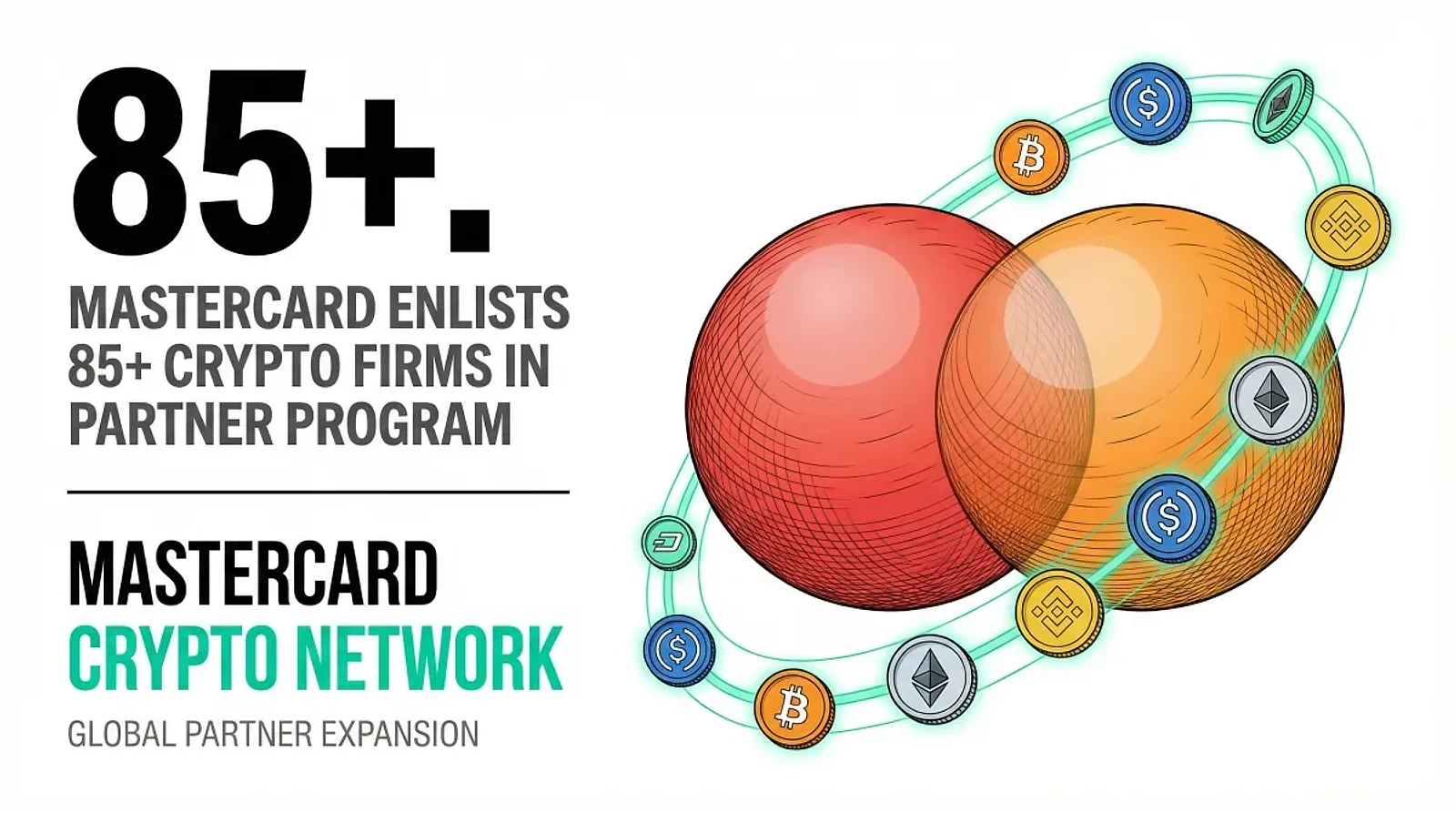
Mastercard Incorporated on March 11, 2026 officially launched the Mastercard Crypto Partner Program, a global initiative assembling more than 85 crypto-native companies, payments providers, and financial institutions into a structured network designed to connect blockchain-based payment tools with Mastercard's existing infrastructure [1][2]. The roster includes marquee names such as Binance, Circle, PayPal, Kraken, Ripple, and Solana, marking the card network's most ambitious move yet to position itself at the intersection of traditional finance and digital assets.
The Partner Roster
The program's participant list reads like a who's who of the digital asset industry, organized across six functional categories. Major exchanges including Binance, Gemini, Kraken, OKX, Bybit, and Crypto.com sit alongside stablecoin issuers Circle (USDC), PayPal (PYUSD), Paxos, SoFi (SoFiUSD), and StraitsX [1][3]. Infrastructure providers such as Fireblocks, BitGo, Modern Treasury, and Galileo handle settlement and custody, while Chainalysis, Elliptic, TRM Labs, and Merkle Science supply compliance and analytics capabilities.
Category — Notable Partners
Exchanges — Binance, Gemini, Kraken, OKX, Bybit, Crypto.com, SwissBorg
Stablecoin issuers — Circle (USDC), PayPal (PYUSD), Paxos, SoFi (SoFiUSD), StraitsX
Settlement and custody — Fireblocks, BitGo, Modern Treasury, Galileo, Anchorage Digital
Compliance and analytics — Chainalysis, Elliptic, TRM Labs, Merkle Science, Blockaid, Sardine
Blockchain protocols — Solana, Polygon, Stellar, Tron, Optimism, Aptos, Monad, Ava Labs (Avalanche)
Payments infrastructure — Marqeta, Lithic, Worldpay, Shift4, Cross River, WebBank, Thredd
The breadth of the roster signals a deliberate strategy. Mastercard is not building its own blockchain or issuing its own stablecoin. Instead, it is offering its 150-million-plus merchant acceptance network, compliance infrastructure, and settlement capabilities as the connective layer between on-chain innovation and everyday commerce [1].
Raj Dhamodharan, Executive Vice President of Digital Asset Blockchain Products and Partnerships at Mastercard, framed the rationale:
"Digital assets are entering a new phase. What once ran in parallel to existing financial systems is increasingly being applied to solve practical, real-world needs, often behind the scenes, from cross-border remittances to B2B money transfers. This creates new opportunities to add value to how money moves globally."
Use Cases in Focus
The program targets four primary use cases: cross-border transfers connecting stablecoin rails to the Mastercard acceptance network for faster and cheaper remittances; business-to-business settlement using stablecoins; global on-chain payouts and disbursements; and stablecoin-enabled card issuance through Mastercard's existing Crypto Card Program [1].
The card program already allows consumers to spend crypto holdings at Mastercard's merchant locations through three product types: prepaid cards that convert crypto to fiat at the point of sale, crypto-backed credit lines, and reward cards that earn digital assets on purchases. Crypto.com has secured a principal license to issue Mastercard cards directly [1][3].
SoFiUSD: The Live Proof Point
Eight days before the partner program launch, Mastercard and SoFi Technologies announced a landmark integration. As of March 3, 2026, card issuers and acquirers on Mastercard's global network can settle transactions using SoFiUSD, described as the first stablecoin offered by a U.S. nationally chartered and insured deposit bank on a public, permissionless blockchain [4][5].
SoFiUSD is issued by SoFi Bank, N.A., an OCC-regulated national bank, and is fully reserved 1:1 by cash with immediate redemption capability. BitGo serves as custodian. The stablecoin launched in December 2025 and has processed approximately $7 million in round-trip transactions to date [4].
Sherri Haymond, Executive Vice President of Digital Commercialization at Mastercard, described the strategic logic:
"By working with SoFi to enable SoFiUSD across the Mastercard network, we're expanding how trusted digital currencies can be used at global scale. Bringing stablecoin settlement on our network will connect regulated stablecoins with the reliability, security, and reach that consumers, businesses and financial institutions expect."
SoFiUSD will be supported on the Mastercard Multi-Token Network (MTN), the company's digital asset platform connecting traditional money with digital assets [4]. SoFi's technology platform, Galileo, will be among the first to offer payment card clients the option to settle transactions in the stablecoin.
Building on Prior Infrastructure
The crypto partner program represents the formalization of relationships Mastercard has been building since at least 2021. Existing initiatives include the Start Path accelerator for blockchain startups, the Engage platform with its dedicated Crypto Card program, and the Crypto Credential blockchain identity system for verified usernames across exchanges that supports Travel Rule compliance [1][3].
A notable precursor was Mastercard's June 2025 partnership with Chainlink, which brought on-chain crypto purchases to cardholders for the first time. That integration powers Swapper Finance, enabling Uniswap purchases via Mastercard cards, with Zerohash handling compliance, Shift4 Payments processing card transactions, and XSwap providing DEX liquidity [3]. Mastercard already supported USDC, PYUSD, USDG, and FIUSD on its network before the program's launch.
The Competitive Landscape
Mastercard's move comes as rival Visa simultaneously expands its own stablecoin-backed card programs across more than 100 countries in partnership with Bridge, a Stripe company [5]. Visa is also testing on-chain settlement for select transactions and has partnered with Phantom and MetaMask to reach 175 million merchant locations. Both card networks are positioning themselves as essential bridges between crypto-native systems and traditional finance, competing to become the default settlement layer for a stablecoin-powered payments ecosystem.
References
[1] Mastercard, "Mastercard Crypto Partner Program," March 11, 2026. https://www.mastercard.com/global/en/news-and-trends/stories/2026/mastercard-crypto-partner-program.html [2] Bitcoin Magazine, "Mastercard Global Crypto Partner Program," March 11, 2026. https://bitcoinmagazine.com/news/mastercard-global-crypto-partner-program [3] Genfinity, "Mastercard Crypto Partner Program Analysis," March 11, 2026. https://genfinity.io/2026/03/11/mastercard-crypto-partner-program/ [4] Mastercard/SoFi Press Release, "SoFi and Mastercard Partner to Enable SoFiUSD Settlement," March 3, 2026. https://www.mastercard.com/global/en/news-and-trends/press/2026/march/sofi-and-mastercard-partner-to-enable-sofiusd-settlement-across-.html [5] Ledger Insights, "SoFi, Mastercard Partner on Stablecoin Settlement as Visa Expands Bridge Card Program," March 3, 2026. https://www.ledgerinsights.com/sofi-mastercard-partner-on-stablecoin-settlement-as-visa-expands-bridge-card-program/