Mastercard Completes ASEAN Rollout of Authenticated Agentic Transactions with UOB and Krungthai Card
Mastercard has completed its first authenticated agentic transaction rollout across Southeast Asia, going live in Singapore and Malaysia with UOB as anchor bank on April 6, followed by Thailand through Krungthai Card on April 7, 2026. The deployment uses Mastercard Agentic Tokens, Payment Passkeys, and a co-developed Verifiable Intent framework to authenticate every AI-initiated purchase.
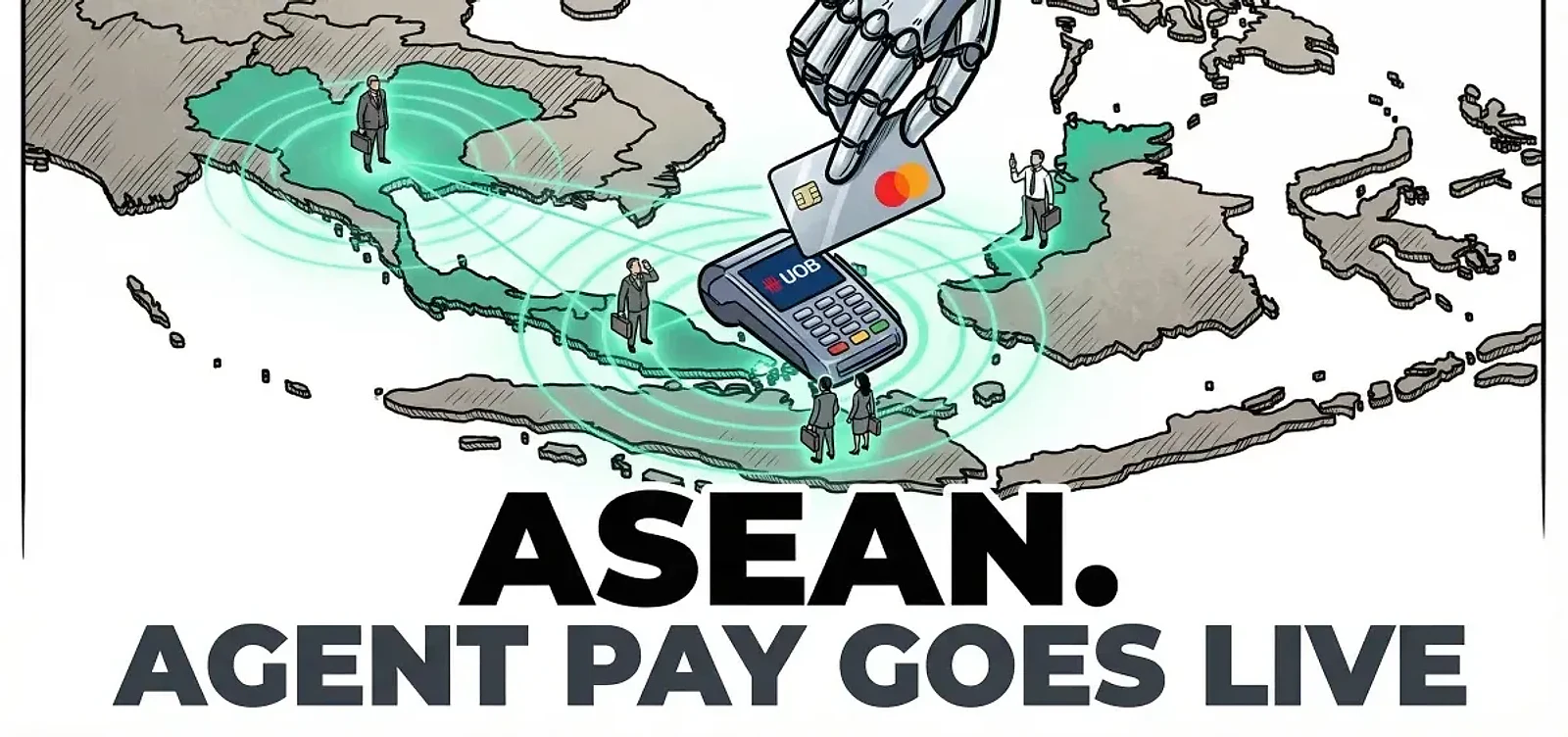
Mastercard activated authenticated agentic transactions across Southeast Asia between April 6 and 8, 2026, completing a region-wide rollout that makes the ASEAN bloc the latest major geography to support AI-initiated commerce on its network. The milestone, announced from Singapore on April 6, pairs Mastercard Agent Pay technology with UOB as the primary anchor bank for Singapore and Malaysia, and with Krungthai Card (KTC) for Thailand, placing three core ASEAN markets on live rails within a single 72-hour window. [1]
How the Authentication Stack Works
At the core of the deployment are three interlocking components. Mastercard Agentic Tokens replace static card credentials with dynamic, single-purpose tokens that an AI agent can consume without exposing underlying account data. Payment Passkeys bind each token issuance to a device-level cryptographic handshake, eliminating the credential-theft risk that plagued earlier autonomous payment models. The third component, Verifiable Intent, is a standards-based framework co-developed with Google that creates a tamper-resistant, auditable record of exactly what a consumer authorized at the moment an AI agent was instructed to act on their behalf. [1]
That third layer is what distinguishes this rollout from prior tokenization schemes. Verifiable Intent does not merely authenticate the payment; it encodes the scope of the consumer's instruction, the merchant category, the spending ceiling, and the time window into a signed record that issuers, merchants, and consumers can independently verify after the fact. The record persists as a shared source of truth across the ecosystem, giving regulators and dispute-resolution processes a reliable audit trail for every AI-executed transaction. [1]
"The first wave of authenticated agentic transactions across ASEAN shows how quickly the region is embracing secure, AI-enabled commerce. With early pilots now live across multiple markets, Mastercard is proving that AI agents can operate responsibly and transparently, giving consumers confidence that every transaction is authenticated and anchored in verifiable intent," said Safdar Khan, Division President, Southeast Asia, Mastercard. [1]
UOB as Regional Anchor, KTC Extends to Thailand
Mastercard chose UOB as its multi-market partner for the initial ASEAN wave, citing the bank's cross-border retail network spanning Singapore, Malaysia, Thailand, Indonesia, and Vietnam. UOB's participation in the Singapore and Malaysia deployments creates a single interoperable testing environment across two jurisdictions with distinct central bank frameworks, the Monetary Authority of Singapore and Bank Negara Malaysia, demonstrating that the Agent Pay stack can operate across regulatory boundaries without requiring market-specific token architectures. [1]
"UOB remains committed to harnessing innovation responsibly to deliver simpler, safer and more seamless customer experiences across the region. Our multi-market collaboration with Mastercard shows how trusted, AI-driven payments can enhance everyday banking and commerce, tailored to diverse lifestyle needs across markets," said Jacquelyn Tan, Head of Group Personal Financial Services, UOB. [1]
For Thailand, Krungthai Card (KTC) went live on April 7, 2026, extending the rollout to one of Southeast Asia's largest credit card markets. KTC's inclusion is significant given Krungthai Bank's position as a state-backed institution; government-affiliated financial infrastructure adopting agentic payment rails signals regulatory comfort in Bangkok ahead of a formal Bank of Thailand framework for autonomous transactions. [2]
ASEAN Completes a Broader Asia-Pacific Arc
The April 6-8 deployments mark the completion of a systematic Asia-Pacific sweep Mastercard began in early 2026. Prior to the ASEAN wave, the company had activated authenticated agentic transactions in Australia, New Zealand, South Korea, Taiwan, Hong Kong, and India during Q1 2026. The ASEAN activation closes the last major regional gap in Asia Pacific, leaving only emerging Southeast Asian markets such as Indonesia, Vietnam, and the Philippines as near-term expansion targets. [1]
Market — Bank Partner — Go-Live Date — Status
Singapore — UOB, DBS — March-April 2026 — Live
Malaysia — UOB — April 2026 — Live
Thailand — Krungthai Card (KTC) — April 7, 2026 — Live
Australia — Various — Q1 2026 — Live
South Korea — Various — Q1 2026 — Live
Hong Kong — Various — Q1 2026 — Live
India — Various — Q1 2026 — Live
New Zealand — Various — Q1 2026 — Live
The regional sequencing reflects a deliberate strategy: anchor markets with strong fintech regulatory frameworks first, use those deployments to validate the cross-border interoperability of the token architecture, then extend to adjacent markets sharing common banking partners or regulatory approaches. [1][2]
AI Centre of Excellence: Singapore as Regional Command
Alongside the transaction rollout, Mastercard confirmed it will establish a new regional AI Centre of Excellence (CoE) in Singapore later in 2026. The facility will consolidate Mastercard's existing Asia Pacific innovation hub with advanced cybersecurity capabilities and AI engineering talent, making it the company's largest innovation space in the region. The CoE will concentrate expertise across fraud detection, real-time risk management, and agentic commerce governance, building on Mastercard's existing deployment of more than 2,000 data scientists, engineers, and consultants focused on data and AI globally. [1]
Singapore's selection as CoE headquarters underscores the city-state's role as the de facto governance centre for the ASEAN AI payments ecosystem. The Monetary Authority of Singapore's regulatory sandbox programs and the country's bilateral digital economy agreements with South Korea, Australia, and the United Kingdom position the CoE to contribute to cross-border standards work in addition to internal Mastercard R&D. [1]
"Trust is the currency of the AI economy. As connected commerce accelerates across ASEAN, data is becoming the key to transforming payments into seamless, intuitive experiences. Mastercard's new AI Centre of Excellence in Singapore, together with deeper collaborations across the region, will strengthen the frameworks needed for AI-powered commerce to scale responsibly," Khan added. [1]
What Comes Next for Agentic Commerce in ASEAN
The immediate priority for Mastercard and its banking partners is expanding the consumer-facing population covered by Agent Pay credentials. The April 2026 deployments represent institutional infrastructure going live; the commercial rollout to individual cardholders will proceed market by market as issuers complete integration testing and consumer disclosure frameworks. [2]
The Verifiable Intent co-development with Google also hints at a broader ambition: the framework's open, standards-based design is intended to allow non-Mastercard AI agents, including those built on Google's Gemini and competing large language model platforms, to authenticate through the same trust layer. If adopted at standards-body level, Verifiable Intent could become the common language through which any AI agent, regardless of the model or platform behind it, demonstrates to a payment network that it is acting within authorized scope. [1]
For merchants and consumers in Singapore, Malaysia, and Thailand, the practical near-term change is that purchases initiated by AI shopping agents, travel booking bots, or subscription management tools will carry the same chargeback protections and dispute rights as cardholder-present transactions, removing one of the principal liability uncertainties that had slowed enterprise adoption of autonomous procurement workflows in the region. [1][2]
References
[1] Mastercard (April 6, 2026): https://www.mastercard.com/news/ap/en/newsroom/press-releases/en/2026/mastercard-powering-asean-s-ai-ambitions-in-the-future-of-payments/ [2] Intellectia.ai (April 7, 2026): https://intellectia.ai/news/stock/mastercard-launches-authenticated-agentic-transactions-in-asean [3] The Paypers (April 8, 2026): https://thepaypers.com