Mastercard and Yellow Card Partner on Stablecoin Payments Across EEMEA
Mastercard and Yellow Card have announced a strategic partnership to deploy stablecoin-enabled payment infrastructure across Eastern Europe, the Middle East, and Africa, targeting cross-border remittances, B2B settlement, digital loyalty ecosystems, and treasury management with Mastercard Crypto Credential technology at its core.
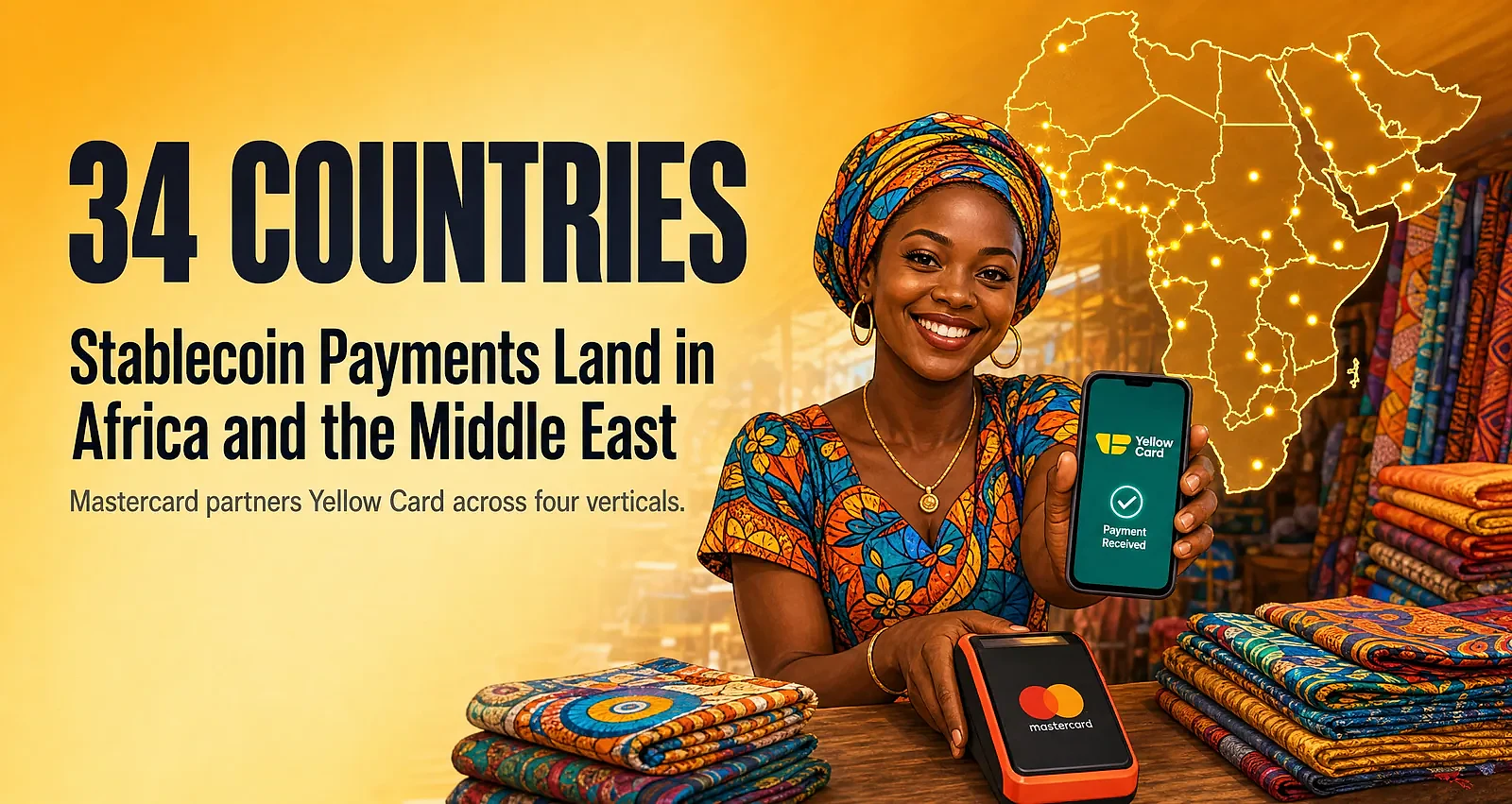
Mastercard and Yellow Card announced on May 7, 2026 a strategic partnership to accelerate stablecoin-enabled payment innovation across Eastern Europe, the Middle East, and Africa (EEMEA), with plans for global expansion, positioning two of the most influential names in emerging-market payments to jointly address some of the costliest and most fragmented financial corridors in the world.[1][2]
The alliance, announced from Dubai, brings together Mastercard's global network and compliance infrastructure with Yellow Card's status as one of Africa's largest licensed stablecoin operators, a company holding regulatory approvals across 34 countries including 20 African markets as well as Brazil, India, Mexico, China, Singapore, and Hong Kong.[2][3] Initial focus markets for the EEMEA rollout include Ghana, Kenya, Nigeria, South Africa, and the United Arab Emirates.[1]
Four Verticals, One Strategic Thesis
The partnership targets four distinct payment verticals where stablecoin rails offer structural cost and speed advantages over conventional correspondent banking: cross-border remittances, B2B settlement, digital loyalty ecosystems, and treasury management.[1][2] Africa alone receives over $50 billion in annual remittance inflows, yet transfer costs across the continent remain among the highest globally, regularly exceeding 6 percent of transaction value on key corridors.[3] Stablecoin settlement, by bypassing multi-hop correspondent banking chains, can compress settlement times from days to minutes at a fraction of the cost.
For B2B settlement, the partnership targets a structural gap: businesses operating across African borders frequently encounter limited correspondent banking relationships, currency mismatch, and liquidity constraints that delay payments and inflate costs. The treasury management vertical extends this logic to corporate treasurers seeking protection against local currency devaluation, a persistent concern across several EEMEA markets.
Mastercard Crypto Credential at the Center
Central to the technical architecture is Mastercard Crypto Credential, a verification framework that replaces complex blockchain wallet addresses with verified, human-readable identifiers. The system confirms that both sender and recipient meet applicable compliance requirements before a transaction is initiated, addressing one of the most persistent barriers to institutional stablecoin adoption: counterparty trust and regulatory accountability.[3]
For remittance corridors where failed or misdirected transfers erode confidence in digital payment methods, this compliance layer matters as much as underlying settlement speed. The integration of Crypto Credential signals that Mastercard's approach to stablecoins is not speculative exposure but infrastructure embedding, weaving digital asset rails into the compliance frameworks that regulated financial institutions already operate within.
"Emerging markets represent the greatest opportunity for payment innovation, but success requires deep local expertise and regulatory navigation. We bring years of experience building compliant stablecoin infrastructure where traditional banking falls short. Mastercard's global network amplifies these capabilities, allowing us to serve businesses and consumers who need better, more affordable ways to move money across borders." - Chris Maurice, CEO, Yellow Card[2]
Yellow Card's Regulatory Footprint
Yellow Card's competitive moat is its licensing depth. Operating across 34 countries with active regulatory approvals rather than informal market presence gives the company a compliance foundation that most stablecoin infrastructure providers cannot replicate at scale. The table below outlines the company's current geographic footprint and the verticals each region supports under the new partnership framework.
Region — Countries / Markets — Key Partnership Verticals
Africa — 20 licensed markets, including Ghana, Kenya, Nigeria, South Africa — Remittances, B2B Settlement, Treasury Management
Middle East — UAE (initial focus) — B2B Settlement, Digital Loyalty Ecosystems
Latin America — Brazil, Mexico — Cross-border Remittances, Treasury Management
Asia-Pacific — India, China, Singapore, Hong Kong — B2B Settlement, Treasury Management
EEMEA Expansion — Eastern Europe (planned) — All four verticals under joint working groups
The partnership will establish joint working groups to identify high-impact use cases and create interoperable solutions for banks and financial institutions within the Mastercard network, bridging traditional finance with blockchain-powered payment rails.[1][2]
Partnership vs. Acquisition: A Strategic Contrast
Mastercard's approach in EEMEA stands in deliberate contrast to its strategy in more developed markets. Earlier in 2025, Mastercard pursued an acquisition of BVNK, a UK-based stablecoin payments company serving institutional clients in Europe and North America, internalizing that capability directly.[4] In emerging markets, however, where regulatory environments are fragmented across dozens of jurisdictions and local operational expertise is a genuine competitive asset, partnership with an already-licensed, deeply embedded operator like Yellow Card is the more efficient entry vector.
Mastercard is not building stablecoin infrastructure from scratch in Africa; it is amplifying infrastructure that already exists, layering its network scale, compliance tooling, and brand credibility onto Yellow Card's operational rails. If pilot phases in the five initial markets deliver measurable cost and settlement improvements, the model could extend to other high-growth, underbanked regions.
Mete Güney, Executive Vice President, Market Development, EEMEA at Mastercard, described the collaboration's scope:
"Stablecoins are an exciting and useful option for some payments, and we look forward to working on additional use cases with Yellow Card, while continuing to leverage Mastercard's expertise to make stablecoins seamless and secure. Together we look forward to taking digital finance into a new sphere, unlocking new efficiencies in cross-border trade, business-to-business settlements, and digital asset security, to generate a wide-ranging positive impact across the financial ecosystem."[1][2]
Regulatory Engagement as a Core Pillar
Both companies have committed to working directly with banks, financial institutions, and regulatory bodies to pilot secure, compliant stablecoin solutions.[1] This co-regulatory approach is a deliberate response to one of the main reasons earlier stablecoin payment initiatives stalled across African markets: a lack of clarity on how dollar-pegged assets fit within existing money transfer and foreign exchange licensing regimes.
By engaging regulators as partners in the pilot design rather than seeking forgiveness after deployment, Mastercard and Yellow Card are constructing a compliance pathway that could make their joint solutions easier to scale, and harder for competitors without equivalent regulatory relationships to replicate. As stablecoins gain institutional clarity across EEMEA jurisdictions, the infrastructure being built under this partnership is positioned as the layer through which that clarity translates into commercial payment volume.
References
[1] Mastercard, "Mastercard and Yellow Card Partner to Unlock Stablecoin Payment Innovation Across EEMEA," May 7, 2026. https://www.mastercard.com/news/eemea/en/newsroom/press-releases/en/2026/may/mastercard-and-yellow-card-partner-to-unlock-stablecoin-payment-innovation-across-eemea.html
[2] Yellow Card, "Mastercard and Yellow Card Partner to Unlock Stablecoin Payment Innovation Across EEMEA," May 6, 2026. https://yellowcard.io/blog/mastercard-and-yellow-card-partner-to-unlock-stablecoin-payment-innovation-across-eemea
[3] Stablecoin Insider, "Mastercard and Yellow Card Partner to Unlock Stablecoin Payments Across EEMEA," May 7, 2026. https://stablecoininsider.org/mastercard-and-yellow-card-partner-to-unlock-stablecoin-payments-across-eemea/
[4] MEXC News, "Mastercard and Yellow Card Team Up to Boost Stablecoin Payments Across EEMEA," May 8, 2026. https://www.mexc.com/news/1077470
[5] Business Insider Africa, "Africa pushes digital cross-border payments as remittances hit $600m monthly," February 19, 2026. https://africa.businessinsider.com/local/markets/africa-pushes-digital-cross-border-payments-as-remittances-hit-dollar600m-monthly/c4756ys