Mastercard Launches Agent Connect to Link Merchants With AI Shopping Agents
Mastercard launched Agent Connect to link merchants with AI agents while retaining control over product data, access and business rules.
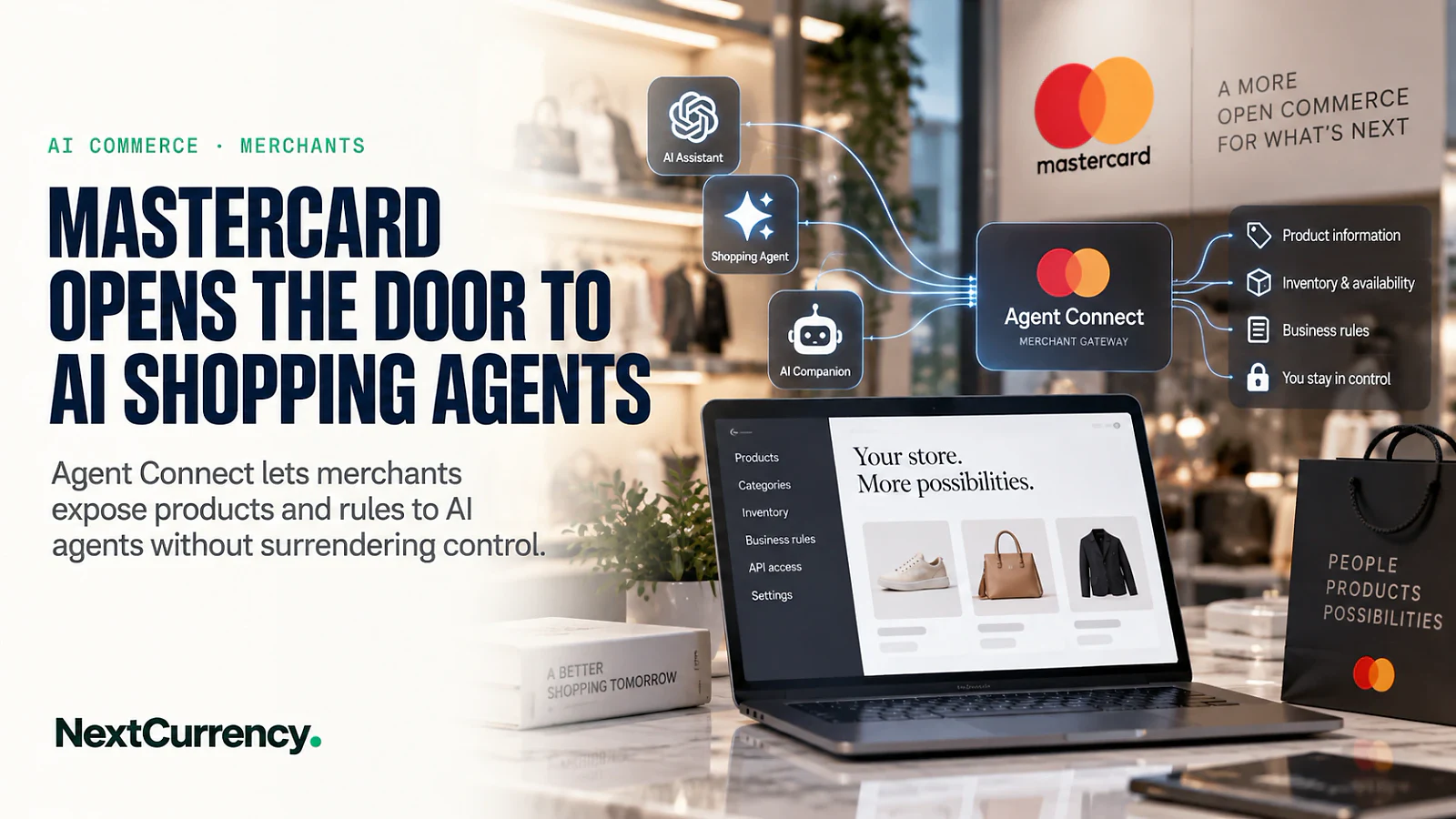
Mastercard has launched Agent Connect and expanded its Agent Suite for Merchants, giving businesses a way to expose product information and shopping functions to AI agents while retaining control over how those agents access data and initiate purchases.
The September 9 announcement focuses on the merchant side of agentic commerce: product discovery, research, consumer-authorized purchases and the rules that determine which AI platforms can interact with a business. It is not evidence that AI agents are already generating material payment volume across the Mastercard network. Mastercard.
Agentic commerce starts before the payment
Much of the early discussion around AI payments has concentrated on execution: how an agent can hold credentials, send a stablecoin or initiate a card transaction.
A commercial purchase begins earlier. An agent needs reliable information about what a merchant sells, what it costs, whether it is available, which delivery options apply and what rules govern the transaction. The merchant also needs to decide which agents can see that information and what actions they can take.
Agent Connect is designed around that layer. Mastercard is positioning itself as an intermediary that can help merchants make their catalogs and commerce functions discoverable across agent ecosystems without surrendering all control to the agent platform.
That changes the problem from “can an AI pay?” to “can a merchant safely do business with an AI acting for a customer?”
Authority becomes part of the payment product
The second problem is proving intent. A consumer may authorize an agent to buy a flight below a certain price, reorder a product or make a purchase from an approved merchant. The payment system has to preserve those boundaries when the agent acts.
Mastercard's broader agentic-commerce work includes mechanisms intended to make consumer authorization and agent identity verifiable. The September announcement extends that strategy into merchant-controlled shopping experiences.
For payments providers, this is important because liability does not disappear when software chooses the item. A merchant, issuer and network still need evidence of who authorized the action, what was authorized and whether the eventual transaction matched those instructions.
Stablecoins can solve part of the execution layer, but they do not answer those questions by themselves.
Partner announcements remain prospective
Mastercard named a broad ecosystem of commerce and payments companies around its agentic strategy. The wording around individual participants includes future-facing plans and exploration, so the roster should not be treated as proof that each company has a production deployment processing agent-initiated payments today.
The useful evidence will be live merchant integrations: agents discovering products through the new interface, consumers issuing bounded purchase mandates and merchants completing transactions with an auditable record of the authority behind them.
Until that happens at scale, Agent Connect is best understood as infrastructure being built ahead of anticipated demand.
What happens next
The market now has three separate layers to watch: agent discovery, authorization and payment execution. Networks, wallets, stablecoin providers and AI platforms may compete in one layer while depending on each other in another.
Mastercard's September 9 move suggests the network believes control of merchant access and trusted intent can be as important as the payment rail itself. The next test is whether merchants and agent platforms adopt that interface widely enough for it to become a standard rather than another proprietary connection.