Mastercard Activates Network-Level Stablecoin Settlement Across 6 Coins and 8 Chains
Mastercard has expanded its global settlement infrastructure to support six regulated stablecoins across eight blockchains, enabling intraday, weekend, and holiday card settlement for the first time as the company moves stablecoin payments from pilot phase to permanent network feature.
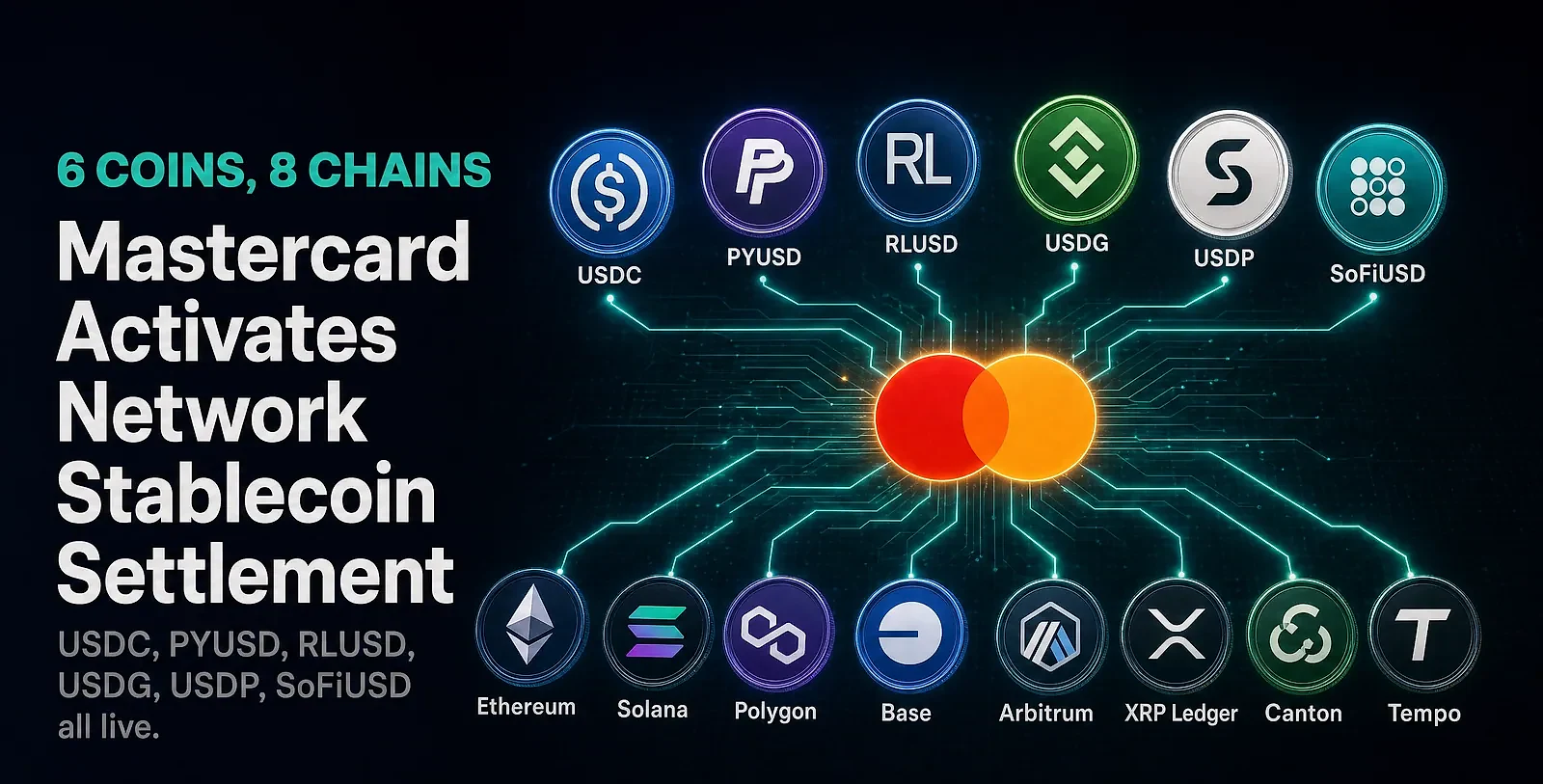
Mastercard announced on June 3, 2026 that it will expand its global payments network to support on-chain card settlement using six regulated stablecoins across eight blockchains, covering transactions 24 hours a day, seven days a week, including weekends and holidays that traditional banking rails cannot serve [1]. The announcement marks a shift from exploratory pilots to what the company describes as a scalable, network-level enhancement accessible through the same global infrastructure partners already use for fiat settlement.
From Pilot to Production-Grade Feature
Mastercard's settlement network has long supported multiple operating models for issuers and acquirers, but those models have been constrained by standard banking hours and fiat-only rails. The new capabilities introduce intraday settlement windows alongside the weekend and holiday coverage, addressing a persistent gap in cross-border transactions, treasury operations, and payouts where timing and liquidity are operationally critical.
"The next phase of stablecoin adoption is about real-world utility, especially in settlement, where timing and liquidity matter most. By introducing intraday and weekend on settlement options across our global network, we're expanding how partners manage liquidity and operate in an always-on digital economy while maintaining the trust, resilience and safeguards they expect from Mastercard."
- Raj Dhamodharan, Executive Vice President, Blockchain and Digital Assets, Mastercard [1]
The stablecoin rails are designed to operate alongside existing fiat processes rather than replace them. Partners retain the choice to settle in traditional currency or on-chain, and all existing security standards, fraud safeguards, and dispute resolution processes carry over to the new settlement path [1].
Six Stablecoins, Eight Chains
The launch supports six regulated stablecoins spanning three major issuers and one fintech, reflecting the growing diversity of dollar-denominated on-chain assets that have accumulated institutional backing [1][2].
Stablecoin — Ticker — Issuer
USD Coin — USDC — Circle
PayPal USD — PYUSD — Paxos (for PayPal)
Global Dollar — USDG — Paxos / Global Dollar Network
Pax Dollar — USDP — Paxos
Ripple USD — RLUSD — Ripple
SoFi USD — SoFiUSD — SoFi
Circle's USDC is already supporting early on-chain settlement flows in select markets ahead of the broader rollout [1]. The eight supported blockchain networks span both established Ethereum-ecosystem layers and purpose-built enterprise chains, giving partners significant routing flexibility [1][2].
Blockchain — Category
Ethereum — Layer 1
Solana — Layer 1
Polygon — Ethereum Layer 2
Base — Ethereum Layer 2
Arbitrum — Ethereum Layer 2
XRP Ledger (XRPL) — Layer 1
Canton — Enterprise / permissioned
Tempo — Enterprise / permissioned
The breadth of chain coverage is directly competitive with Visa, which expanded its own stablecoin settlement pilot to nine blockchains in April 2026, reaching an annualized run rate of $7 billion, up 50 percent from the prior quarter [2]. Mastercard's addition of Canton and Tempo alongside the public chains signals an intent to capture enterprise treasury and institutional payment flows that require permissioned infrastructure.
First Partners: US and Latin America
Five organizations are expected to be among the earliest supporters of the stablecoin settlement option, with an initial focus on the United States and Latin America [1].
Partner — Type — Region Focus
ARQ (formerly DolarApp) — Fintech / cross-border — Latin America, US
CBW Bank — Community bank — US
Cross River — Fintech bank — US
Lead Bank — Fintech bank — US
Nuvei — Payment processor — US, global
The partner lineup spans community banking, fintech banking infrastructure, and global payment processing, reflecting the range of use cases Mastercard expects to serve. ARQ, the rebranded DolarApp, has built stablecoin-native rails as a core part of its cross-border remittance platform. "At ARQ, stablecoins have been core to our infrastructure from day one. They're how we deliver real-time, cross-border financial solutions at a fraction of traditional costs," said Alvaro Correa, co-founder and chief operating officer of ARQ. "Partnering with Mastercard to enable on-chain settlement is a major step toward building the financial infrastructure we envision for the Americas." [1]
Cross River cited accelerating institutional demand for the feature. "We've seen firsthand the accelerating demand from our partners for faster, more transparent settlement, and stablecoins have emerged as a powerful tool to meet that need," said Luca Cosentino, head of on-chain finance at Cross River [1].
Jackie Reses, CEO and co-founder of Lead Bank, described the launch as a foundational infrastructure moment: "At Lead, we believe the future of financial infrastructure is 24/7, and on-chain settlement is where that future becomes real." [1]
Nuvei CEO Phil Fayer pointed to broader strategic alignment, noting the collaboration "extends settlement options alongside traditional payment rails, creating new opportunities for customers to improve liquidity, streamline global disbursements, and gain greater flexibility in how funds move." [1]
Issuer Validation: Paxos, Ripple, Circle
The stablecoin issuers included in the announcement each treated the listing as an institutional validation of their respective tokens. Peter Jonas, chief revenue officer at Paxos, stated that "the future of settlement is programmable, instant and global," and that Paxos's regulated infrastructure provides Mastercard a trusted on-chain path using PYUSD, USDG, and USDP [1].
Jack McDonald, senior vice president of Stablecoins at Ripple, framed the inclusion of RLUSD as a landmark for the XRP Ledger ecosystem: "Mastercard's move into on-chain settlement is a landmark validation that blockchain technology is ready for the world's most critical payment infrastructure. RLUSD's inclusion in Mastercard's global settlement network reflects growing demand for trusted, regulated stablecoins built for real-world financial use cases on public blockchains like the XRP Ledger." [1]
Kash Razzaghi, chief commercial officer at Circle, highlighted the infrastructure dimension: "As demand grows for faster and more flexible movement of money, organizations are increasingly seeking infrastructure that can operate beyond traditional banking hours. Mastercard's expanded settlement capabilities help meet that need." [1]
Regulatory Foundation and Strategic Context
The June 3 announcement rests on regulatory groundwork laid over the preceding months. Mastercard Transaction Services (U.S.) LLC received a New York BitLicense from the New York State Department of Financial Services on May 27, 2026, formally authorizing digital asset business activity under one of the most stringent virtual currency frameworks in the United States [3]. That license directly underpins the company's ability to offer on-chain settlement to US-based issuers and acquirers.
Separately, Mastercard's pending acquisition of BVNK, a London-headquartered stablecoin infrastructure provider that processed over $30 billion in stablecoin payments in 2025 and operates across more than 130 countries, was announced in March 2026 for up to $1.8 billion, consisting of $1.5 billion in base consideration plus $300 million in contingent payments [4][5]. The BVNK deal, expected to close by late 2026 pending regulatory approval, is distinct from the settlement expansion announced June 3 but complements it: BVNK's on-ramp, off-ramp, and treasury infrastructure would deepen the on-chain payment stack Mastercard is assembling.
Taken together, the BitLicense, the BVNK acquisition, and the six-coin settlement expansion represent a sequence of coordinated moves that transform Mastercard's stablecoin posture from cautious experimentation to direct competitive infrastructure deployment. The broader dollar-pegged stablecoin market has grown to nearly $300 billion in total supply, with Tether (USDT) holding approximately $188 billion and USDC near $76 billion [2]. Crypto cards on the Mastercard network had reached $340 million in cumulative volume as of June 3, 2026, and that volume now has a native on-chain settlement path available [3].
Expansion Timeline
Mastercard has not set a hard deadline for full global rollout but stated that expanded settlement capabilities will continue to roll out subject to regulation, with additional regions, partners, and regulated stablecoins expected to be added through 2026 [1]. The company positions the framework as an open, additive layer, one that expands choice without requiring partners to migrate away from existing fiat settlement workflows.
References
[1] Mastercard, "Mastercard Expands Settlement Capabilities to Include Stablecoin, Intraday, Holiday and Weekend Options," June 3, 2026. https://www.mastercard.com/us/en/news-and-trends/press/2026/june/mastercard-expands-settlement-capabilities-to-include-stablecoin.html
[2] CoinMarketCap Academy, "Mastercard Adds USDC, PYUSD, RLUSD to Card Settlement," June 3, 2026. https://coinmarketcap.com/academy/article/mastercard-adds-usdc-pyusd-rlusd-settlement
[3] Blockhead, "Mastercard Secures New York BitLicense in Stablecoin Infrastructure Push," May 28, 2026. https://www.blockhead.co/2026/05/28/mastercard-secures-new-york-bitlicense-in-stablecoin-infrastructure-push/
[4] Mastercard Investor Relations, "Mastercard to Acquire BVNK to Connect On-Chain Payments and Fiat Rails," March 17, 2026. https://investor.mastercard.com/investor-news/investor-news-details/2026/Mastercard-to-Acquire-BVNK-to-Connect-On-Chain-Payments-and-Fiat-Rails/default.aspx
[5] S&P Global Market Intelligence, "Mastercard's $1.8B Bet on BVNK Accelerates Stablecoin Push," March 25, 2026. https://www.spglobal.com/market-intelligence/en/news-insights/research/2026/03/mastercards-1-8-b-bet-on-bvnk-accelerates-stablecoin-push