Korea Gold Exchange to Launch K-Gold and K-Silver Tokens, First Tokenized Silver Globally
Korea Gold Exchange Digital Asset plans to issue KGLD and KSVR tokens in Q3 2026, targeting overseas exchange listings first and Upbit in H1 2027. The company claims KSVR would be the first silver token ever listed on a global exchange.
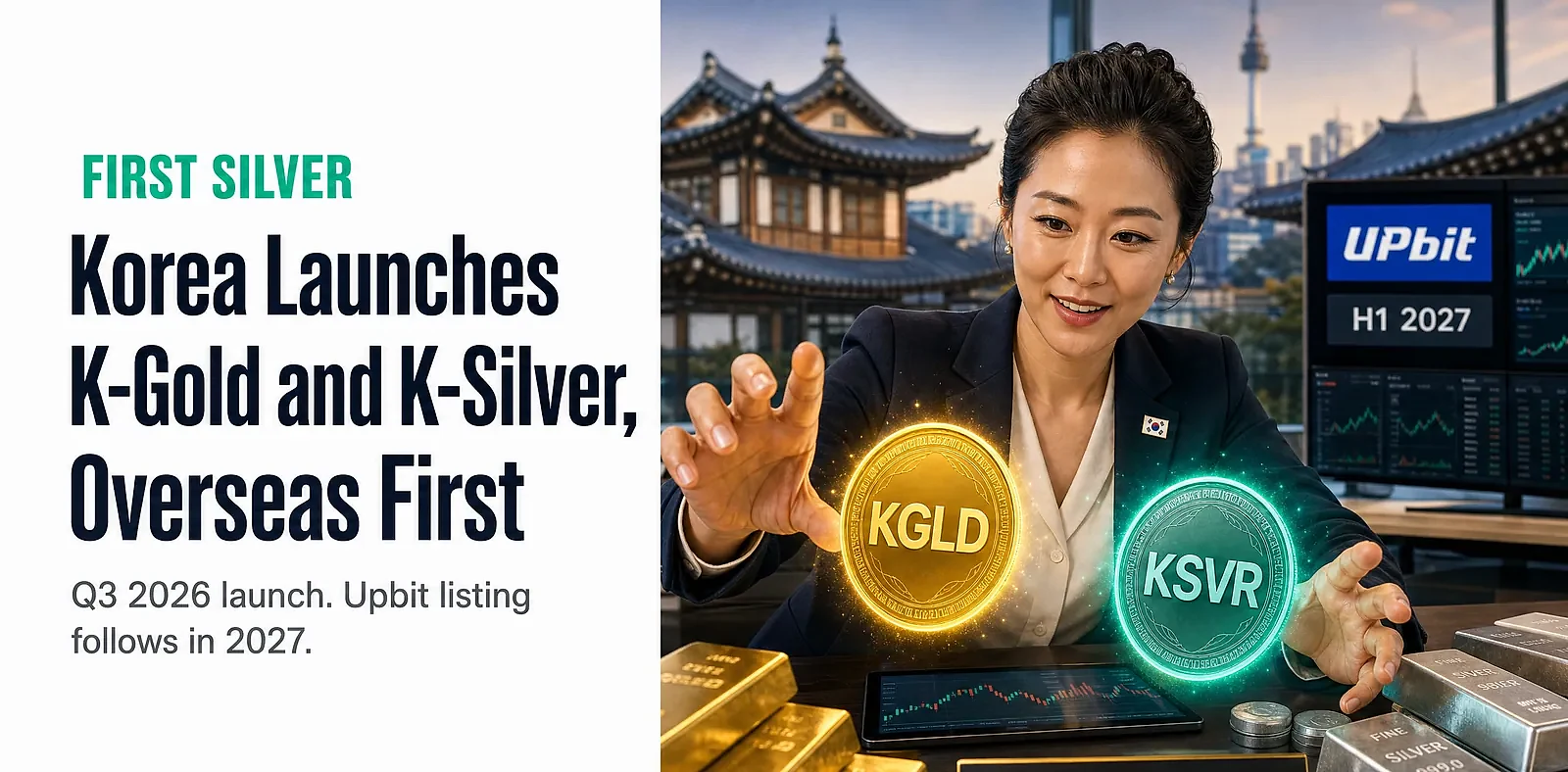
Korea Gold Exchange Digital Asset announced on May 9, 2026 that it will issue KGLD (K-Gold) and KSVR (K-Silver) real world asset tokens in the third quarter of 2026, targeting overseas virtual asset exchange listings within the year before approaching domestic platforms including Upbit in the first half of 2027. The announcement, made through an interview with CEO Lee Sang-yoon, positions K-Silver as a global first: no silver-backed token has ever been listed on an exchange anywhere in the world.
A Two-Token RWA Strategy Built on Physical Reserves
Korea Gold Exchange Digital Asset, a subsidiary of ITCEN GLOBAL operating under the KG E Holdings special purpose company structure, is the digital finance arm of Korea's largest physical gold distributor. While Korea Gold Exchange handles offline distribution to jewelry shops and retail networks, Korea Gold Exchange Digital Asset connects physical gold holdings to on-chain financial infrastructure. The company has already applied for trademarks across a range of token identifiers for both metals, including KGLD, CENG, KRWgc, and USDgc for gold, and XAGC, XAGT, KSVR, and CENS for silver [1].
KGLD will be issued on a 1:1 basis against physical gold held at Korea Gold Exchange vaults, convertible into physical gold in Korea at any time. Lee Sang-yoon framed this domestic custody model as a competitive advantage over existing global tokens.
"Tether Gold purchases gold in the London spot market, stores it in secure Swiss vaults, and issues tokens based on that. K-Gold stores gold at Korea Gold Exchange and then issues tokens. From an issuance perspective, it has the advantage of relatively fewer constraints. K-Gold can be converted into physical gold in Korea at any time." - Lee Sang-yoon, CEO, Korea Gold Exchange Digital Asset [1]
The five-year roadmap calls for 50 tonnes of physical gold to be tokenized as KGLD and the construction of a 10 trillion won digital gold finance ecosystem, including a "Gold Standard Wallet" application offering 1 to 3 percent annual interest through gold token staking and stablecoin loans backed by gold collateral [1].
Overseas First, Domestic Second: An Unconventional Listing Sequence
Korea Gold Exchange Digital Asset's listing strategy is notably inverted relative to most Korean-origin projects. Rather than seeking domestic legitimacy on Upbit or Bithumb first, Lee Sang-yoon confirmed the company will prioritize overseas virtual asset exchange listings in 2026, testing marketability internationally before applying for domestic listings in H1 2027. This reflects both the competitive advantage of serving a global investor base and the regulatory complexity of South Korea's evolving digital asset framework.
South Korea's Digital Asset Basic Act, the Phase 2 legislation intended to govern stablecoin issuance, reserve requirements, and exchange standards, remains stalled as of May 2026 due to unresolved tensions between the Financial Services Commission (FSC) and the Bank of Korea (BOK) over stablecoin governance [2]. By listing overseas first, KorDA effectively sidesteps the domestic regulatory bottleneck while building a trading track record that could ease eventual Upbit listing approval.
Korea Gold Exchange Digital Asset, referred to in the market as KorDA, had already partnered with LayerZero in April 2026 to apply the Omnichain Fungible Token (OFT) standard to KGLD, enabling the token to operate across multiple blockchains under a single-supply, single-policy structure [3]. This infrastructure positions KGLD for integration into DeFi protocols and institutional financial services across chains without liquidity fragmentation.
KSVR: A Silver Token Without Precedent
The silver component of the launch may carry even greater significance than KGLD. Lee Sang-yoon stated plainly that no silver token has ever been listed on any exchange globally, making KSVR a category-defining asset if the launch proceeds as planned [1]. He noted that physical silver's industrial applications, including use in semiconductor panels and renewable energy components, give it demand dynamics distinct from gold, and expressed confidence that K-Silver could achieve stronger market traction than K-Gold.
The tokenized gold market surpassed 6 billion dollars in early 2026, with Tether Gold (XAUT) and Pax Gold (PAXG) controlling approximately 96.7 percent of total market share [4]. KGLD enters a market where the two incumbents are deeply entrenched, but silver tokenization represents an entirely uncontested category. Lee benchmarked KGLD against XAUT's current Upbit performance, noting that XAUT's daily transaction volume on Upbit is approximately 10 billion won, representing roughly 3 trillion won annualized, and stated KorDA expects to exceed that figure [1].
KGLD vs. Global Tokenized Precious Metal Tokens
Token — Issuer — Metal — Backing Location — Exchange Listed — Market Cap (approx.)
XAUT — Tether (TG Commodities) — Gold — Swiss vaults — Upbit, Bitfinex, others — ~$3.5B
PAXG — Paxos Trust — Gold — London LBMA vaults — Coinbase, Kraken, others — ~$2.4B
KGLD — KorDA (ITCEN GLOBAL) — Gold — Korea Gold Exchange — Planned Q3 2026 — Pre-launch
KSVR — KorDA (ITCEN GLOBAL) — Silver — Korea Gold Exchange — Planned Q3 2026 — Pre-launch
Sources: Chosun Biz [1], Binance Square [4], BingX [5]
Cross-Border Expansion and the Japan Connection
Beyond gold and silver, KorDA has outlined a broader RWA expansion roadmap. The company is conducting joint research on stablecoins with JPYC, the leading yen-denominated stablecoin issuer in Japan, with the goal of building a cross-border payment standard linking yen, gold, and won in 2026 [1]. This Korea-Japan corridor initiative reflects a wider APAC strategy that treats tokenized precious metals as settlement infrastructure rather than purely speculative assets.
Lee Sang-yoon came to KorDA from a career spanning IBM, Oracle, and Dell, before becoming Chief Strategy Officer at ITCEN GLOBAL in 2021 and leading the company's Web3 and digital asset pivot. The company validated its gold-backed financial model in 2024 through a partnership with Hana Bank, under which customers could deposit physical gold and earn interest without storage fees through the "Hana Gold Trust" product [1].
If K-Silver achieves exchange listings as planned, it will establish a new asset class in the tokenized commodity market and add a second precious metal tier to Asia's rapidly expanding RWA ecosystem, just as South Korea's domestic crypto regulatory structure works through its next legislative phase.
References
[1] Lee Jeong-hun, Chosun Biz, "Lee Sang-yoon vows Korea gold, silver tokens launch and exchange listings," May 9, 2026. https://biz.chosun.com/en/en-finance/2026/05/09/OWMDHPY3O5DLHA6LI7UYQJSEYM/
[2] Yahoo Finance / cryptonews, "South Korea's Stablecoin Bill Hits a Wall as Regulators Clash," December 30, 2025. https://finance.yahoo.com/news/south-korean-stablecoin-bill-delayed-101858432.html
[3] LayerZero, "KorDA Chooses LayerZero as Interoperability Partner for KGLD," April 14, 2026. https://layerzero.network/blog/korda-tokenizes-gold-with-layerzero
[4] Binance Square, "Tokenized Gold Market Surpasses $6 Billion as XAUT and PAXG Dominate," February 13, 2026. https://www.binance.com/sv/square/post/291365252496721
[5] BingX, "Tether Gold (XAUT) vs. Pax Gold (PAXG)," December 30, 2025. https://bingx.com/en/learn/article/tether-gold-xaut-vs-pax-gold-paxg-which-tokenized-gold-coin-is-better