Kite Lets Users Pay at Local QR Codes From a Stablecoin Balance in Seven Countries, With AEON Settling in Local Currency
Kite's Scan & Pay, launched with AEON on 18 November 2026, works at merchants' existing national QR codes in Vietnam, the Philippines, Brazil, Argentina, Colombia, Peru and Bolivia, with the merchant paid in local currency. Payments are capped at $500 each in most markets and $1,500 a day.
By Daniel Osei, Journalist, Payments and Cards
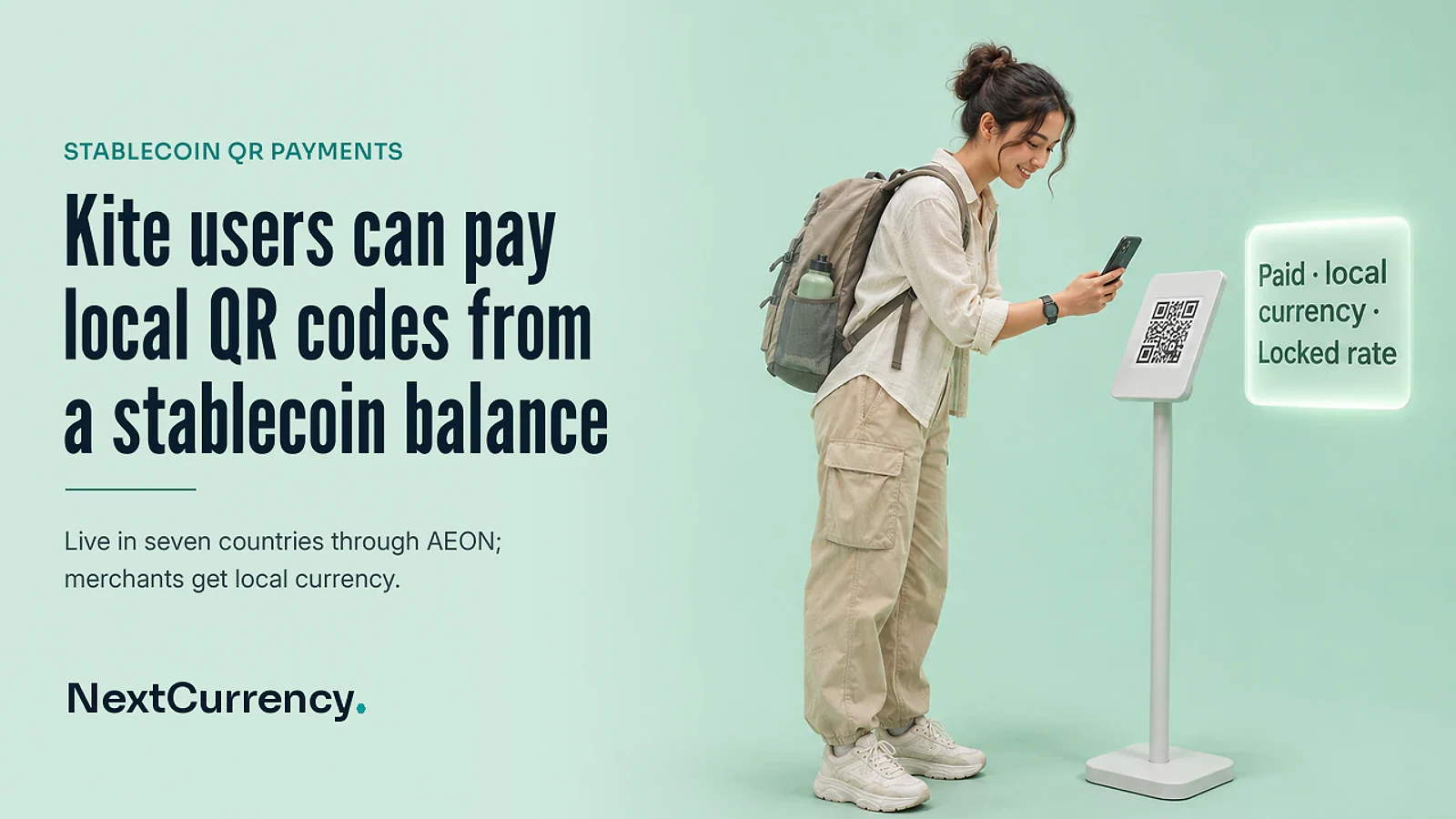
Kite, a non-custodial wallet app for storing, sending and spending money across borders, said on 18 November 2026 that its users can now pay at merchants' existing national QR codes directly from a stablecoin balance in seven countries: Vietnam, the Philippines, Brazil, Argentina, Colombia, Peru and Bolivia. AEON, which calls itself a settlement layer for the AI economy, handles the conversion and pays the merchant in local currency.
The merchant does nothing new. "The merchant keeps the QR code already stuck to their counter," Kite says; there is no app, account or hardware to add.
How a payment moves
A user opens the scanner in the Kite app, scans the merchant's QR code, enters an amount if the code does not carry one, reviews a locked exchange rate and total, and approves with Face ID, Touch ID or a PIN. The money comes out of the stablecoin balance in the user's Kite Wallet, not the Kite card, and moves directly to the settlement partner. Kite says the merchant receives the amount within seconds and that a failed collection is returned to the wallet automatically.
Payments can be made in USDC on Base, Polygon, Ethereum, Arbitrum and BNB Smart Chain, or USDT on Polygon, Ethereum, Arbitrum and BNB Smart Chain; other assets must first be swapped into one of those.
AEON sits underneath. Each country runs its own scheme, which Kite lists as Pix in Brazil, VietQR in Vietnam, QR Ph in the Philippines and Bre-B in Colombia, with others in Argentina, Peru and Bolivia, each with its own acquirers and settlement rules. AEON handles those acquirer relationships and the local settlement. Its network, it says, reaches merchants across Southeast Asia, Africa and Latin America.
Limits
Kite publishes limits for the service. Single payments range from $0.65 to $500 in most launch countries and $1 to $400 in Argentina and Peru. Users can spend up to $1,500 a day and $50,000 a month. The per-payment caps point to everyday and travel spending rather than large purchases.
Part of a wider pattern
Turning stablecoin balances into payments on domestic QR networks is spreading across emerging markets. Wallets have already launched similar scan-to-pay features on Vietnam's VietQR and the Philippines' QR Ph, and stablecoin firms have been building routes into Brazil's Pix. What these share is that the stablecoin never reaches the merchant: a settlement partner absorbs the conversion, and the local rail carries the last mile.
That puts much of the economics with the converter. Kite did not say what fees or FX margin apply beyond the locked rate shown at checkout, and it gave no user or transaction numbers. Its pitch is aimed at people passing through: "We wanted one balance that works wherever you land, using the rails the merchant already trusts," said founder Aditya Chintawar. It says nine more countries are in the next phase of the rollout, without naming them or giving dates.