Japan reportedly studies blockchain rails for instant stock and government-bond settlement
Nikkei reporting cited by Reuters says Japanese authorities and financial institutions are preparing a study of blockchain infrastructure that could compress T+2 equity and T+1 JGB settlement toward real time.
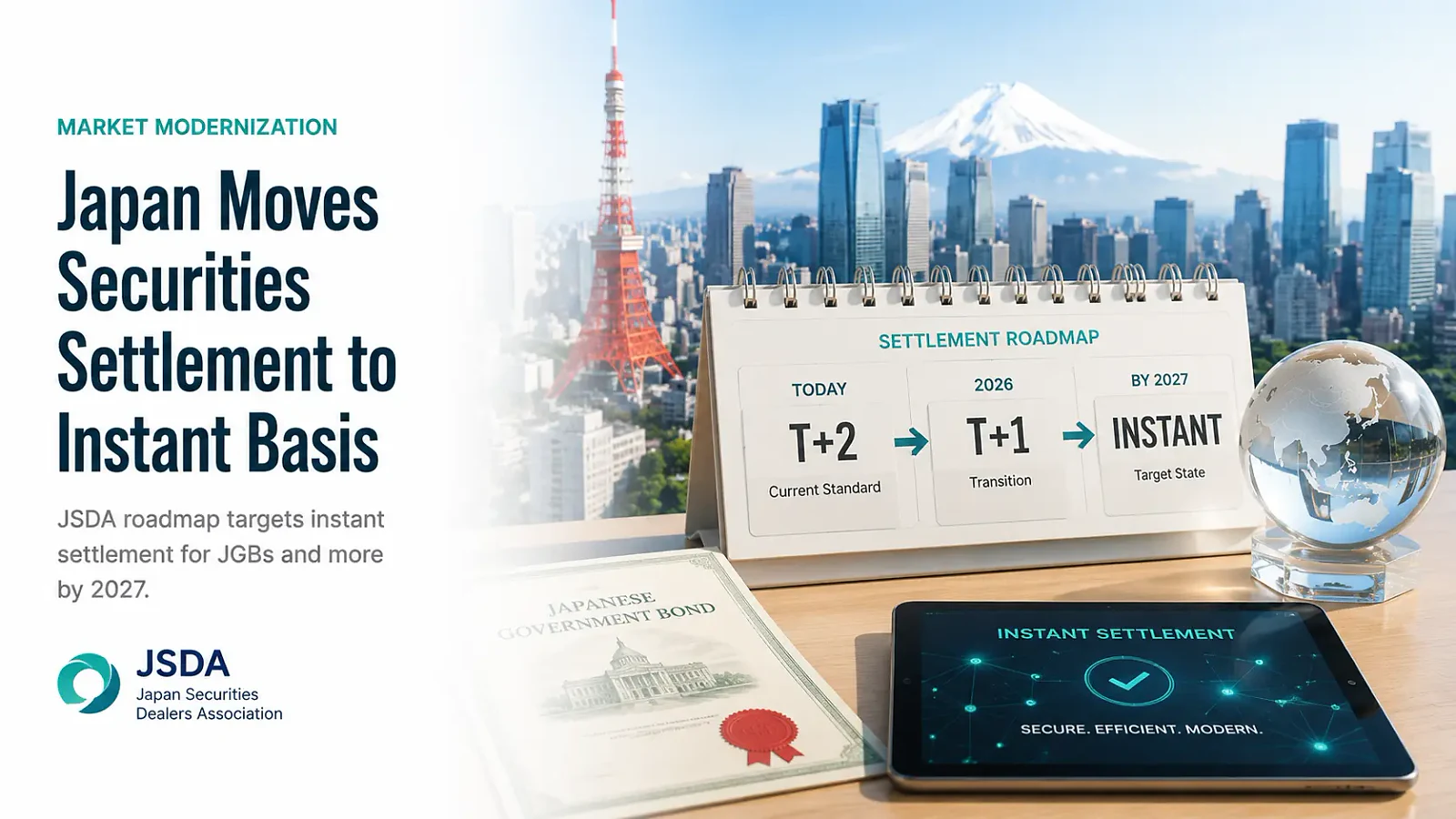
Japan is reportedly preparing a study of blockchain-based infrastructure for near-instant settlement of stocks and Japanese government bonds, a project that would target one of the most consequential parts of financial-market infrastructure: the time between trade execution and final cash settlement.
Reuters reported on August 25, citing Nikkei, that the Financial Services Agency, Ministry of Finance, Bank of Japan and private financial institutions are expected to establish a study group and formulate a development plan around early 2027 at the earliest.
The project remains a reported study, not an approved national settlement system. No matching primary announcement from the Japanese authorities was available at the time of publication.
The target is settlement time, not tokenisation for its own sake
Japanese equity cash settlement currently takes place two business days after execution, or T+2. Japanese government bond transactions settle the following day, or T+1.
The reported blockchain infrastructure would aim to reduce that gap substantially. Reuters said a plan could cover blockchain design, division of responsibilities among authorities and financial institutions, and a roadmap for implementation. Operations could potentially begin within several years, with the reporting pointing to an early-2030s horizon if the project is formally approved.
The same infrastructure could eventually be considered for international remittances, according to the report.
The economic case for faster securities settlement is not primarily about putting an asset on-chain. It is about reducing the period during which cash and securities remain committed between execution and final settlement. Shorter settlement can reduce counterparty exposure and free capital more quickly, although it also changes liquidity-management requirements for brokers, custodians and investors.
Real-time settlement creates new liquidity questions
Moving from T+2 or T+1 toward immediate settlement compresses risk but removes time that market participants currently use to source securities and cash.
A workable system therefore has to answer questions around delivery-versus-payment, intraday liquidity, settlement assets, market resilience and failure handling. If securities move instantly but the payment leg remains slower, the risk is not eliminated; it simply moves elsewhere in the process.
That is why the reported involvement of the Bank of Japan and Ministry of Finance would matter if formally confirmed. A national securities-settlement system would need to define how tokenised or blockchain-recorded assets interact with central-bank money and existing market infrastructure.
Japan would be testing blockchain at system scale
Financial institutions globally have run tokenisation pilots for bonds, funds and collateral. The Japanese proposal is potentially more significant because it concerns core settlement infrastructure for major public markets rather than a limited issuance experiment.
JGBs are a foundational asset in Japan's financial system, while Tokyo's equity market is among the world's largest. A settlement redesign that touches both would be materially different from launching a tokenised security on a new platform.
But the evidentiary threshold remains important. Reuters attributed the plan to Nikkei, and the key agencies had not published equivalent details in the source set available for this article. The architecture, budget, legal basis, permissioning model and settlement asset remain unspecified.
The correct conclusion is therefore conditional: Japan is reported to be preparing a blockchain-settlement study that could target real-time settlement of stocks and government bonds. If the authorities formally launch the programme, the story will shift from policy reporting to one of the most ambitious market-infrastructure modernisation efforts involving distributed ledger technology.
The settlement-cycle problem the study would target
Market — Current cash settlement — Reported objective
Japanese equities — T+2 — Near-instant / real-time settlement
Japanese government bonds — T+1 — Near-instant / real-time settlement
Development plan — — — Around early 2027 at the earliest
Potential operating horizon — — — Reportedly early 2030s if approved
A shorter cycle can reduce counterparty exposure, but it can also increase the importance of intraday liquidity. Under T+2, participants have time to arrange funding and resolve trade-processing issues before settlement. Under real-time settlement, cash and securities need to be available much closer to execution. Market design therefore has to balance lower credit exposure against potentially higher liquidity demands.
That trade-off is why the eventual settlement asset is crucial. If a blockchain records the security leg but cash still settles asynchronously through conventional systems, much of the delivery-versus-payment benefit is lost. Formal confirmation from the Bank of Japan or other agencies would therefore need to specify how central-bank money, commercial-bank money or tokenised cash interacts with the proposed ledger.