IRGC Demands Gulf States Expel US and Israeli Ambassadors in Exchange for Hormuz Safe Passage
Iran's Islamic Revolutionary Guard Corps issued a formal ultimatum on March 9 offering Strait of Hormuz transit rights to any country that expels U.S. and Israeli diplomats, as Brent crude hit $119.50 and approximately 150 tankers sat anchored in the Gulf.
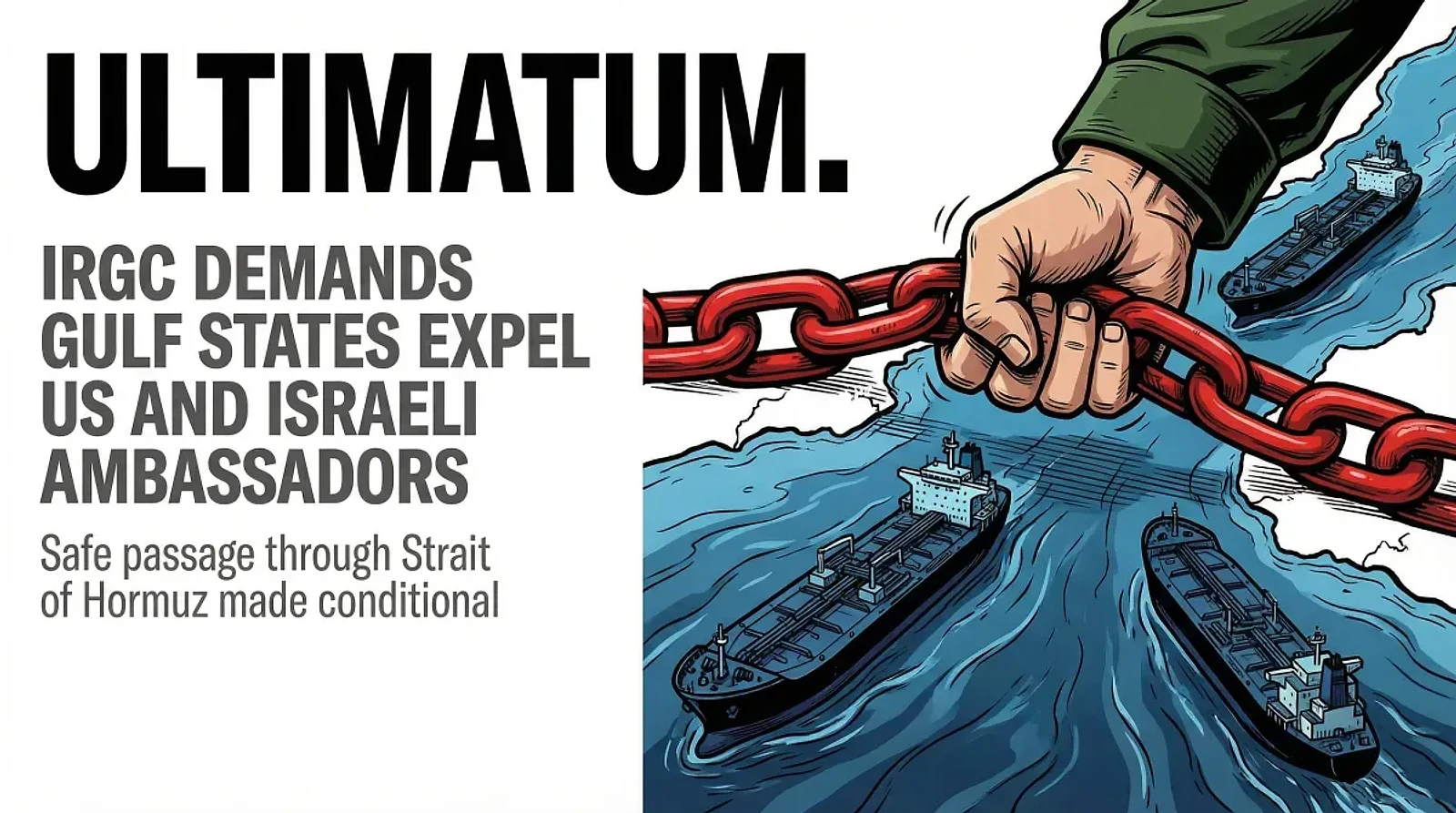
Iran's Islamic Revolutionary Guard Corps (IRGC) issued a formal ultimatum on Monday, March 9, 2026, declaring via state-run Tasnim News Agency and broadcaster IRIB that any Arab or European country expelling U.S. and Israeli ambassadors from its territory would receive "complete freedom and authority" to transit the Strait of Hormuz beginning the following day. The demand came on Day 9 of Operation Epic Fury, the joint U.S.-Israeli military campaign against Iran launched on February 28, 2026, and arrived as Brent crude traded near $119.50 per barrel, up roughly 50% since the conflict began [1][2].
The Ultimatum
The IRGC's statement, attributed to Iranian state media and disseminated through Tehran Times and multiple international wire services, left no room for ambiguity:
"Any Arab or European country that expels Israeli and American ambassadors from its territory will have complete freedom and authority to pass through the Strait of Hormuz starting tomorrow."
IRGC spokesperson Ali Mohammad Naini, speaking through Tasnim, escalated the economic threat:
"The Iranian armed forces will not allow the export of a single litre of oil from the region to the hostile side and its partners until further notice."
The IRGC also responded to President Trump's suggestion that the war could end soon: "It is we who will determine the end of the war. The equations and future status of the region are now in the hands of our armed forces; American forces will not end the war" [1][3][4].
Eight Days of Blockade
The ultimatum formalized a coercive posture building since the IRGC announced the Strait of Hormuz closure on March 2, 2026, four days after U.S. and Israeli strikes killed Iranian Supreme Leader Ayatollah Ali Khamenei. Commercial traffic through the strait dropped approximately 90%, and by early March roughly 150 crude and LNG tankers sat at anchor in the Persian Gulf [2][5].
On March 7, 2026, IRGC drones struck the oil tanker Prima for violating the closure, approximately 10 nautical miles north of Jubail, Saudi Arabia. The UK Maritime Trade Operations (UKMTO) confirmed the attack [5][6].
Date — Event
February 28, 2026 — U.S. and Israel launch strikes on Iran; Khamenei killed
March 2, 2026 — IRGC formally closes the Strait of Hormuz; traffic drops ~90%
March 7, 2026 — IRGC drones strike tanker Prima near Jubail, Saudi Arabia
March 7, 2026 — Iranian President Pezeshkian issues public apology to GCC states
March 9, 2026 — IRGC issues safe-passage ultimatum via Tasnim
March 9, 2026 — Mojtaba Khamenei named new Supreme Leader by Assembly of Experts
March 10, 2026 — Brent swings ~$30 in 24 hours ($120 to ~$90) after Trump signals war may end
Strategic Calculus: Wedge, Not Offer
Analysts broadly interpreted the ultimatum as a tool to fracture the coalition between Gulf Cooperation Council (GCC) states and Washington. Euromaidan Press assessed on March 10:
"The offer was not designed to be accepted. It was designed to force every government with ships at anchor to price out the choice publicly, and to be seen doing it."
The Soufan Center, in a March 7 intelligence brief, noted that "Gulf states hosting U.S. bases immediately became targets for Iranian missiles and drones in the aftermath of Operation Epic Fury." Iran's broader strategy aimed to make hosting American military infrastructure economically and physically untenable for GCC governments [7].
The escalation followed a graduated approach. In early February 2026, Iran used regional mediators in Oman and Qatar to warn GCC states that permitting U.S. and Israeli strikes from their territory made them "legitimate targets." On March 7, President Masoud Pezeshkian issued a public apology to GCC states for IRGC attacks on their infrastructure, framing it as an implicit offer to halt strikes in exchange for base neutralization [2][8].
GCC Response: No Compliance, Quiet Restrictions
As of March 10, 2026, no GCC country had publicly complied with the demand. However, reports indicated that Gulf hosts had quietly restricted the United States from using local bases for offensive missions, creating what analysts described as a "cold" U.S. military presence [2][8]. Bahrain declared force majeure on oil shipments as of March 9. Saudi Arabia, the UAE, Kuwait, and Iraq had already begun curbing oil output as onshore storage filled [4][8].
The scale of Iranian attacks on GCC infrastructure provided leverage behind the demand.
Country — Drones Launched — Missiles Launched
UAE — 1,422 — 246
Kuwait — 406 — 219
Bahrain — 164 — 95
Qatar — 63 — 129
Notable incidents included a drone near Dubai International Airport that disrupted operations, a desalination plant struck in Bahrain, and Kuwait International Airport fuel storage tanks hit [6][9].
Oil Markets: A $30 Swing
Brent crude surged above $100 per barrel for the first time since Russia's 2022 invasion of Ukraine, peaking near $120 on March 9 and 10. The rally then reversed sharply: Brent fell approximately $30 in 24 hours on March 10 after Trump signaled the war may be nearing its end and announced plans to waive sanctions on Iranian oil and deploy U.S. Navy escorts through Hormuz [2][5].
G7 finance ministers said the group "stands ready" to release strategic reserves if necessary. French President Emmanuel Macron, speaking from Paphos, Cyprus, announced France was organizing a "purely defensive, purely support mission" to escort tankers. EU foreign policy chief Kaja Kallas said the bloc was considering expanding its maritime mission to cover the strait [2][4].
Iran's Stated Terms
Iran's Deputy Foreign Minister Majid Takht-Ravanchi stated on March 9 that Tehran has a "single condition for halting hostilities if Israel and the United States comply: no further aggression." Ali Larijani, Secretary of Iran's Supreme National Security Council, responded to Macron's escort proposal: "The stability is difficult to achieve when some parties seek to fuel the conflict." Iran stated that Russia, China, and France had all contacted Tehran to encourage de-escalation [3][4].
The IRGC's stated objective remains to "put an end to the existence of American presence in the Persian Gulf," a maximalist goal that frames the Hormuz ultimatum within a broader strategy of regional expulsion [3][8].
References
[1] Shafaq News, "Iran Offers Hormuz Passage to Countries Expelling US, Israeli Ambassadors," March 9, 2026. https://shafaq.com/en/Middle-East/Iran-offers-Hormuz-passage-to-countries-expelling-US-Israeli-ambassadors
[2] Euromaidan Press, "Iran Hormuz Ultimatum, Oil Price Swing," March 10, 2026. https://euromaidanpress.com/2026/03/10/iran-hormuz-ultimatum-oil-price-swing/
[3] Business Standard, "IRGC Offers Conditional Free Passage via Hormuz, Vows to Decide War's End," March 10, 2026. https://www.business-standard.com/world-news/irgc-offers-conditional-free-passage-via-hormuz-vows-to-decide-war-s-end-126031000077_1.html
[4] Free Malaysia Today/AFP, "Iran Guards Say Will Block Oil Exports as Long as War Continues," March 10, 2026. https://www.freemalaysiatoday.com/category/world/2026/03/10/iran-guards-say-will-block-oil-exports-as-long-as-war-continues
[5] Marine Insight, "Iran Offers Safe Passage to Ships via Hormuz If Countries Expel US, Israeli Ambassadors," March 10, 2026. https://www.marineinsight.com/shipping-news/iran-offers-safe-passage-to-ships-via-hormuz-if-countries-expel-us-israeli-ambassadors/
[6] Long War Journal, "Iran Continues Striking Civilian Infrastructure and US Bases in the Gulf, March 7-8 Updates," March 8, 2026. https://www.longwarjournal.org/archives/2026/03/iran-continues-striking-civilian-infrastructure-and-us-bases-in-the-gulf-march-7-8-updates.php
[7] The Soufan Center, "IntelBrief," March 7, 2026. https://thesoufancenter.org/intelbrief-2026-march-7/
[8] Roan Capital Partners, "Situation Report: Epic Fury, US-Iranian Conflict as of March 9, 2026." https://roancp.com/situation-report-epic-fury-us-iranian-conflict-as-of-march-09-2026/
[9] OneIndia, "IRGC Threatens to Burn Ships in Hormuz, Demands Gulf Nations Expel U.S., Israeli Diplomats," 2026. https://www.oneindia.com/videos/irgc-threatens-to-burn-ships-in-hormuz-demands-gulf-nations-expel-u-s-israeli-diplomats-4292532.html