IMF Paper Finds Stablecoin Growth Lowers Treasury Yields and Weakens the Dollar
Working Paper WP/26/44 presents the first causally identified empirical evidence that stablecoin demand shocks lower short-term U.S. Treasury yields by up to 1.9 basis points per 1% market cap increase, depreciate the dollar by 0.09%, and benefit payment providers while leaving banks unaffected.
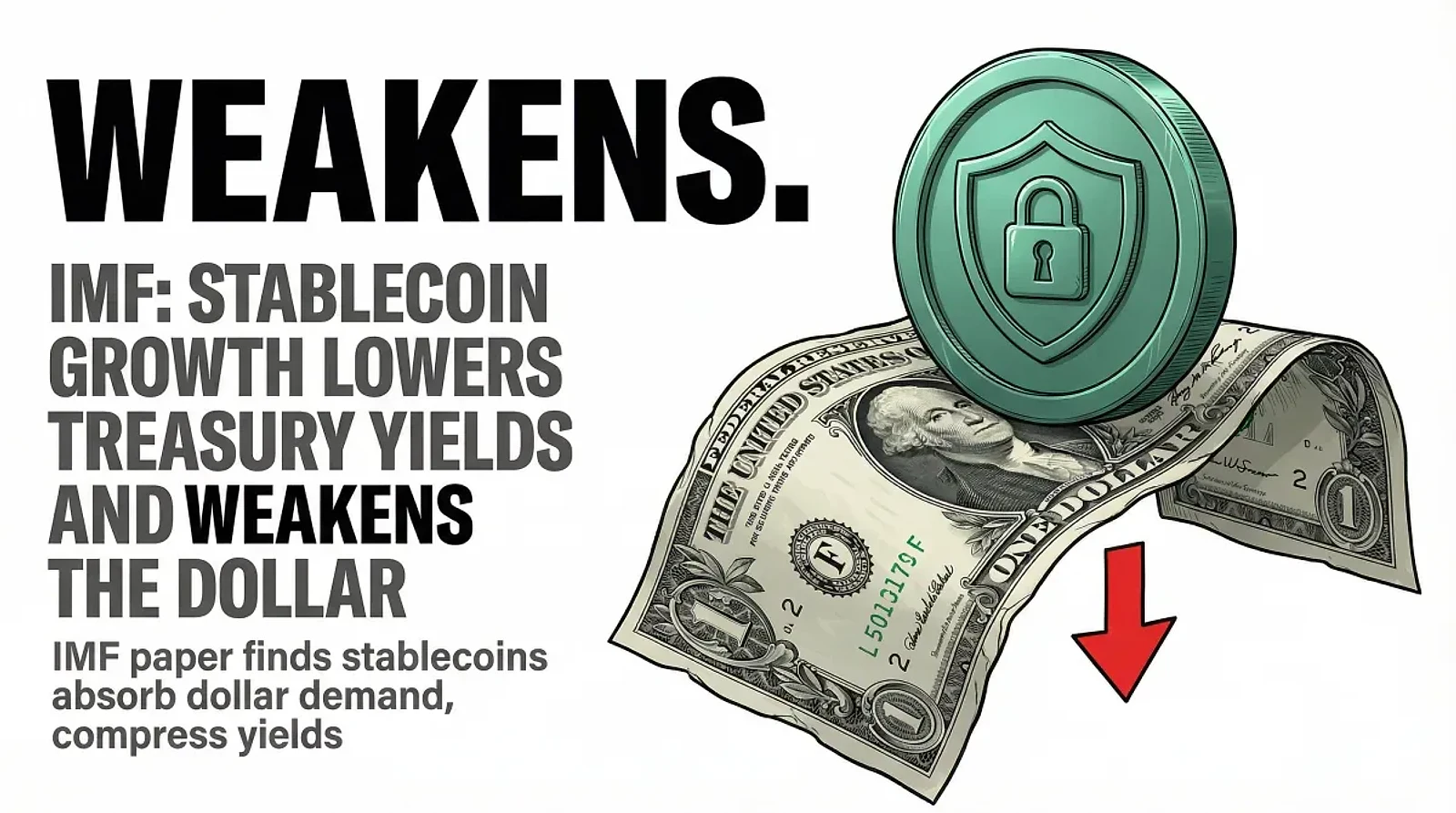
The International Monetary Fund (IMF) published Working Paper WP/26/44, titled "Stablecoin Shocks," on March 6, 2026, presenting the first peer-reviewed, causally identified empirical study of how stablecoin adoption affects U.S. financial markets. The 40-page paper, authorized for distribution by Daria Zakharova of the IMF's Strategy, Policy, and Review Department, finds that stablecoin demand exerts persistent downward pressure on short-term Treasury yields, modestly depreciates the U.S. dollar, and delivers statistically significant equity gains to payment providers, while banks show no material disintermediation risk [1].
The Core Transmission Channel
The paper's central contribution is identifying what its authors call a "novel channel of asset-market transmission." The mechanism is straightforward: stablecoin issuers hold short-term U.S. Treasuries as reserves. When stablecoin demand rises, issuers purchase more Treasury bills. That additional demand lowers yields on short-duration government debt.
Authored by Eugenio Cerutti, Melih Firat, Martina Hengge of the IMF, and Takaaki Sagawa of Northwestern University, the study draws on data from January 2019 through June 2025, a period during which the combined market capitalization of USDC and USDT grew from less than $5 billion to more than $300 billion [1].
The headline finding: a stablecoin demand shock corresponding to a 1% increase in the combined USDC and USDT market capitalization lowers the 1-month Treasury bill yield by approximately 1.9 basis points at its peak effect, reached around week 24 of the impulse response. The 3-month T-bill yield falls by 0.498 basis points, statistically significant at the 1% level. Effects on 1-year and 10-year yields are smaller and statistically insignificant, confirming that the transmission operates specifically through the short end of the curve [1].
The paper identifies stablecoin demand as a "novel channel of asset-market transmission" that affects Treasury markets, dollar strength, and equity valuations.
Econometric Results: The Numbers
The following table summarizes the paper's principal findings across asset classes.
Variable — Response to 1% Stablecoin Mkt Cap Increase — Statistical Significance
1-month T-bill yield — -1.9 bps (peak, ~week 24) — Significant
3-month T-bill yield — -0.498 bps — p < 0.01
1-month T-bill yield (high-freq.) — -0.423 bps — Significant
1-year Treasury yield — Small, negative — Not significant
10-year Treasury yield — Small, negative — Not significant
Broad dollar index — -0.09% (depreciation at trough) — Significant
Bloomberg Galaxy Crypto Index — +1.5% (peak) — Significant
S&P 500 — +0.25% — Modest/muted
The dollar depreciation finding may seem counterintuitive, since foreign demand for stablecoins could theoretically strengthen the dollar by increasing dollar-denominated asset purchases. The authors explain that a second channel dominates: lower Treasury yields prompt global portfolio rebalancing away from U.S. assets, producing net depreciation of approximately 0.09% at the trough [1].
Winners and Losers: The Firm-Level Evidence
Perhaps the most policy-relevant finding concerns which companies benefit from stablecoin growth and which do not. The paper estimates equity return responses at the individual firm level, revealing a sharp divide between payment providers and traditional banks.
Firm or Sector — Equity Return Response — Significance
Coinbase (COIN) — +1.436% — p < 0.05
PayPal (PYPL) — +0.521% — p < 0.01
Square (SQ) — +0.587% — p < 0.05
Adyen — +0.584% — p < 0.05
Mastercard (MA) — +0.147% — Not significant
Visa (V) — +0.091% — Not significant
Amazon (AMZN) — +0.163% — Not significant
Walmart (WMT) — -0.120% — Not significant
Nasdaq Large-Cap Banks Index — No significant response — Not significant
Community Banks Index — No significant response — Not significant
Small Banks Index — No significant response — Not significant
Coinbase captures the largest benefit at +1.436% per 1% stablecoin market cap shock, consistent with its position as the primary U.S. exchange distributing USDC yield. PayPal, Square, and Adyen, all of which have built stablecoin payment infrastructure, show statistically significant positive returns. Traditional card networks Mastercard and Visa show positive but insignificant effects. Banks of all sizes, including community and small banks, show no statistically significant equity response, meaning that equity markets do not price stablecoin disintermediation risk for the banking sector [1].
Methodology: Two Identification Strategies
The paper employs a dual identification approach that strengthens the causal claims beyond what prior descriptive studies have achieved. The primary strategy uses narrative identification, in which the authors constructed a daily dataset of 50 stablecoin-specific news events from 2019 to 2025 using Google News. Events were manually filtered to retain only those originating within the stablecoin ecosystem, excluding macro-driven shocks such as the Silicon Valley Bank failure or the FTX bankruptcy [1].
The authors then apply heteroskedasticity-based identification following Rigobon (2003), exploiting the fact that stablecoin market cap variance is 2.18 times higher on event days than non-event days (Brown-Forsythe test, p < 0.05). The resulting SVAR-IV framework uses a weekly frequency VAR with 13-week lags and produces an instrument F-statistic of 12.78, above the conventional threshold of 10 [1].
As a robustness check, the paper applies a Max-Share identification method following Uhlig (2004), which recovers stablecoin shocks by maximizing forecast error variance without requiring narrative judgment. The results align closely with the primary approach.
Reserve Composition and the GENIUS Act
The paper provides context on the reserve composition that drives the Treasury yield channel. As of end-October 2025, USDC held 35% of its reserves in U.S. Treasuries maturing within three months, with the remainder in cash and T-bill repurchase agreements. USDT reported 62% of reserves in T-bills as of its September 2025 reserve report, with the balance including Bitcoin and commodities. The GENIUS Act requires future stablecoin reserves to consist of highly liquid assets including Treasuries with maturity of 93 days or less [1].
Policy Implications
The finding that banks show no disintermediation risk in equity markets is directly relevant to the ongoing U.S. debate over stablecoin yield payments. The banking industry's core argument for the GENIUS Act's yield ban rests on the claim that yield-bearing stablecoins would drain bank deposits. The IMF paper's evidence suggests that, at least through mid-2025, equity markets had not priced such a risk for any category of U.S. bank.
The paper's framing positions stablecoin growth as a structural force that benefits firms with direct exposure to crypto payment rails, compresses short-term government borrowing costs, and introduces a new variable into the Federal Reserve's monetary transmission calculus.
References
[1] Cerutti, E., Firat, M., Hengge, M., and Sagawa, T., "Stablecoin Shocks," IMF Working Paper WP/26/44, March 6, 2026. https://www.imf.org/en/publications/wp/issues/2026/03/06/stablecoin-shocks-574528
[2] IMF Working Paper WP/26/44 (full PDF). https://doi.org/10.5089/9798229040228.001